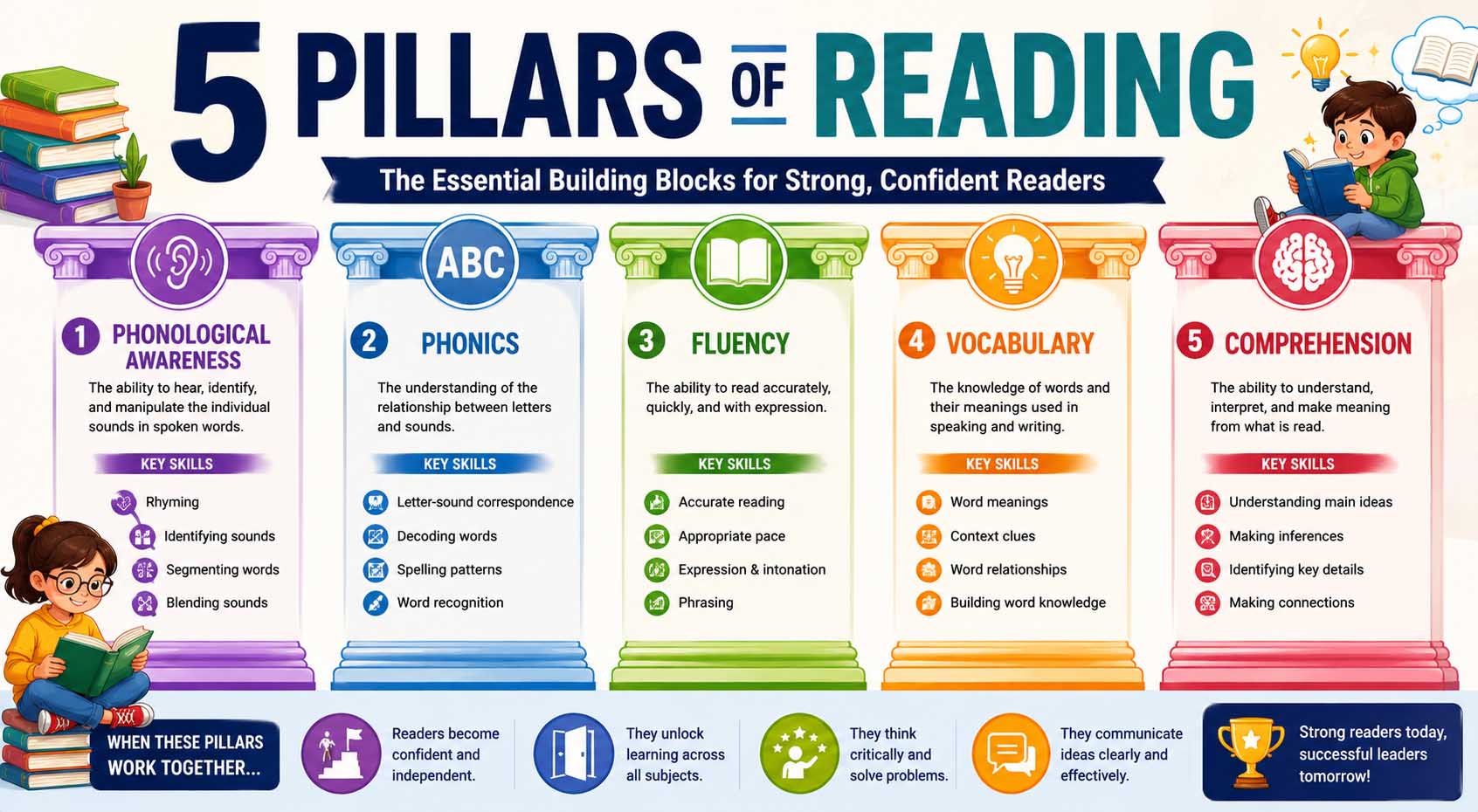
The 5 pillars of reading—phonemic awareness, phonics, fluency, vocabulary, and comprehension—describe five major areas that support successful reading development. Together, they help learners understand spoken sounds, connect those sounds with print, read accurately and smoothly, understand words, and make meaning from complete texts.
These five areas became widely recognized through evidence-based reading research and the work summarized by the National Reading Panel. For teachers and parents, the framework provides a practical way to understand why a child may excel in one reading skill yet need extra instruction in another.
What Are the 5 Pillars of Reading?
If you are wondering what are the 5 pillars of reading, here is the quick answer:
- Phonemic awareness – hearing and working with individual sounds in spoken words.
- Phonics – connecting speech sounds with letters and letter patterns.
- Fluency – reading accurately, smoothly, and at an appropriate pace while using natural expression and phrasing.
- Vocabulary – knowing the meanings of words.
- Reading comprehension – understanding, interpreting, connecting, and learning from information presented in a text.
Although these skills can be explained separately, they work together during real reading. For example, a beginning reader may use phonemic awareness and phonics to decode a new word. Later, repeated practice helps the word become easier to recognize, which supports fluency. Meanwhile, vocabulary knowledge and comprehension skills help the reader understand what the sentence actually means.
As a result, strong reading instruction does not treat reading as one isolated ability. Instead, it identifies the specific skills learners need and teaches them systematically.
Why the 5 Pillars of Reading Instruction Matter
The 5 pillars of reading instruction provide educators with a useful framework for planning lessons and identifying learning needs.
For example, imagine a student who can explain stories clearly when someone reads aloud but struggles to read those same stories independently. That learner may understand language well but need more support with word recognition, phonemic awareness, or phonics.
Another student may read every word accurately but struggle to explain the passage afterward. In that situation, vocabulary, background knowledge, or comprehension may need more attention.
This distinction is also helpful when learning about phonics vs phonemic awareness, since the two skills are closely related but are not interchangeable. Phonemic awareness deals with sounds in spoken language, whereas phonics connects those sounds to written letters.
The National Reading Panel report from the National Institute of Child Health and Human Development provides authoritative background on major areas of reading instruction identified through its review of reading research.
Pillar 1: Phonemic Awareness
Phonemic awareness is the ability to hear, identify, and manipulate phonemes, the smallest meaningful sound units in spoken words.
For example, the word cat contains three phonemes: /k/, /ă/, and /t/.
A child demonstrating phonemic awareness might recognize that cat and cup begin with the same sound. Later, the learner may blend /m/ /ă/ /p/ to form map or separate fish into its individual sounds.
Examples of Phonemic Awareness Activities
Teachers can build this skill through short oral activities such as:
- Identifying beginning or ending sounds
- Blending separate sounds into words
- Segmenting words into individual phonemes
- Removing a sound from a word
- Substituting one sound for another
For instance, a teacher might ask, “What word do you get when you blend /s/ /ŭ/ /n/?”
Because this skill concerns spoken sounds, beginners can practice it before they can read independently.
Pillar 2: Phonics and Word Reading
Phonics teaches the relationship between sounds and written letters or letter combinations.
Once learners understand that spoken words contain individual sounds, they need to learn how print represents those sounds. For example, they learn that the letter m commonly represents /m/ and that combinations such as sh can represent a single sound.
Effective phonics instruction is generally explicit and systematic. Therefore, teachers introduce sound-spelling relationships in a planned sequence rather than expecting children to discover every pattern by themselves.
Parents and new educators who want practical lesson strategies can benefit from learning how to teach phonics, particularly how to move from simple letter-sound relationships toward blending and increasingly complex spelling patterns.
Phonics in Real Reading
Suppose a learner encounters the unfamiliar printed word ship. The student can identify the sounds represented by sh, i, and p, blend them, and recognize the spoken word.
This process is part of decoding in reading, which allows learners to translate written words into spoken forms using their knowledge of the alphabetic system.
With enough accurate practice, many frequently encountered words become easier to recognize automatically. Consequently, the reader can devote more attention to meaning instead of laboriously decoding every word.
Pillar 3: Reading Fluency
Fluency means reading text accurately, at an appropriate rate, and with suitable expression.
A fluent reader does not simply read as fast as possible. Instead, the reader recognizes words efficiently while using phrasing and expression that reflect the meaning of the text.
Consider these two experiences.
A developing reader might slowly sound out several words in each sentence. By the time the student reaches the end, remembering the beginning can be difficult.
A more fluent reader recognizes most words efficiently. Therefore, more mental attention remains available for understanding ideas, making connections, and following the author’s message.
Ways to Build Reading Fluency
Repeated reading can help when students practice appropriate texts several times with guidance.
Teacher modeling also matters. When students hear an experienced reader pause at punctuation and use meaningful expression, they gain an example of what fluent reading sounds like.
Partner reading and supported oral reading can provide useful practice as well. However, instruction should emphasize accuracy and understanding rather than speed alone.
Pillar 4: Vocabulary Development
Vocabulary refers to the words a person understands and uses.
Readers with broad vocabulary knowledge can understand texts more easily because they already know many of the words they encounter. In contrast, a passage filled with unfamiliar vocabulary can remain confusing even when every word is decoded correctly.
Children develop vocabulary through conversation, listening, direct teaching, and reading.
For example, a student may encounter the word enormous in a story. A teacher can explain that it means “very large,” provide examples, discuss similar words, and encourage the learner to use enormous in a new sentence.
Reading widely also exposes students to words that may appear less frequently in everyday conversation. Therefore, vocabulary growth continues well beyond the early elementary years.
Pillar 5: Reading Comprehension
Reading comprehension brings the other skills together around the main purpose of reading. Whether a learner reads a story, textbook, website, or set of instructions, the goal is usually to understand the information or experience conveyed by the text.
Comprehension draws on several resources at once. Readers use vocabulary, background knowledge, language skills, knowledge of text structure, reasoning, and accurate word recognition.
Students may also learn strategies such as predicting, asking questions, summarizing, identifying main ideas, making inferences, and checking whether the text makes sense.
The relationship between word recognition and language understanding is also central to the simple view of reading, a framework that describes reading comprehension as depending on both decoding and linguistic comprehension.
5 Pillars of Science of Reading: How Do They Connect?
The phrase 5 pillars of science of reading is often used when discussing evidence-informed literacy instruction. However, the science of reading itself is broader than a five-item checklist.
It refers to a large interdisciplinary body of research about how people learn to read and how reading can be taught effectively.
Still, the five pillars provide a convenient instructional framework because each represents an area supported by reading research.
Here is a quick reference:
| Reading Pillar | Main Question | Simple Example |
|---|---|---|
| Phonemic awareness | Can the learner hear and manipulate sounds? | Blending /d/ /ŏ/ /g/ into dog |
| Phonics | Can sounds be connected to print? | Reading shop using known letter patterns |
| Fluency | Can text be read accurately and smoothly? | Reading a passage with natural phrasing |
| Vocabulary | Does the learner know the words? | Understanding that rapid means fast |
| Comprehension | Does the learner understand the text? | Explaining why a character made a decision |
Therefore, the science of reading 5 pillars can help teachers organize instruction, but effective teaching still requires attention to individual learners, language development, knowledge building, spelling, writing, and other aspects of literacy.
How the Five Reading Pillars Work Together
Real reading rarely uses only one pillar.
Imagine a student reading this sentence:
The rabbit disappeared beneath the enormous oak tree.
First, phonemic awareness and phonics knowledge support recognition of unfamiliar printed words. Next, increasing automaticity helps the student read the sentence fluently.
Meanwhile, vocabulary knowledge helps the learner understand disappeared and enormous. Finally, comprehension allows the student to create a mental picture and understand what happened.
This interaction also explains why reading and writing often reinforce each other. Writing requires students to think about sounds, spelling patterns, vocabulary, sentence structure, and meaning, which can strengthen knowledge that supports reading.
Using the 5 Pillars of Reading in the Classroom
Teachers do not necessarily need five completely separate lessons every day. Instead, several skills can appear naturally within a well-planned literacy block.
For beginning readers, a lesson might start with a short phonemic-awareness exercise. Next, students could receive explicit phonics instruction and practice reading words containing the target spelling pattern.
Afterward, they might read connected text that includes previously taught patterns. The teacher could discuss unfamiliar vocabulary and then ask questions that encourage comprehension.
Older students usually need a different balance. For instance, they may spend less time on basic phonemic awareness while receiving more instruction in advanced word recognition, morphology, academic vocabulary, knowledge building, and comprehension.
Therefore, instruction should respond to what students already know rather than assuming every learner needs identical practice.
Common Mistakes When Teaching the Reading Pillars
One mistake is focusing heavily on only one pillar.
Phonics is essential for learning how written language represents speech, yet phonics alone does not provide all the vocabulary and knowledge required to understand increasingly complex texts.
Likewise, comprehension strategies cannot replace accurate word reading. A student who cannot reliably decode the words on a page will face obvious barriers to understanding that page independently.
Another mistake is confusing fast reading with fluent reading. Fluency includes accuracy and meaningful phrasing, so pushing students to race through passages can work against comprehension.
Finally, instruction should not require children to guess unknown words mainly from pictures or context when the word can be decoded. Context can support meaning, but students also need dependable knowledge of how print represents spoken language.
Frequently Asked Questions About the 5 Pillars of Reading
What Are the Five Components of Reading?
The five are phonemic awareness, phonics, fluency, vocabulary, and reading comprehension. Together, they support accurate word reading and meaningful understanding of text.
Are Phonics and Phonemic Awareness the Same?
No. Phonemic awareness involves hearing and manipulating sounds in spoken words, while phonics teaches relationships between those sounds and written letters or spelling patterns.
Which Reading Pillar Should Be Taught First?
Phonemic awareness and early phonics receive strong attention when children begin learning to read. However, vocabulary and oral-language comprehension also develop from an early age. As learners progress, instruction across the areas overlaps.
Is Fluency Just Reading Quickly?
No. Good fluency combines accuracy, appropriate rate, and expression. Therefore, speed without accuracy or understanding is not the goal.
Do the Five Reading Pillars Apply to Older Struggling Readers?
Yes, although instruction should match the student’s actual needs. An older struggling reader may still have gaps in decoding or fluency, while another may primarily need vocabulary and comprehension support.
Building Strong Readers With the Five Pillars
The 5 pillars of reading give parents, teachers, and learners a clear way to understand the skills behind successful reading. Phonemic awareness builds sensitivity to speech sounds, while phonics connects those sounds with print. Fluency makes reading increasingly efficient, vocabulary provides access to word meanings, and comprehension brings everything together so the reader can understand the text.
Rather than treating these skills as five isolated boxes, educators can use them as connected parts of literacy development. When instruction is explicit, responsive, and supported by meaningful reading practice, students have more opportunities to build both accurate word-reading skills and the knowledge needed to understand what they read.