If your teacher asks you to write a research paper, one of the first things to figure out is which format you actually need. The types of research papers vary by purpose, subject, evidence, and writing style, so an analytical paper looks very different from an experimental report or argumentative paper. Once you understand these differences, choosing a topic, finding sources, organizing evidence, and writing the final draft becomes much easier.
Students often assume every research paper follows the same structure. However, some papers explain and analyze information, while others defend a position, report original findings, compare ideas, or examine one specific case. Therefore, knowing the assignment type before you begin can save a lot of time.
What Are the Main Types of Research Papers?
Research papers can be grouped in several ways, depending on the course and academic field.
However, the most common categories students encounter include:
- analytical research papers
- argumentative research papers
- experimental research papers
- interpretive research papers
- comparative research papers
- cause-and-effect research papers
- survey research papers
- case study research papers
- review papers
- report-style research papers
Some instructors use broader classifications. For instance, they may describe the two main types of research papers as analytical and argumentative because these are especially common in general education courses.
Meanwhile, science and social science classes often use experimental, survey, and case study formats more frequently.
Analytical Research Papers
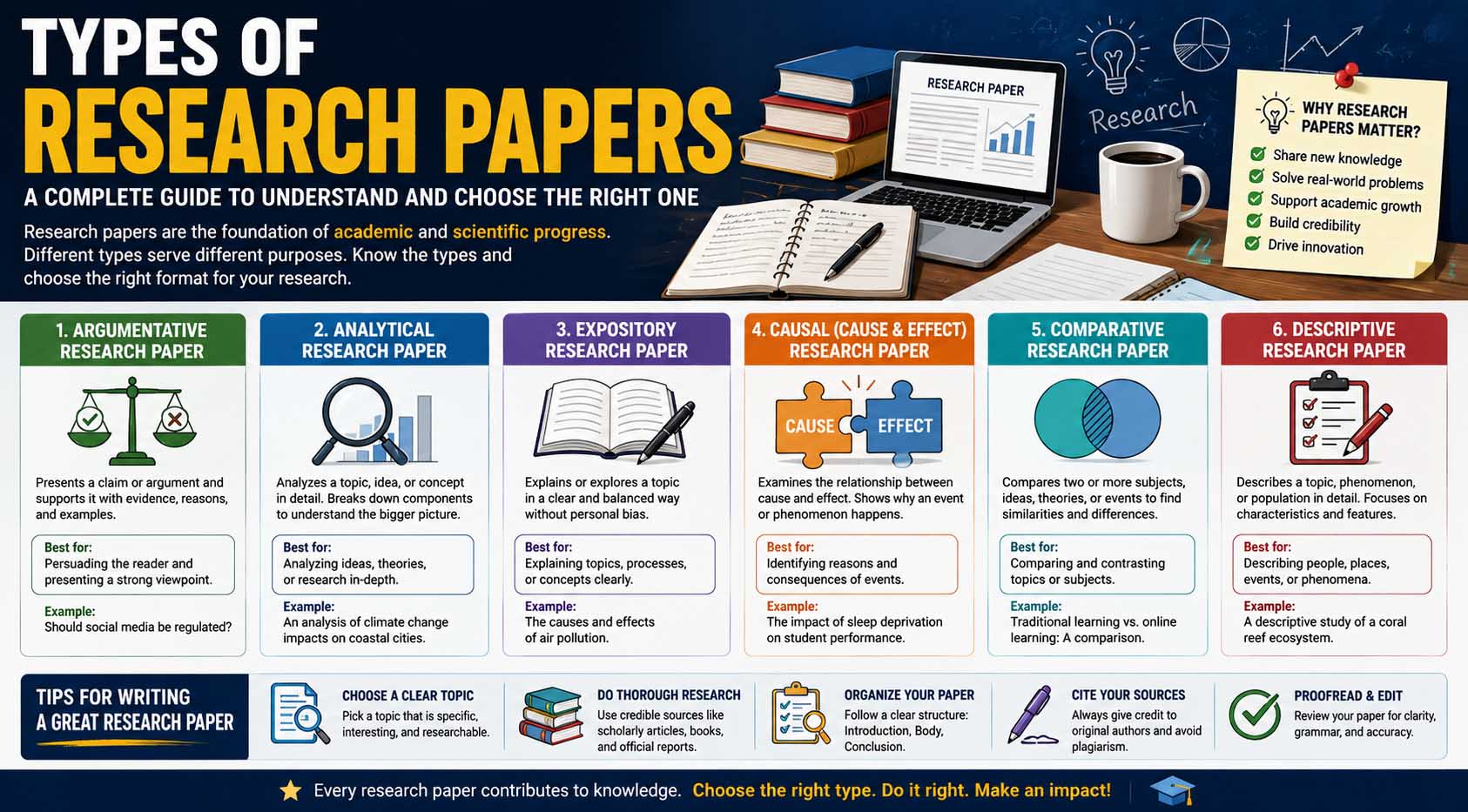
An analytical research paper examines a topic by breaking it into parts and evaluating evidence from multiple sources.
Instead of arguing that one side is definitely correct, you study the available information and explain what the evidence shows.
For example, a student might analyze how social media use affects study habits among college students. The paper could compare several studies, identify patterns, and discuss differences in the findings.
This type of paper requires strong source evaluation. Therefore, knowing what is a scholarly source becomes especially useful because analytical papers often depend on peer-reviewed studies, academic books, and reliable institutional publications.
What Makes an Analytical Paper Strong?
A strong analytical paper should:
- present a clear research question
- use credible sources
- compare evidence carefully
- identify patterns and disagreements
- avoid unsupported personal opinions
- explain why the evidence matters
The goal is not simply to summarize sources. Instead, the writer should connect them and develop a thoughtful interpretation.
Argumentative Research Papers
An argumentative research paper takes a clear position on a debatable issue and supports that position with evidence.
For example, a student might argue that high schools should start later in the morning. The paper would present research on sleep, academic performance, and student health while also addressing opposing viewpoints.
Unlike a simple opinion essay, an argumentative research paper must rely heavily on credible evidence.
Therefore, students should support claims with research rather than personal belief alone.
Analytical vs. Argumentative Research Papers
These two formats are often confused.
| Feature | Analytical Paper | Argumentative Paper |
|---|---|---|
| Main purpose | Examine and explain | Persuade and defend |
| Thesis | Interpretation or finding | Clear position |
| Use of sources | Compare and analyze | Support an argument |
| Counterarguments | Sometimes included | Usually important |
| Tone | Neutral and evaluative | Evidence-based and persuasive |
If your assignment asks you to “evaluate,” “analyze,” or “examine,” an analytical approach may fit. Meanwhile, prompts asking you to “argue,” “defend,” or “take a position” usually point toward an argumentative paper.
Experimental Research Papers
Experimental research papers report original research based on an experiment.
These papers are common in biology, chemistry, psychology, engineering, and other research-focused fields.
For example, a student might test whether different amounts of sunlight affect plant growth. Then, the paper would explain the research question, method, results, and interpretation.
Most experimental papers include sections such as:
- introduction
- methods
- results
- discussion
- references
However, exact formatting depends on the course and citation style.
Understanding different types of study designs can help students plan experimental work because research design determines how data is collected and how reliable the findings may be.
Interpretive Research Papers
Interpretive research papers are especially common in literature, history, humanities, and some social science classes.
In this type of paper, the student examines a text, event, idea, artwork, or historical source and develops an interpretation.
For example, a literature student might analyze how symbolism is used in a novel. Meanwhile, a history student might interpret political speeches from a particular time period.
Although the paper involves interpretation, it should still rely on evidence.
Therefore, quotations, primary sources, scholarly criticism, or historical documents usually support the analysis.
Comparative Research Papers
A comparative research paper examines the similarities and differences between two or more subjects, ideas, methods, or concepts to help readers understand how they relate to one another.
For example, students may compare:
- two educational systems
- two political theories
- two novels
- two scientific approaches
- two historical events
A strong comparison does more than create a list of similarities and differences. Instead, it explains why those differences matter.
For instance, comparing two teaching methods becomes more useful when the paper explains how each approach affects student participation or learning outcomes.
Cause-and-Effect Research Papers
Cause-and-effect research papers examine why something happens and what happens as a result.
For example, a student might study the causes and effects of sleep deprivation among teenagers.
The paper may examine several possible causes, such as school schedules, technology use, or stress. Then, it may analyze effects on concentration, mood, or academic performance.
However, students should be careful with causal claims.
Just because two things occur together does not automatically mean one caused the other. Therefore, strong evidence and careful wording are especially important in this type of research.
Survey Research Papers
Survey research papers collect information directly from a group of people through questionnaires, polls, or structured interviews.
For example, a student might survey classmates about study habits before exams.
The paper would usually explain:
- who participated
- how questions were designed
- how responses were collected
- what patterns appeared
- what limitations existed
Survey papers can be useful for learning basic data collection skills.
However, small or biased samples can limit the conclusions. Therefore, students should avoid making broad claims based on a narrow group.
Case Study Research Papers
A case study focuses closely on one person, organization, event, community, or situation.
For example, a business student might study how one company responded to a major crisis. Meanwhile, an education student might examine how one school introduced a new teaching strategy.
Students who need a more detailed structure can benefit from learning How to Write a Case Study before starting because this format often requires careful organization of background information, evidence, analysis, and findings.
Case studies work well when the goal is depth rather than broad generalization.
Review Research Papers
A review paper summarizes and analyzes existing research on a specific topic.
Instead of collecting new experimental data, the writer studies what other researchers have already published.
For example, a student might review recent studies on online learning and student engagement.
A review paper may identify:
- common findings
- major disagreements
- research gaps
- changes over time
- questions that still need study
Because review papers depend heavily on published academic material, understanding different types of journals helps students decide where strong scholarly evidence is likely to appear.
Different Types of Research Papers by Purpose
Another useful way to classify the different types of research papers is by what the writer is trying to accomplish.
For example:
- analytical papers explain and interpret
- argumentative papers defend a position
- experimental papers test a hypothesis
- survey papers collect responses
- comparative papers examine similarities and differences
- review papers summarize existing research
- case studies examine one subject deeply
Therefore, the best paper type depends on the research question rather than personal preference.
If your question asks, “What happens when…?” an experiment may fit.
If it asks, “How are these two approaches different?” a comparison may work better.
Meanwhile, if it asks, “What does existing research say?” a review paper may be appropriate.
Types of References in Research Papers
The types of references in research papers depend on the subject and assignment requirements.
Common source categories include:
Scholarly Journal Articles
These are especially useful for academic and scientific research because they often present original studies or expert analysis.
Academic Books
Books can provide broad background, theory, history, and detailed explanations.
Primary Sources
Primary sources include original documents such as interviews, diaries, speeches, historical records, raw data, or original research.
Government and Institutional Sources
Government agencies, universities, research institutes, and professional organizations often publish useful data and reports.
Reliable Websites
Some websites can be useful, especially when they belong to recognized institutions. However, students should evaluate authorship, evidence, publication date, and purpose before using them.
The Purdue Online Writing Lab guide to research sources explains common academic source categories and the kinds of information they typically provide.
When organizing sources before writing, students may also find What Is an Annotated Bibliography? helpful because an annotated bibliography adds a short evaluation or summary beside each source.
How to Choose Between Types of Research Papers
Choosing among the types of papers in research becomes easier when you look closely at the assignment.
First, identify the action words in the prompt.
For example:
- “analyze” suggests analytical writing
- “argue” suggests an argumentative paper
- “compare” suggests comparative research
- “investigate” may suggest experimental or analytical research
- “review” suggests a literature or research review
- “evaluate one example” may suggest a case study
Next, consider what evidence is available.
If you do not have access to a laboratory or participants, an experimental or survey design may not be practical. Instead, an analytical or review paper may work better.
Finally, check the instructor’s required format before deciding.
A Simple Research Paper Planning Process
Once you know your paper type, planning becomes much easier.
Step 1: Understand the Assignment
First, read the prompt carefully and highlight requirements such as word count, citation style, source minimum, and due date.
Step 2: Develop a Focused Question
Next, avoid topics that are too broad.
For example, “technology in education” is huge. However, “how AI writing tools affect first-year college students’ revision habits” is much more manageable because it focuses on a specific group, tool, and aspect of writing behavior.
Step 3: Find Reliable Sources
Start with library databases, academic journals, books, and trusted institutions.
Then, save citation information immediately so you do not have to search for it again later.
Step 4: Organize Evidence
Next, group sources by theme, argument, result, or research question.
This approach makes drafting much easier than simply writing from sources in the order you found them.
Step 5: Create a Working Thesis
Your thesis may change during research, and that is normal.
However, having a working thesis gives the paper direction.
Step 6: Draft Before Perfecting
Finally, write the first draft for ideas and structure.
Then, revise for evidence, clarity, transitions, and citation accuracy.
Trying to perfect every sentence immediately can slow the process.
Common Mistakes Students Make
One common mistake is choosing a paper type that does not match the assignment.
For example, a student may write an opinion-heavy argumentative paper when the instructor asked for neutral analysis.
Another problem is relying too heavily on one source. Research papers should usually combine multiple perspectives rather than repeat one author’s ideas.
Students also sometimes confuse summary with analysis.
A summary tells readers what a source says. In contrast, analysis explains why the evidence matters and how it connects to the research question.
Finally, weak citations can damage an otherwise strong paper. Therefore, keep track of sources throughout the research process rather than trying to reconstruct citations at the end.
Frequently Asked Questions About Research Paper Types
What Are the Two Main Types of Research Papers?
In many introductory writing courses, analytical and argumentative papers are treated as the two main types. However, academic research also includes experimental, comparative, survey, case study, interpretive, and review formats.
Which Research Paper Type Is Easiest?
There is no single easiest type. However, analytical and review papers may feel more manageable for beginners because they usually rely on existing sources rather than original experiments or surveys.
What Type of Research Paper Uses Experiments?
Experimental research papers report studies in which researchers manipulate variables, observe results, and analyze findings.
What Type of Paper Compares Two Subjects?
A comparative research paper examines the similarities and differences between two or more subjects. As a result, readers can understand how the subjects are alike, how they differ, and what those comparisons reveal.
Can a Research Paper Use More Than One Approach?
Yes. Some papers combine approaches. For example, a comparative paper may also include analysis, while a case study may use both interviews and document review.
How Many Sources Should a Research Paper Have?
The number depends on the assignment, length, subject, and instructor’s requirements. Therefore, follow the source minimum given in your course guidelines rather than relying on a universal number.
Choosing the Right Type Before You Start Writing
Understanding the types of research papers makes the entire writing process more manageable. Instead of starting with a blank page, begin by deciding what your paper needs to do: analyze, argue, compare, test, review, survey, or examine one case closely.
Then, match your sources and structure to that purpose.
Once the format is clear, focus on a specific research question, gather credible evidence, organize your notes, and build your draft around clear ideas rather than isolated quotations.
As a result, your paper will be easier to follow, better supported, and more closely aligned with the assignment requirements.