
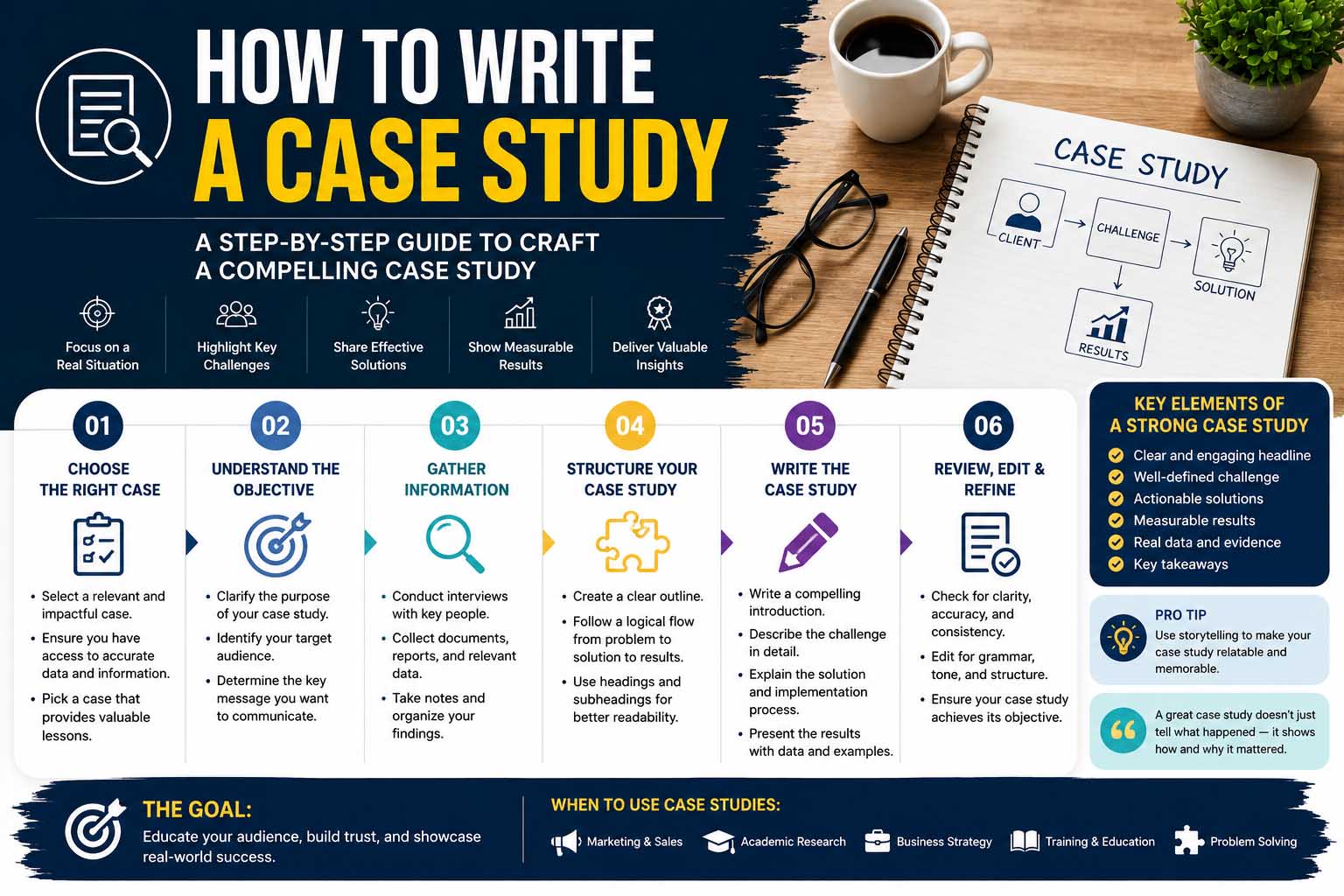
Many students feel unsure when they’re assigned a case study for the first time. Unlike a standard essay, a case study asks you to examine a real situation, explain what happened, analyze the evidence, and suggest practical solutions.
The good news is that writing a case study becomes much easier when you follow a clear process. Whether you’re studying business, education, nursing, psychology, law, or social sciences, the basic structure stays largely the same.
This guide explains how to write a case study step by step, includes practical examples, and shares writing tips that can help you earn better grades.
What Is a Case Study?
A case study is a detailed examination of a person, group, organization, event, or problem.
Rather than simply describing information, you investigate a situation by:
Identifying the main issue
Examining available evidence
Analyzing causes
Discussing possible solutions
Supporting ideas with research
Case studies are common in many college and university courses because they help students apply classroom knowledge to real-life situations.
Quick Overview of the Writing Process
| Step | Purpose |
|---|---|
| Understand the assignment | Know exactly what your instructor expects |
| Research the case | Gather reliable information |
| Identify the main problem | Focus your analysis |
| Analyze evidence | Explain why the issue exists |
| Suggest solutions | Recommend realistic actions |
| Organize your paper | Create a logical structure |
| Edit and proofread | Improve clarity and accuracy |
When Students Write Case Studies
You may encounter case study assignments in subjects such as:
Business
Marketing
Nursing
Medicine
Psychology
Education
Law
Social work
Public health
Engineering
Each subject has slightly different expectations, but the overall writing process remains similar.
How to Write a Case Study Step by Step
Step 1: Read the Assignment Carefully
Before writing anything, understand exactly what your instructor wants.
Check:
Word count
Required formatting
Citation style
Required sections
Submission deadline
Number of sources
Highlight important instructions so nothing gets overlooked.
Step 2: Understand the Case
Read the case several times.
Ask yourself:
What happened?
Who is involved?
Many fellowship sponsors also benefit…
What evidence is available?
What decisions were made?
Take notes while reading instead of relying on memory.
Step 3: Conduct Research
Even if your instructor provides a case, you’ll usually need outside sources.
Look for:
Academic journals
Books
Government reports
Educational websites
Industry publications
Use recent and reliable sources whenever possible.
Step 4: Identify the Main Problem
Many cases include several challenges.
Your job is to identify the primary issue.
For example:
Instead of writing:
“The company had many problems.”
Write:
The company’s declining customer satisfaction was caused by delayed deliveries and poor communication.
A focused problem statement makes the rest of the paper easier to organize.
Step 5: Analyze the Evidence
This is where your critical thinking exercises become especially valuable.
Don’t simply repeat facts.
Explain:
Why the problem occurred
What factors contributed
How different issues connect
What the evidence suggests
Support every major point with research or information from the case.
Step 6: Recommend Solutions
Every recommendation should connect directly to the problem you’ve identified.
Strong solutions are:
Realistic
Practical
Supported by evidence
Clearly explained
If several options exist, explain why one solution is stronger than another.
Step 7: Revise Your Work
Before submitting your paper:
Check grammar
Correct spelling
Improve transitions
Remove repetition
Verify citations
Read the paper aloud
Editing often improves both clarity and grades.
Suggested Case Study Structure
Most academic case studies follow a similar format.
Title
Keep it clear and specific.
Example:
Improving Student Attendance Through Parent Engagement
Introduction
Introduce:
The topic
The case
The purpose of the paper
Keep the introduction concise while giving readers enough context. Reviewing introduction paragraph examples can help you write a stronger opening.
Background
Explain the situation.
Include:
Important facts
Relevant history
Key people or organizations
Context needed to understand the problem
Problem Statement
Clearly explain the central issue.
Avoid listing several unrelated problems.
Stay focused.
Analysis
This section is usually the longest.
Discuss:
Evidence
Causes
Supporting research
Patterns
Possible explanations
Show your reasoning instead of only summarizing information.
Recommendations
Suggest realistic improvements.
Explain:
What should happen
Why it should happen
Expected outcomes
References
List every source according to your required citation style.
How to Write a Case Study Paper
Students often search for how to write a case study paper because they are unsure how formal it should be.
A strong paper usually includes:
Clear organization
Logical flow
Evidence-based analysis
Proper citations
Academic tone
Original thinking
Your instructor wants to see analysis rather than simple description.
Always explain why something happened instead of only describing what happened.
How to Write a Case Study Analysis?
Learning how to write a case study analysis means moving beyond summary. Instead of simply describing the events or facts, you should evaluate the situation, identify key issues, examine supporting evidence, and propose well-reasoned solutions.
Good analysis answers questions like:
Why did this problem occur?
What evidence supports this conclusion?
What alternative actions existed?
Which solution is most realistic?
What lessons can others learn?
Analysis demonstrates critical thinking, which is often the main grading criterion.
How to Write a Case Study Examples
Students frequently search for how to write a case study examples before beginning an assignment.
Here’s a simple example.
Topic
Improving Employee Productivity
Problem
A company experienced declining productivity over six months.
Analysis
Research showed poor communication, unclear expectations, and outdated software slowed employee performance.
Recommendation
Introduce project management software, improve team meetings, and provide employee training.
Notice how the example explains both the problem and the solution instead of simply describing events.
How to Write a Case Study Example for School
Here’s another short example suitable for students.
Case
A middle school noticed declining reading scores.
Findings
Teachers discovered students spent less time reading outside school.
Solution
The school introduced:
Weekly reading challenges
Parent reading logs
Classroom book clubs
Result
Reading participation increased over the following semester.
This basic structure works for many educational assignments.
Common Mistakes Students Make
Many case study papers lose marks because of avoidable errors.
Watch out for:
Summarizing Instead of Analyzing
Don’t simply retell the story.
Explain why events happened.
Using Weak Evidence
Support your ideas with reliable sources rather than opinions.
Covering Too Many Problems
Focus on the most important issue instead of trying to solve everything.
Skipping Recommendations
A good case study usually includes practical suggestions.
Don’t stop after identifying the problem.
Poor Organization
Use headings and logical paragraphs to guide readers through your analysis.
Tips for Writing a Better Case Study
These habits make writing easier.
Start research early.
Highlight key facts.
Keep detailed notes.
Organize ideas before writing.
Use simple language.
Support every claim with evidence.
Edit more than once.
Ask someone else to proofread your work.
Case Study Writing Checklist
Before submitting your assignment, check each item.
| Checklist | Completed |
|---|---|
| Assignment requirements followed | ✓ |
| Main problem clearly identified | ✓ |
| Research included | ✓ |
| Analysis supported by evidence | ✓ |
| Recommendations provided | ✓ |
| Proper citations included | ✓ |
| Grammar checked | ✓ |
| References completed | ✓ |
Helpful Study Strategies
Case study assignments become easier with regular practice.
Try these methods:
Break the Work into Smaller Tasks
Complete one section at a time instead of writing everything in one sitting.
Use an Outline
Planning your headings first creates a smoother paper.
Ask Questions While Reading
Think like an investigator.
Ask:
Why?
How?
What caused this?
What evidence supports this?
These questions naturally improve your analysis.
Review Sample Papers
Reading strong examples helps you understand structure and expectations.
Be careful not to copy another student’s work.
Use examples only for learning.
Creating how to create a study guide before starting your research can also help organize key information and evidence.
Frequently Asked Questions
What is the first step in writing a case study?
Start by carefully reading the assignment instructions and understanding the case before beginning your research.
How long should a case study be?
Length depends on your assignment. Some classroom case studies are only a few pages, while university papers may be much longer.
Do I need research sources?
Most academic case studies require outside research to support your analysis and recommendations.
Can You Use First Person in a Case Study?
Follow your instructor’s guidelines. Many academic case studies use third-person writing unless instructed otherwise. Understanding what is second person point of view can also help you avoid using the wrong narrative perspective.
What’s the difference between a case study and an essay?
An essay usually discusses a topic or argument. A case study focuses on analyzing a real situation and proposing solutions.
How many solutions should I include?
Quality matters more than quantity. One well-supported recommendation is often stronger than several weak suggestions.
Key Takeaways for Students
Learning how to write a case study is mostly about organizing your thinking. Start by understanding the case, identify the main problem, gather reliable evidence, and explain your reasoning clearly. Finish by offering practical recommendations that connect directly to your analysis.
As you practice, you’ll become more confident at spotting patterns, evaluating evidence, and building strong arguments. Those skills aren’t just useful for classroom assignments—they’re valuable in many careers where solving real-world problems is part of the job.