
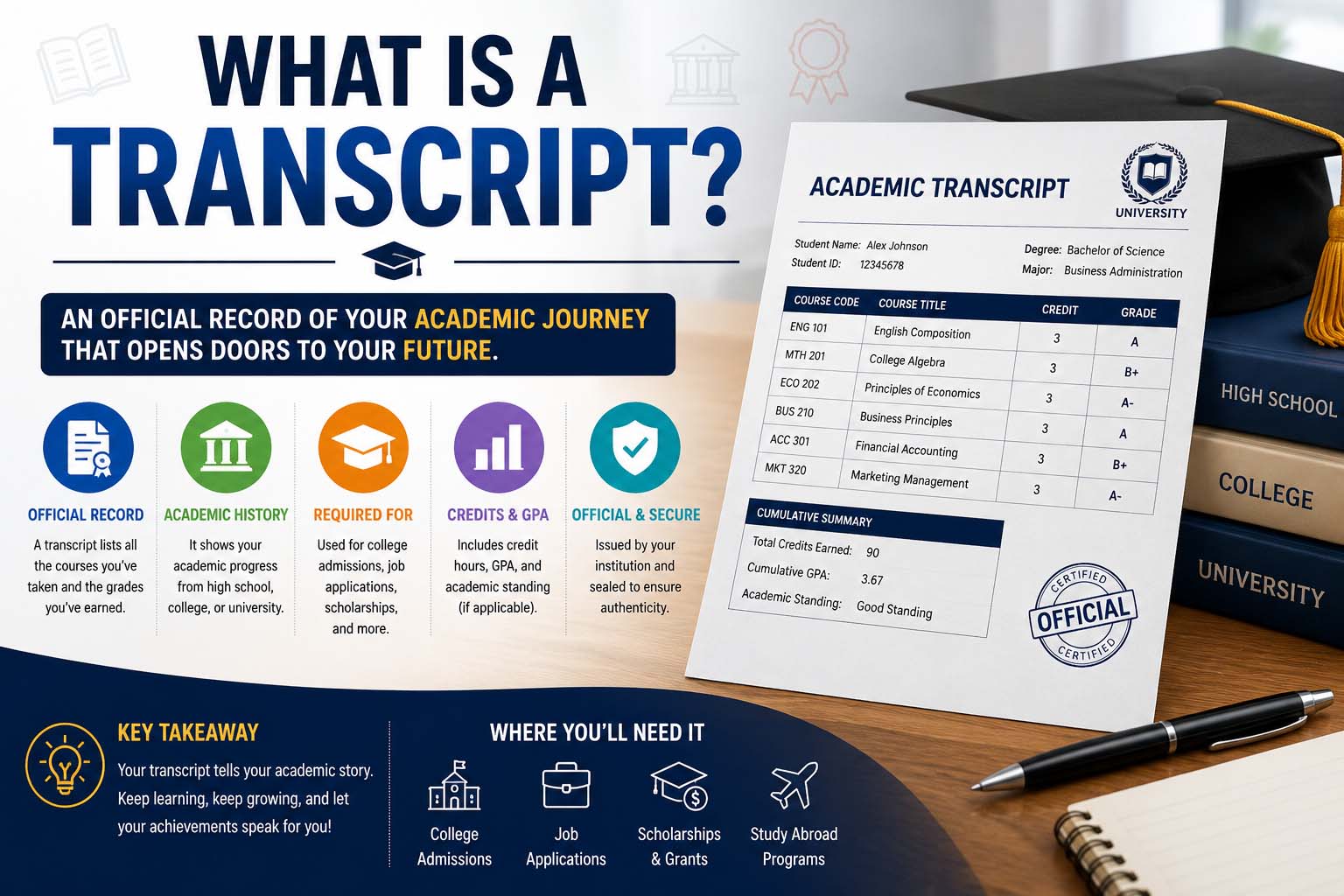
If you are applying to college, transferring schools or applying for scholarships, you may need to submit academic records. However, if you have never requested one before, you might wonder: what is a transcript? In education, it simply documents the courses you took, the grades you earned and other academic details. In contrast, a tax version shows information from records held by a tax authority.
Although different organizations use these documents for different purposes, all of them help verify information. Therefore, this guide explains the main types, what they contain, how to request them and when you might need one.
Quick Answer: What Is a Transcript?
Simply put, a transcript is a document that records important academic, financial or other information. In education, it is an official record that a school, college or university issues. In general, it summarizes a student’s coursework and academic performance.
Generally, depending on the institution, an academic version may include:
- First, courses completed
- Next, grades earned
- Also, credits awarded
- Grade point average (GPA)
- Academic honors, such as the distinctions explained in What Is Cum Laude?
- Finally, graduation information
Meanwhile, tax versions summarize selected information from a taxpayer’s records. For most students, however, the academic type is the one they will meet most often.
Types of Transcripts at a Glance
Although they share a common purpose, the contents depend on the issuing organization.
| Type | Primary purpose | Issued by |
|---|---|---|
| High school transcript | College admissions, scholarships and academic verification | High school |
| College transcript | Transfers, graduate admissions and employment | College or university |
| School transcript | Recording academic progress | Educational institution |
| Tax transcript | Verifying selected tax information | Tax authority |
| Tax return transcript | Summarizing information from a filed tax return | Tax authority |
For example, a high school record helps colleges evaluate applicants. Similarly, a college record helps universities review transfer credits and previous academic performance.
In addition, students comparing application options may benefit from understanding the difference between early action and early decision, since different plans have different deadlines.
What Information Does an Academic Record Include?
An academic record shows a student’s educational history at a particular institution. Although formats vary, most contain identifying details and information about completed coursework. Common items include:
- The student’s full name and identification number
- Next, the school or institution name
- Also, courses completed and grades earned
- In addition, credit hours or units
- Grade point average
- Furthermore, academic terms or semesters
- Finally, the graduation date and degree awarded, if applicable
Some institutions also include class rank, academic standing or honors. For example, a college record may show both semester GPA and cumulative GPA. In contrast, a high school record may focus on course grades, graduation credits and class rank. Therefore, the exact information depends on the student’s level and the institution’s reporting practices.
Why Academic Records Matter
Indeed, these records give a documented history of educational progress. As a result, colleges, employers and scholarship organizations can use them to evaluate qualifications. So, here are the most common uses:
- College admissions. First, admissions teams examine completed subjects, grades and course difficulty to confirm that applicants meet the requirements.
- Scholarship applications. Next, merit-based scholarships may consider GPA, course completion or academic honors, although requirements vary between programs.
- Employment and licensing. Also, some employers and professional licensing bodies request academic records to confirm that applicants completed specific requirements.
- Transfers. Finally, a receiving institution can evaluate completed courses and decide whether credits qualify for transfer.
What Is a High School Transcript?
First, a high school transcript is an official record of a student’s academic performance during high school. Typically, it includes courses completed, grades earned, credits awarded and graduation information. Colleges frequently request it because it helps them evaluate a student’s academic preparation.
Although schools use different formats, most records contain several common sections:
- First, student information and school contact details
- Next, academic years or semesters
- Also, course titles, final grades and credits earned
- Finally, the cumulative GPA and graduation status
Some schools also list honors courses, Advanced Placement (AP) classes, dual enrollment courses and class rank. For example, a record may show that a student completed Algebra II, English Literature, Biology and U.S. History during one academic year.
Also, several groups commonly ask for it, including colleges and universities, scholarship organizations, trade schools, military programs and certain employers. Therefore, review your academic record before important deadlines. Moreover, if you discover an incorrect grade or a missing course, contact your school promptly to request a review.
What Is a School Transcript?
Simply put, a school transcript is a broader term for an academic record that an educational institution issues. In addition, depending on the education system, it may refer to records from elementary schools, middle schools, high schools, colleges, universities or vocational institutions.
However, not every level uses the same format. For example, an elementary school may provide a progress report or cumulative record instead of a traditional course-and-credit document. Meanwhile, colleges usually provide detailed records that show individual courses, credit hours and grades.
What Is a College Transcript?
First, a college transcript is an academic record that a college or university issues. Moreover, unlike many high school records, college versions often include more detail about courses, credit hours and degree progress. Common details include:
- First, the student’s name and the institution name
- Next, courses completed and course codes
- Also, credit hours and letter grades
- Then, semester and cumulative GPA
- Finally, the degree awarded and academic standing
Depending on the institution, it may also show declared majors, minors or academic honors.
In practice, students and graduates may need one when transferring universities, applying to graduate school, seeking professional licensing, applying for certain jobs or verifying educational qualifications. For example, graduate programs may review undergraduate records to judge an applicant’s preparation for advanced study. Therefore, keeping track of your records can simplify future applications.
Official vs. Unofficial Transcripts: What Is the Difference?
First, students often meet two terms: official and unofficial. Although both may display similar academic information, institutions handle them differently.
| Official | Unofficial |
|---|---|
| Issued or authenticated by the institution | Often downloaded or printed by the student |
| May include secure digital verification or institutional seals | Usually lacks formal authentication |
| Commonly required for final admissions verification | Often useful for planning or advising |
| May be sent directly to the receiving organization | Can usually be viewed or shared personally |
| Used for formal verification | Used mainly for reference or preliminary review |
In short, an official copy is an academic record that the issuing institution authenticates. For example, a university may send an official electronic copy directly to another institution through an approved delivery service. Alternatively, a school may provide a sealed paper copy. However, an official copy does not always need to be printed or sealed, because many institutions now accept secure digital documents.
An unofficial copy is generally a student-accessible version, such as one you download from an online student portal. Although it can help with academic planning, some organizations will not accept it for final verification. Therefore, always check the receiving organization’s requirements before you submit either version.
How to Request a Transcript in 5 Steps
Requesting one is usually straightforward, although procedures vary between institutions. Follow these steps:
- Contact your school or registrar. First, visit the registrar’s office, the student services department or the official website. Many colleges also provide ordering services through student portals.
- Complete the request. Next, provide the details the institution needs to locate your records, such as your full name, student ID, date of birth, years attended and graduation year. In addition, some schools require identity verification.
- Choose the delivery method. Then pick secure electronic delivery, postal delivery, in-person collection or direct delivery to another institution. For example, electronic delivery may reach a university faster than a mailed paper copy, but the receiving organization must accept your chosen method.
- Pay any required fee. After that, remember that some institutions provide records free while others charge a processing or delivery fee, so review the current fee schedule.
- Confirm processing and delivery. Finally, check your request status and confirm that the recipient received the document. Because processing times vary, order well before the application deadline.
When Do You Need to Submit One?
Typically, you may need academic records at different stages of your education or career. Common situations include:
- First, college applications and university transfers
- Next, graduate school admissions
- Also, scholarship applications and financial aid verification
- Then, professional licensing and employment applications
- Finally, international education applications and certain visa or credential evaluations
For example, a university may request your high school record during admissions. Later, if you transfer colleges, your new institution may require official records from your previous school. In addition, some scholarship applications require both academic records and supporting documents.
Students exploring funding options may also find What Is a Fellowship? helpful when they compare educational funding and professional development programs.
What Is a Tax Transcript?
Notably, the word is not limited to education. A tax transcript summarizes selected information from records that a tax authority keeps. In the United States, the Internal Revenue Service (IRS) offers several types, and a taxpayer may need one to verify income or previously reported tax information.
Moreover, depending on the circumstances, organizations may request tax records for mortgage applications, loan applications, income verification and other financial documentation. For example, a lender may ask for particular tax information to verify income during a mortgage application. Unlike an academic record, however, a tax version focuses on financial and tax records rather than coursework and grades.
Tax Return vs. Tax Account Transcript
First, a tax return transcript summarizes most line items from a return as originally filed, including accompanying forms and schedules. It generally includes items such as filing status, adjusted gross income, taxable income, deductions and tax credits.
| Tax return transcript | Tax account transcript |
|---|---|
| Shows most line items from the original filed return | Shows basic tax account information |
| Useful for reviewing originally reported tax details | Can show changes made after filing |
| Does not reflect later amendments | May reflect payments, adjustments and account activity |
According to the IRS guide to transcript types, the return version shows your original return and not later changes, while the account version includes changes made after you filed. Therefore, identify the correct document before you submit a request.
Common Mistakes to Avoid
Although requests are usually simple, small mistakes can delay important applications. Fortunately, planning ahead prevents most problems:
- Waiting too long. Some institutions need several business days to process requests, and postal delivery adds time. Therefore, submit your request early.
- Sending an unofficial copy. Some colleges require authenticated records. As a result, the receiving institution may ask for a replacement.
- Forgetting previous schools. For example, a student who attended two colleges before transferring may need to submit records from both.
- Ignoring errors. Occasionally, records contain incorrect grades or missing credits, so contact the registrar’s office and request a review before you send anything.
- Missing deadlines. Consequently, keep a record of submission deadlines and confirm delivery whenever possible.
Tips for Keeping Academic Records Organized
Organized records make future applications easier. For example, you can follow these habits:
- First, save unofficial copies for personal reference.
- Also, keep your student identification information secure.
- Next, record your school’s registrar contact details.
- Moreover, review your grades after each academic term.
- Then check for missing or incorrect information, and request corrections when necessary.
- Finally, track application and document submission deadlines.
In addition, store digital copies in a secure location. However, remember that a saved unofficial copy may not replace an official one when an organization requires authentication.
Transcript Request Checklist
Before you send your request, review this checklist:
- First, have you confirmed which type you need?
- Next, does the receiving organization require an official copy?
- Also, have you checked your name and identifying information?
- Then, are your courses, grades and credits accurate?
- Additionally, are the recipient details correct?
- Likewise, is your delivery method accepted?
- Moreover, is the submission deadline clear?
- Finally, did the recipient receive the document?
For example, if you are applying to several colleges, each institution may have different delivery requirements. Therefore, review every application separately. Once you complete these checks, you will be better prepared to submit your records without unnecessary delays.
Frequently Asked Questions About Transcripts
What is a transcript in education?
It is a record that an educational institution issues to document coursework, grades, credits and other academic information. For example, colleges use it to evaluate previous educational performance.
What is a high school transcript used for?
It helps verify a student’s courses, grades, credits and graduation status. Therefore, colleges, scholarship organizations and certain employers may request one.
What is the difference between a school transcript and a report card?
A report card usually summarizes performance during one grading period. In contrast, a transcript provides a cumulative record of completed coursework and academic results.
Can I order mine online?
Yes, many schools and universities offer online request services. However, availability and delivery options depend on the institution.
How long does it take to receive one?
Processing times vary between institutions. For example, secure electronic delivery may be faster than postal delivery, so check your school’s schedule and order early.
Is a tax return transcript the same as a tax return?
No. A tax return transcript summarizes most line items from an originally filed return. However, it is not an exact photocopy of the original document.
Key Takeaways: What a Transcript Is
In short, understanding what is a transcript means recognizing that different organizations use these records to document and verify important information. In education, high school and college versions summarize academic performance, including courses, grades, credits and graduation details. Meanwhile, tax versions provide selected information from a taxpayer’s records.
Therefore, keep your records organized, request them before deadlines and confirm whether the receiving organization requires an official or unofficial copy. With proper preparation, you can avoid unnecessary delays and handle future educational or financial paperwork with greater confidence.