
If you’re preparing college applications, you’ve probably come across the terms Early Action (EA) and Early Decision (ED). They sound similar, but they work very differently.
Understanding the difference between early action and early decision can help you choose the application plan that best fits your academic goals, financial situation, and college preferences.
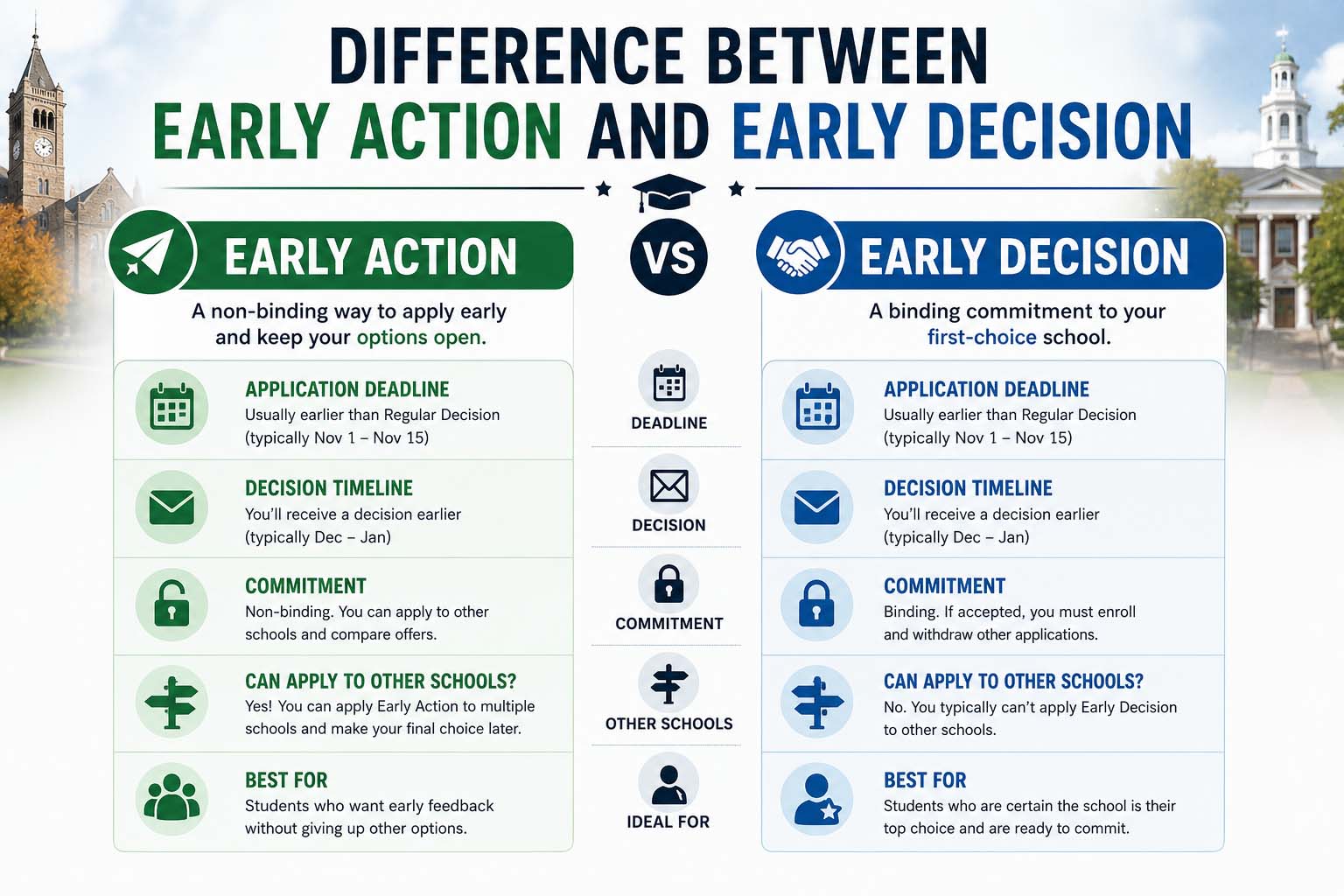
Both options allow students to apply earlier than regular decision deadlines. The biggest difference is that Early Decision is usually binding, while Early Action is generally non-binding.
Let’s look at how each option works and when each one makes the most sense.
What Is Early Action?
Early Action is an admission plan that allows students to submit their college applications before the regular deadline.
Students who apply Early Action usually receive an admission decision earlier, often several months before regular applicants.
One of the biggest advantages is flexibility.
If you’re accepted through Early Action, you can usually:
- Compare financial aid offers
- Apply to other colleges
- Wait until the national enrollment deadline before making your final choice
This makes Early Action attractive for students who want early results without committing immediately.
What Is Early Decision?
Early Decision is another early application option, but it comes with a significant commitment.
When you apply through Early Decision, you’re agreeing that if the college accepts you, you will enroll there.
Because of this commitment:
- You usually apply to only one Early Decision school.
- If accepted, you withdraw applications from other colleges.
- You attend that college unless special circumstances apply, such as financial aid concerns.
Early Decision is best suited for students who are completely certain about their first-choice college.
Difference Between Early Decision and Early Action
The difference between early decision and early action is easiest to understand by comparing the two side by side.
| Feature | Early Action | Early Decision |
|---|---|---|
| Application Deadline | Earlier than regular decision | Earlier than regular decision |
| Admission Decision | Early | Early |
| Binding Agreement | No | Usually yes |
| Apply to Other Colleges | Usually yes | Usually limited |
| Final College Choice | Student decides later | Student commits if accepted |
Although policies vary slightly between colleges, this comparison reflects how most schools handle these admission plans.
What Is the Difference Between Early Action and Early Decision?
Many students ask, what is the difference between early action and early decision because both options have similar names.
The biggest differences involve commitment and flexibility.
Early Action Offers More Freedom
Students accepted through Early Action generally have time to:
- Compare colleges
- Review scholarship opportunities
- Evaluate financial aid packages
- Visit campuses again before deciding
This flexibility reduces pressure during the admissions process.
Early Decision Requires Commitment
Early Decision is designed for students who already know exactly where they want to attend.
Applying through Early Decision demonstrates strong interest in one institution, but it also means giving up the opportunity to compare multiple admission offers if accepted.
Why Colleges Offer Early Admission Plans
Colleges benefit from early admission programs because they can better estimate the size of their incoming class.
Students benefit because they often:
- Receive decisions sooner.
- Experience less uncertainty.
- Have more time to prepare for college after acceptance.
These programs can make the admissions process smoother for both students and universities.
Who Should Choose Early Action?
Early Action may be a good fit if you:
- Have strong grades by the application deadline.
- Want an early admission decision.
- Want to compare several colleges.
- Need time to review financial aid offers.
- Aren’t completely sure which college you’ll attend.
Students considering different academic paths may also spend time researching What Is a Professional Degree? before deciding which colleges and programs best match their long-term career goals.
Who Should Choose Early Decision?
Early Decision may be the right option if:
- You’ve identified your dream school.
- You’re confident you’ll attend if accepted.
- You’ve researched tuition and financial aid.
- Your application is already competitive.
Applying Early Decision simply because you hope it increases your admission chances isn’t always the best strategy if you’re still undecided.
Advantages of Early Action
Many students appreciate the flexibility that Early Action provides.
Some advantages include:
Earlier Admission Decisions
Receiving an admission decision earlier reduces uncertainty during senior year.
Students often know their status months before regular applicants.
More Time to Plan
An early acceptance gives students extra time to:
- Apply for scholarships
- Arrange housing
- Prepare financial plans
- Visit campuses
Lower Stress Later
Having one acceptance early can reduce pressure while waiting for other colleges to respond.
Advantages of Early Decision
Early Decision also offers several benefits.
Demonstrates Strong Interest
Applying through Early Decision clearly shows that a college is your first choice.
Admissions offices recognize this commitment.
Earlier Planning
Students accepted through Early Decision can focus on preparing for college much earlier than many regular applicants.
That extra time may help with housing, orientation, and financial planning.
Possible Drawbacks
Every admission plan has disadvantages.
Early Action
Potential drawbacks include:
- Earlier application deadlines
- Less time to improve grades
- Less time to strengthen extracurricular activities
Students need to prepare application materials well before senior-year deadlines.
Early Decision
Early Decision carries greater responsibility.
Potential disadvantages include:
- Binding commitment
- Limited ability to compare offers
- Less flexibility if priorities change
Because of this commitment, families should carefully review tuition costs and financial aid policies before applying.
Academic Preparation Before Applying
Regardless of which admission plan you choose, colleges will review your academic record carefully.
Your application may include:
- High school transcript
- Standardized test scores (if required)
- Recommendation letters
- Essays
- Activities list
Before submitting applications, it’s helpful to understand What Is a Transcript? since this document summarizes your academic performance and plays a major role in admissions decisions.
Example Scenarios
Sometimes the best way to understand admission plans is to look at real-world examples.
Example 1: Student Who Has a Dream School
Emma has wanted to attend the same university for years.
She has:
- Researched the program thoroughly.
- Visited the campus.
- Discussed tuition with her family.
- Decided she will attend if accepted.
For Emma, Early Decision could be an appropriate choice because she’s comfortable making a binding commitment.
Example 2: Student Comparing Several Colleges
Jacob likes three universities equally.
He’s interested in comparing:
- Financial aid packages
- Campus culture
- Academic programs
- Housing options
Early Action gives him the flexibility to receive decisions early while still choosing later.
Typical College Application Timeline
Although exact deadlines vary by school, many colleges follow a similar schedule.
| Application Stage | Typical Timeframe |
|---|---|
| Early Action deadline | Fall of senior year |
| Early Decision deadline | Fall of senior year |
| Early admission decisions | Late fall or winter |
| Regular decision deadline | Winter |
| Enrollment decision | Spring |
Always verify dates directly with each college because deadlines may differ.
How to Decide Which Option Is Right
Before submitting your application, ask yourself a few important questions.
Choose Early Action if:
- You’re still comparing colleges.
- Financial aid will influence your decision.
- You want flexibility after acceptance.
- You’d like early admission results without making a commitment.
Choose Early Decision if:
- You have one clear first-choice school.
- You’re ready to commit if accepted.
- Your family understands the financial commitment.
- Your application is already as strong as possible.
Taking time to answer these questions honestly can make the decision much easier.
Common Mistakes Students Make
Avoiding a few common mistakes can improve your application experience.
Applying Early Decision Without Being Certain
Some students apply Early Decision simply because they believe it will improve their chances.
If you’re unsure about attending that college, Early Action or Regular Decision may be the better choice.
Missing Deadlines
Early admission deadlines usually arrive well before regular applications.
Create a checklist so essays, recommendation letters, and application forms are completed ahead of time.
Ignoring Financial Planning
College costs vary significantly.
Before agreeing to a binding admission plan, review tuition, scholarships, and financial aid with your family.
Does Early Admission Improve Acceptance Chances?
Some colleges admit a higher percentage of students through early application programs.
However, this doesn’t mean Early Action or Early Decision automatically improves your chances.
Admissions offices still evaluate:
- Grades
- Course rigor
- Test scores (if required)
- Essays
- Activities
- Recommendations
A strong application remains the most important factor.
Planning Beyond Your First Degree
While choosing an undergraduate admission plan, it’s also helpful to think about your long-term education goals. Understanding How Long to Get a Bachelor’s Degree? can help you plan your academic timeline before considering internships, graduate school, or professional training.
Some students already know they may continue their education after earning a bachelor’s degree. Learning What Is Grad School? can help you understand the options available if you decide to pursue a master’s or doctoral program in the future.
Students interested in research or academic careers may eventually explore What Is a Fellowship?, which can provide funding and advanced learning opportunities after completing undergraduate or graduate studies.
Frequently Asked Questions
What’s the difference between early action and early decision?
Early Action usually allows students to apply early without committing to attend if accepted. Early Decision is typically binding, meaning students agree to enroll if admitted.
Can I apply Early Action to more than one college?
Many colleges allow multiple Early Action applications, although some schools have restrictive policies. Always read each college’s admission rules carefully.
Can I decline an Early Action offer?
Yes. In most cases, students accepted through Early Action may decline the offer and attend another college.
Can I apply Early Decision and Regular Decision?
Yes. Many colleges allow students to submit Regular Decision applications elsewhere while waiting for an Early Decision result. If accepted through Early Decision, you’ll generally be expected to withdraw those other applications.
Is Early Decision better than Early Action?
Neither option is better for every student. The right choice depends on your confidence in your first-choice college, your financial situation, and whether you want the flexibility to compare multiple offers.
Should I apply early if my grades may improve?
If you expect significantly stronger grades later in senior year, waiting for Regular Decision may strengthen your application. Discuss your situation with your school counselor before deciding.
Choosing the Admission Plan That Fits You
Understanding the difference between early action and early decision helps you make a college application strategy that matches your goals rather than following what other students choose.
If flexibility and comparing college options matter most, Early Action is often the better fit. If you’ve found your dream school and you’re ready to commit, Early Decision may be worth considering. Review each college’s admission policies carefully, stay organized, and give yourself enough time to prepare a strong application before the deadline arrives.