Have you ever looked at a college directory and wondered about the difference between faculty and staff? Although the two terms are often used together, they don’t mean the same thing. Both groups help schools and universities succeed, but their daily responsibilities, qualifications, and interactions with students are usually quite different.
Whether you’re applying to college, starting a new semester, or simply trying to understand how educational institutions operate, knowing the distinction can help you communicate with the right people and better understand how your school functions.
This guide explains the roles of faculty and staff, highlights their differences, and answers common questions students and parents often have.
What Is the Difference Between Faculty and Staff?
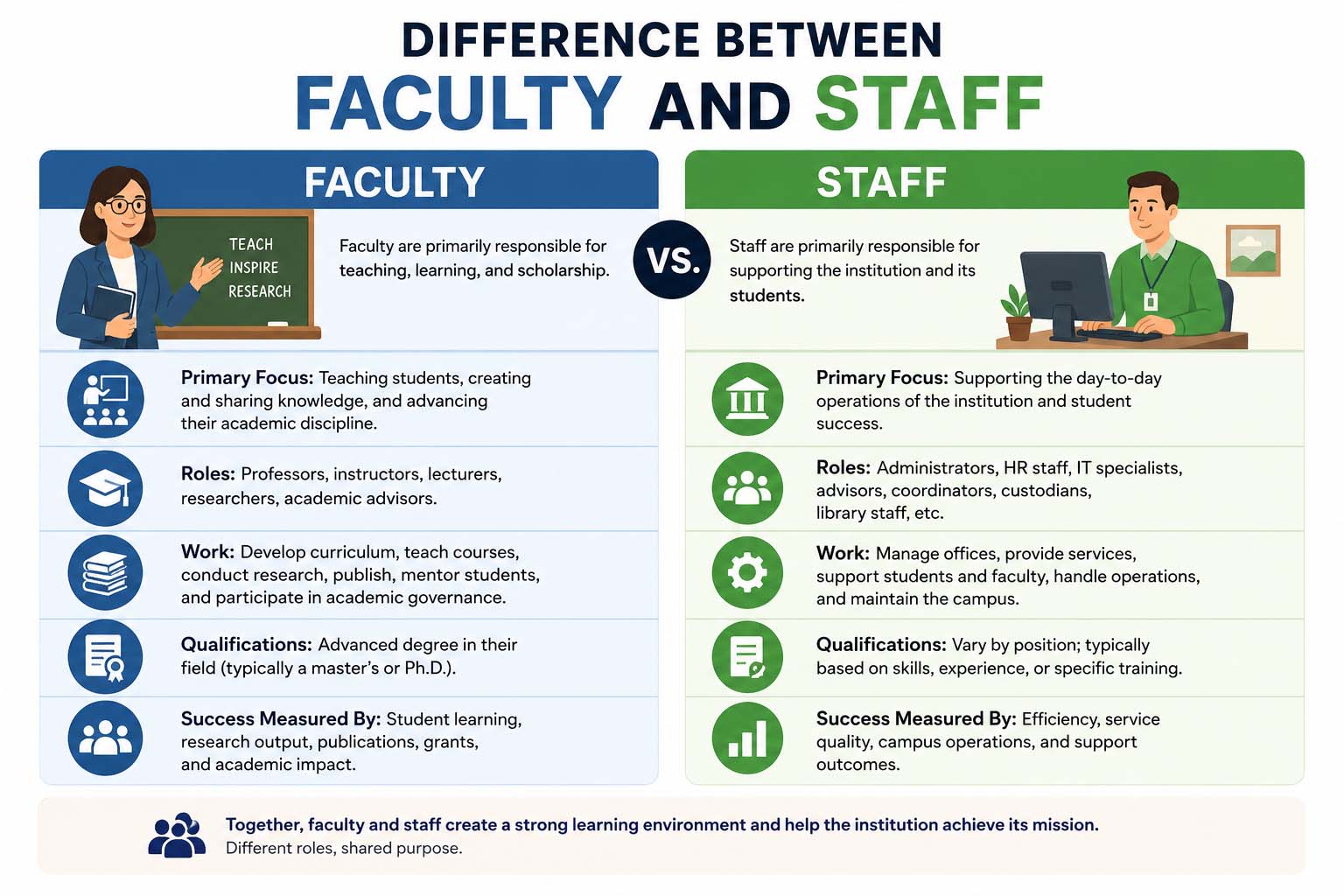
The easiest way to understand the difference between faculty and staff is to focus on their primary responsibilities.
Faculty refers to educators who teach students, conduct research, develop academic programs, and contribute to the institution’s educational mission.
Staff includes employees who support the daily operation of the school or university. They work in administrative offices, libraries, technology departments, admissions, financial aid, student services, maintenance, and many other areas.
Although their jobs differ, both faculty and staff work together to create a successful learning environment.
What Does Faculty Mean?
Faculty members are responsible for delivering education and supporting academic development.
Depending on the institution, faculty may include:
- Professors
- Associate professors
- Assistant professors
- Lecturers
- Instructors
- Academic researchers
Their responsibilities often include:
- Teaching classes
- Preparing lessons
- Creating exams and assignments
- Advising students
- Conducting research
- Publishing academic work
- Serving on academic committees
In colleges and universities, faculty members often specialize in one academic field and teach courses related to their expertise.
Some institutions also employ part-time instructors. If you’re curious about how these teaching positions differ from full-time professors, learning What Is an Adjunct Professor? provides helpful background on another important academic role.
What Does Staff Mean?
Staff members support the school’s operations and student experience outside of classroom instruction.
They may work in departments such as:
- Admissions
- Registration
- Financial aid
- Human resources
- Information technology
- Library services
- Student affairs
- Career services
- Facilities management
- Campus security
Their work helps students enroll in classes, access campus resources, solve technical problems, and receive support throughout their education.
Although staff members usually don’t teach academic courses, their contributions are essential to keeping the institution running smoothly.
Difference Between Staff and Faculty at a Glance
The difference between staff and faculty becomes clearer when comparing their primary duties.
| Feature | Faculty | Staff |
|---|---|---|
| Primary Role | Teaching and academic leadership | Administrative and operational support |
| Student Interaction | Mostly in classrooms and academic advising | Through campus services and student support |
| Main Focus | Education and research | Campus operations and administration |
| Academic Responsibilities | Yes | Usually no |
| Research Duties | Often included | Rarely required |
| Examples | Professors, lecturers, instructors | Advisors, librarians, IT specialists, admissions officers |
While these distinctions apply in most institutions, some employees may have responsibilities that overlap.
Faculty and Staff Work Together
Although their responsibilities differ, faculty and staff depend on one another every day.
For example:
- Faculty teach courses.
- Staff register students for those courses.
- Faculty assign grades.
- Staff update academic records.
- Faculty advise students academically.
- Staff help students with financial aid, housing, and technology.
Without strong collaboration, schools would struggle to provide a smooth educational experience.
Students often interact with both groups throughout their academic journey, even if they don’t always realize it.
What Is the Difference Between Faculty and Staff in Colleges?
Many students ask, what is the difference between faculty and staff after beginning college.
The distinction is especially noticeable in higher education because universities employ large teams of both educators and support professionals.
Faculty members generally spend much of their time:
- Teaching lectures
- Leading seminars
- Supervising research
- Meeting with students during office hours
- Developing curriculum
Staff members may spend their day:
- Processing admissions applications
- Scheduling classrooms
- Managing payroll
- Maintaining computer systems
- Organizing student events
- Supporting campus safety
Even though students often meet professors most frequently, they rely on staff for many important services behind the scenes.
Education and Qualifications
Faculty and staff usually follow different career paths.
Faculty positions often require advanced academic qualifications.
Depending on the institution and subject, professors may hold:
- Master’s degrees
- Doctoral degrees (PhDs)
- Professional degrees
- Research experience
- Teaching experience
Staff positions vary much more.
Some roles require specialized certifications, while others require bachelor’s or master’s degrees depending on the department.
Many college instructors earn advanced credentials before entering higher education. If you’re unsure how specialized academic qualifications differ from traditional degrees, learning What Is a Professional Degree? can help explain why some faculty members hold credentials in fields such as law, medicine, pharmacy, or education.
For example:
- Financial aid counselors may have backgrounds in finance or education.
- IT specialists typically have technology training.
- Librarians often earn specialized graduate degrees.
- Career advisors may have counseling or business experience.
Qualifications depend on the specific responsibilities of each position rather than whether someone is considered faculty or staff.
Examples of Faculty and Staff Roles
Looking at everyday situations makes the difference easier to understand.
Faculty Examples
A biology professor teaches laboratory courses.
An English instructor grades essays and holds office hours.
A mathematics professor supervises graduate research.
A music lecturer prepares students for performances.
These individuals directly support academic learning.
Staff Examples
An admissions officer reviews student applications.
A librarian helps students locate research materials.
An IT technician restores access to a student’s online learning account.
A registrar processes course enrollment requests.
These professionals support students without serving as classroom instructors.
Why Understanding the Difference Matters
Knowing who does what helps students solve problems more quickly.
If you have questions about:
- Course content
- Assignments
- Grades
- Research projects
- Academic advising
You’ll usually contact a faculty member.
If you need help with:
- Registration
- Tuition payments
- Financial aid
- Campus technology
- Student identification cards
- Housing
You’ll usually work with staff members.
Understanding these responsibilities saves time and helps students reach the right office from the beginning.
Common Areas Where Faculty and Staff Work Together
Although faculty and staff have different responsibilities, many campus activities require teamwork.
For example, faculty members may recommend updates to academic programs, while staff coordinate scheduling, enrollment systems, classroom assignments, and student records.
Large projects, student orientation events, graduation ceremonies, and academic support initiatives often involve collaboration between multiple departments across the institution.
This teamwork allows students to experience a well-organized learning environment while focusing on their education rather than administrative processes.
Common Misunderstandings About Faculty and Staff
Many people assume every employee at a school or university is part of the faculty. In reality, only employees with academic teaching or research responsibilities are generally considered faculty members.
Here are a few common misconceptions.
Myth 1: Everyone Who Works at a College Is Faculty
This isn’t true.
A university employs professionals in many departments, including admissions, finance, information technology, campus safety, libraries, and student services. Most of these employees are staff members rather than faculty.
Myth 2: Staff Members Never Work With Students
Staff interact with students every day.
Academic advisors, librarians, financial aid specialists, career counselors, and residence life coordinators all provide services that help students succeed inside and outside the classroom.
Myth 3: Faculty Only Teach Classes
Teaching is one of their primary responsibilities, but many faculty members also conduct research, publish scholarly work, mentor students, serve on university committees, and help design academic programs.
What Is the Difference Between Staff and Faculty in Everyday Situations?
If you’re still wondering what is the difference between staff and faculty, looking at real-life examples can help.
Imagine you’re starting your first semester at college.
You meet a professor during your biology class. That professor explains assignments, teaches lessons, and grades your exams. This person is part of the faculty.
Later, you visit the financial aid office to ask about tuition payments. The employee helping you complete paperwork is a staff member.
The following week, your student email stops working. You contact the campus IT department, where a technician restores your account. That technician is also part of the staff.
Each employee contributes differently, but together they create a positive learning experience.
How Faculty and Staff Support Student Success
Students often focus on classroom instruction, yet many people contribute to their education behind the scenes.
Faculty support success by:
- Teaching course material
- Providing academic guidance
- Encouraging critical thinking
- Supervising research
- Writing recommendation letters
Staff support success by:
- Helping with enrollment
- Managing financial aid
- Providing counseling services
- Maintaining campus technology
- Organizing student programs
- Supporting career development
When both groups work together effectively, students benefit from a well-rounded educational experience.
Career Paths for Faculty and Staff
Working in education offers many career opportunities beyond teaching.
People interested in becoming faculty members usually pursue advanced academic qualifications. Depending on the discipline, they may continue their education through What Is Grad School? before applying for teaching or research positions at colleges and universities.
Many faculty members also participate in research projects and professional development throughout their careers.
Staff careers are equally diverse.
Professionals may specialize in:
- Student affairs
- Human resources
- Information technology
- Finance
- Admissions
- Library science
- Marketing
- Campus operations
These roles provide opportunities for growth without requiring classroom teaching responsibilities.
Academic Opportunities Connected to Faculty
Faculty members often help students discover opportunities that extend beyond regular coursework.
For example, professors frequently recommend internships, undergraduate research projects, scholarships, and What Is a Fellowship? opportunities for students who want to continue their education or develop specialized expertise.
Building strong relationships with faculty can open doors to valuable academic and professional experiences.
Tips for Communicating With Faculty and Staff
Knowing who to contact makes college life much easier.
Here are a few practical guidelines.
Contact Faculty When You Need:
- Help understanding course material
- Advice about assignments
- Academic mentoring
- Research supervision
- Recommendation letters
Contact Staff When You Need:
- Registration assistance
- Financial aid information
- Housing support
- Technology help
- Campus services
- Career center appointments
If you’re unsure, the school’s main office can usually direct you to the correct department.
Common Mistakes Students Make
Students new to college sometimes confuse faculty and staff responsibilities.
Some common mistakes include:
Asking the Wrong Office
Students occasionally ask professors about tuition billing or financial aid.
Although faculty may point you in the right direction, those questions are usually handled by administrative staff.
Waiting Too Long to Seek Help
Whether your concern is academic or administrative, asking for help early often prevents larger problems later.
Most colleges encourage students to use available support services throughout the semester.
Overlooking Campus Resources
Many students only interact with professors during class.
However, staff members provide services that improve academic success, including tutoring centers, counseling, career planning, disability support, and technology assistance.
Taking advantage of these resources can make college much less stressful.
Faculty, Staff, and Academic Records
Another area where faculty and staff work together is student records.
Faculty evaluate assignments and submit final grades.
Administrative staff process those grades, maintain official academic records, and prepare documents requested by students.
For example, if you’re applying for scholarships, transferring schools, or seeking employment, you may need What Is a Transcript? to understand how your official academic record is created and maintained.
This cooperation ensures student records remain accurate and secure.
Frequently Asked Questions
Are professors considered faculty?
Yes. Professors are faculty members because their primary responsibilities include teaching, research, and academic leadership.
Are administrators faculty or staff?
Most administrators are staff members. However, some university leaders may also hold faculty appointments depending on the institution.
Can someone be both faculty and staff?
Yes. At some colleges, employees may have both teaching and administrative responsibilities. Their official role depends on the institution’s policies.
Do faculty members grade students?
Yes. Faculty members usually create assessments, evaluate student work, assign grades, and provide academic feedback.
Why is it useful to know the difference?
Understanding the difference between faculty and staff helps students contact the right people, access campus services more efficiently, and better understand how schools and universities operate.
Key Takeaways
Understanding the difference between faculty and staff makes navigating school or college much easier. Faculty members focus on teaching, research, curriculum development, and academic mentoring, while staff members manage the administrative and operational services that keep an institution running smoothly.
Although their responsibilities differ, both groups play essential roles in student success. Knowing who to contact for academic guidance, enrollment questions, financial aid, or campus services can save time and help you make the most of your educational experience. Whether you’re preparing for college or already enrolled, recognizing how faculty and staff work together will help you confidently navigate campus life.