If you’ve started learning Spanish, you’ve probably wondered about the difference between por and para. Both words often translate to the English word “for,” yet they are not interchangeable. Choosing the wrong one can completely change the meaning of a sentence.
The good news is that learning when to use each preposition is easier than it first seems. Once you understand the purpose behind each word and practice with real examples, you’ll begin choosing the correct one naturally.
This guide explains the difference between para and por in simple language. You’ll find clear definitions, comparison tables, practical examples, study tips, and common mistakes so you can build confidence in both spoken and written Spanish.
Difference Between Por and Para Explained
The easiest way to understand the difference between por and para is to think about what each word answers.
- Para usually answers questions like “For what purpose?”, “For whom?”, or “Where to?”
- Por usually answers questions like “Why?”, “How?”, “Through where?”, or “Because of what?”
Although both words can translate as “for,” they express different ideas.
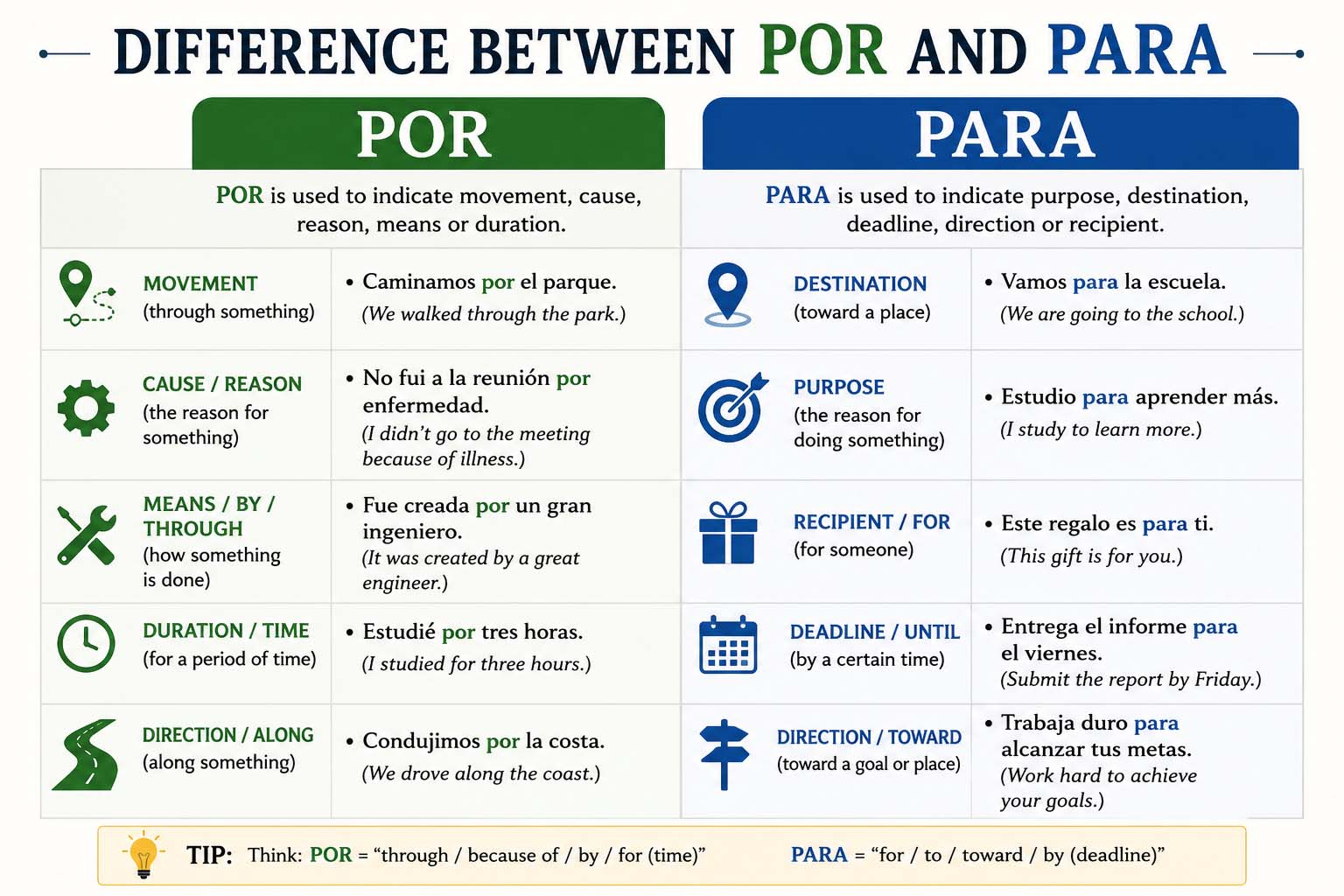
| Para | Por |
|---|---|
| Purpose | Reason |
| Destination | Movement through a place |
| Recipient | Exchange |
| Deadline | Duration |
| Goal | Means or method |
This simple comparison answers one of the most common questions from beginners: what is the difference between por and para in Spanish?
What Does “Para” Mean?
The word para often points toward a destination, purpose, goal, or intended recipient.
Think of it as looking forward to a result.
Common Uses of Para
You use para when talking about:
- Goals
- Destinations
- Deadlines
- Intended recipients
- Intended use
Examples of Para
- Este regalo es para ti.
(This gift is for you.) - Estudio para aprender español.
(I study to learn Spanish.) - Salimos para Madrid.
(We are leaving for Madrid.) - La tarea es para mañana.
(The homework is due tomorrow.)
Notice that each sentence points toward a destination, purpose, or future result.
What Does “Por” Mean?
Unlike para, por often explains the reason behind something or describes how something happens.
It frequently answers questions like why, how, or through what means.
Common Uses of Por
You use por when talking about:
- Reasons
- Causes
- Duration
- Means of transportation
- Exchange
- Movement through a location
- Passive voice
Examples of Por
- Gracias por tu ayuda.
(Thank you for your help.) - Caminamos por el parque.
(We walked through the park.) - Estudié por dos horas.
(I studied for two hours.) - Viajamos por avión.
(We traveled by plane.) - Lo hice por mi familia.
(I did it because of my family.)
Each example explains a reason, method, path, or period of time.
Difference Between Por and Para in Spanish with Examples
One of the best ways to understand the difference between por and para in Spanish is by comparing similar sentences.
| Sentence with Para | Sentence with Por |
| Trabajo para una empresa internacional. (I work for a company.) | Trabajo por dinero. (I work because of money.) |
| Este libro es para Ana. | Gracias por el libro. |
| Salimos para la escuela. | Caminamos por la escuela. |
| Necesito terminarlo para el viernes. | Estudié por tres horas. |
Notice that changing the preposition changes the meaning.
That’s why learning these small differences makes a big improvement in your Spanish.
If you’re also expanding your Spanish vocabulary, studying Partes del Cuerpo Humano can help you practice using these prepositions in everyday conversations.
An Easy Memory Trick
Students often try to memorize dozens of grammar rules.
Instead, remember this simple shortcut.
Remember PARA as “Destination”
Think about where something is going.
Ask yourself:
- Who receives it?
- What is the purpose?
- When is the deadline?
- Where is it going?
If the answer points toward a goal, para is often the correct choice.
Remember POR as “Journey”
Think about what happened along the way.
Ask yourself:
- Why did it happen?
- How did it happen?
- How long did it last?
- What caused it?
If the answer explains the reason or process, por usually fits.
This isn’t perfect for every sentence, but it works well for many everyday situations.
Step-by-Step Method to Choose the Correct Word
If you’re unsure which preposition to use, follow these steps.
Step 1: Find the Main Idea
Ask yourself what the sentence is trying to express.
Is it explaining a goal or a reason?
Step 2: Look for Time
If the sentence gives a deadline, choose para.
Example:
La tarea es para mañana.
If the sentence gives a duration, choose por.
Example:
Dormí por ocho horas.
Step 3: Check for Movement
If someone travels to a place, use para.
If someone moves through a place, use por.
Step 4: Think About Purpose
Whenever you can replace the phrase with “in order to,” para is often correct.
Example:
Estudio para aprobar el examen.
(I study in order to pass the exam.)
Common Situations Where Students Get Confused
Some situations cause confusion because English uses the word for in both cases.
Working “For” Someone
Trabajo para una universidad.
Here, the employer is the destination or organization you work for.
Thanking Someone “For” Something
Gracias por venir.
The phrase explains the reason for the thanks.
Buying Something “For” Someone
Compré flores para mi madre.
The flowers are intended for another person.
Paying “For” Something
Pagué veinte dólares por el libro.
Here, por expresses an exchange.
Frequent Mistakes Beginners Make
Everyone mixes up these two words while learning Spanish.
Fortunately, the mistakes are predictable.
Translating Directly from English
English often uses only one word—”for.”
Spanish divides that meaning between por and para, so direct translation doesn’t always work.
Memorizing Without Understanding
Some students memorize long lists of rules.
Instead, try understanding the purpose behind each sentence.
Once you know the meaning, choosing the correct preposition becomes much easier.
Ignoring Context
The same English sentence may require different Spanish translations depending on the situation.
Always think about what the speaker wants to express.
Practice Sentences
Try identifying whether each blank needs por or para.
- Este regalo es _____ mi profesor.
- Caminamos _____ la playa.
- Gracias _____ tu paciencia.
- Salimos _____ Barcelona.
- Estudié _____ cuatro horas.
- Necesito terminarlo _____ el lunes.
Answers
- para
- por
- por
- para
- por
- para
Regular practice helps these patterns become automatic.
Using Por and Para in Longer Sentences
Once you’re comfortable with short examples, begin reading longer passages.
For instance:
“Trabajo para una organización internacional porque quiero ayudar a otras personas.”
This sentence uses both words correctly.
As your Spanish improves, you’ll notice these prepositions appearing together more often.
Reading complex sentence examples is another helpful way to see how grammar works when several ideas are combined into one sentence.
Why These Prepositions Matter
Learning difference between para and por in Spanish isn’t just about passing quizzes.
These words appear constantly in:
- Conversations
- School assignments
- Emails
- News articles
- Books
- Travel situations
- Business communication
Using the correct preposition makes your Spanish sound much more natural.
Even native speakers rely on context rather than simple translation, so developing that habit early is worthwhile.
Quick Reference Guide
Keep this checklist nearby while studying.
Use PARA for:
- ✅ Purpose
- ✅ Destination
- ✅ Recipient
- ✅ Deadline
- ✅ Goal
- ✅ Intended use
Use POR for:
- ✅ Reason
- ✅ Cause
- ✅ Exchange
- ✅ Transportation
- ✅ Duration
- ✅ Movement through
- ✅ Means of communication
Reviewing this list before speaking or writing can reduce many common mistakes.
Frequently Asked Questions
Is para always translated as “for”?
No.
Depending on the sentence, it may also mean to, in order to, or toward.
Is por always translated as “for”?
No.
It can also mean by, through, because of, via, or during.
Which one is harder to learn?
Most learners find por slightly more challenging because it has more everyday uses.
Still, practice makes both much easier.
Can both appear in the same sentence?
Yes.
Example:
“Compré este regalo para ti por tu cumpleaños.”
The first preposition identifies the recipient.
The second explains the reason.
What’s the fastest way to remember them?
Instead of translating into English, ask what the sentence is expressing.
If it’s about purpose or destination, think para.
If it’s about reason, method, or cause, think por.
Keep Practicing One Situation at a Time
Mastering the difference between por and para doesn’t happen overnight, and that’s perfectly normal. Focus on one usage at a time instead of trying to memorize every rule in a single study session. Read Spanish articles, listen to native speakers, and write your own example sentences using both prepositions.
As your vocabulary grows, understanding grammar also becomes easier. Exploring topics such as What Is a Root Word? can help you recognize patterns in language learning and improve the way you remember new words. With regular practice, you’ll begin choosing por and para naturally, making your Spanish clearer and more confident every time you use it.