Why do some questions get a one-word reply while others start a long talk? Knowing the types of questions helps you answer better, ask better and think more clearly. Whether you study for an exam, run a survey or just chat with a friend, the right question makes a big difference.
First, you will learn the seven most common types, with a simple example of each. Next, you will see the grammar types, the levels of thinking teachers use, and the formats that exams, surveys and interviews use.
What Are the Types of Questions?
A question is a prompt that gathers facts, tests understanding, sparks thinking or starts a conversation. People group questions in different ways, depending on how you answer them and what they aim to do. Therefore, the “right” list depends on the setting, such as school, grammar, a survey or a job interview.
Types of Questions at a Glance
Use this table for a quick look, and then read about each type below.
| Type | Purpose | Example |
|---|---|---|
| Open-ended | Invites a detailed answer | Why does climate change matter? |
| Closed-ended | Collects a specific answer | Did you finish the homework? |
| Multiple choice | Tests knowledge with set options | Which planet is closest to the Sun? |
| Rhetorical | Makes a point without needing an answer | Who doesn’t want to succeed? |
| Probing | Digs deeper into an answer | What evidence supports your view? |
| Clarifying | Removes confusion | What do you mean by that term? |
| Leading | Pushes toward one answer | Don’t you think this option is better? |
Open-Ended Questions
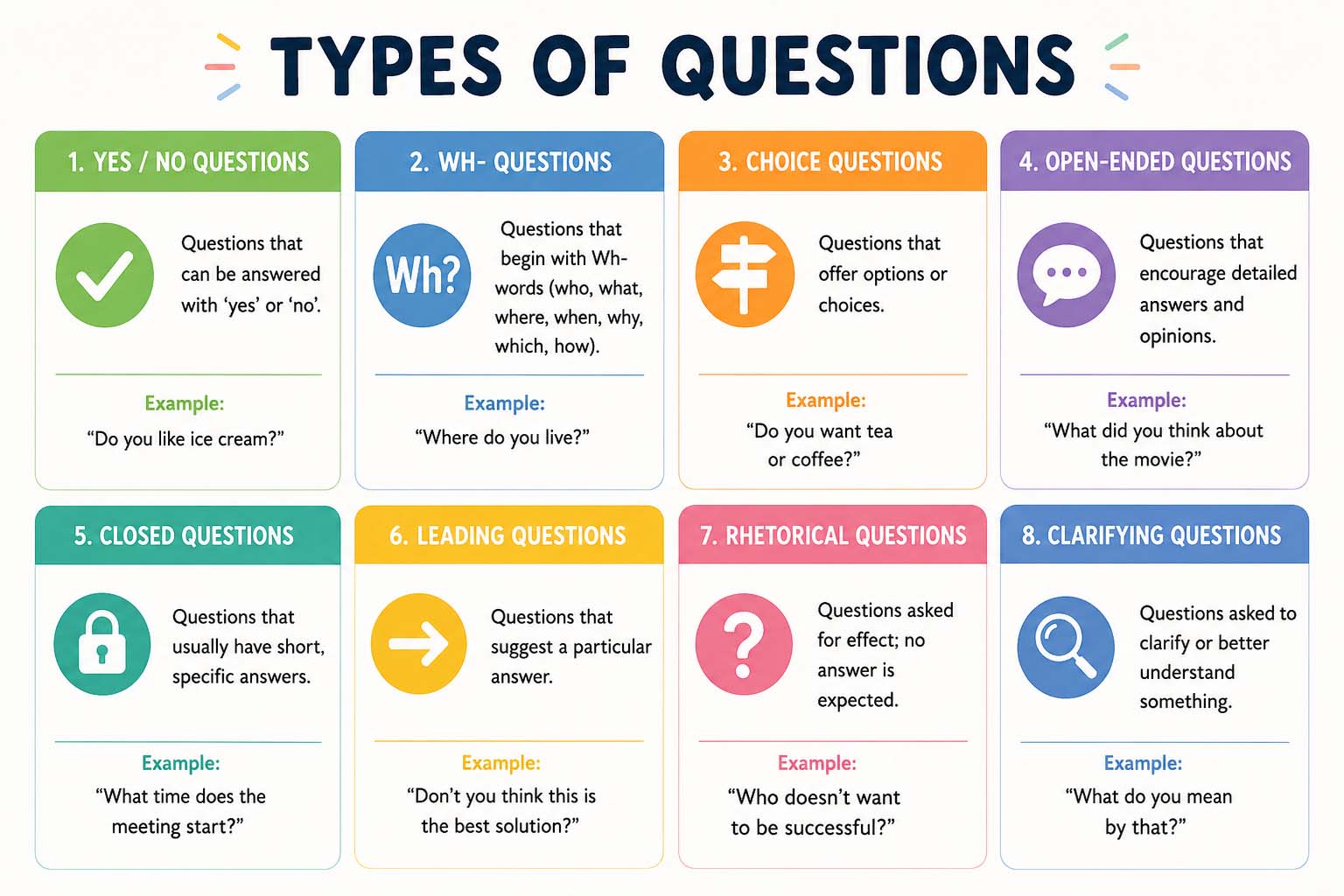
Open-ended questions cannot be answered with a simple “yes” or “no.” Instead, they ask for an explanation. For example: Why do you agree with this idea? How would you solve this problem? What could happen next?
Teachers use them in class discussions because they show how students think, not just what they remember. Also, they encourage creativity and build reasoning skills. To practice this kind of thinking, try some critical thinking exercises.
Closed-Ended Questions
In contrast, closed-ended questions have a limited set of answers, such as yes or no, true or false, or one fact. For example: Is water made of hydrogen and oxygen? What year did World War II end?
Because the answers are short, closed-ended questions work well for quizzes, surveys and fact checks. However, they show little about a person’s reasoning.
Other Common Types of Questions
Multiple-Choice Questions
A multiple-choice question gives several answers, and you pick the best one. For example: Which gas do plants absorb? A. Oxygen, B. Nitrogen, C. Carbon dioxide, D. Hydrogen. The answer is C, carbon dioxide.
Well-made multiple-choice questions can test more than memory. They can also test comparison and application.
Rhetorical Questions
Rhetorical questions are asked for effect, so no direct answer is expected. Writers and speakers use them to make readers think or to stress a point. For example: “What could be more exciting than discovering something new?”
Probing Questions
Probing questions ask someone to explain an answer in more detail. For example: Why do you believe that? Can you give an example? What led you to that conclusion? Teachers use them to push students to expand their thinking.
Clarifying Questions
Clarifying questions prevent misunderstandings. For example: Could you explain that another way? What do you mean by this term? When an answer seems unclear, a clarifying question reveals the real meaning.
Leading Questions
Leading questions suggest the answer the speaker wants, such as “Don’t you think renewable energy is the best solution?” Because the wording pushes one side, it can create bias. Therefore, researchers, reporters and interviewers should avoid leading questions when they want honest answers.
Grammar Types of Questions in English
In English grammar, questions are grouped by the form of the sentence. Four types come up most often.
Yes/No Questions
These usually start with a helping verb and expect “yes” or “no.” For example: Do you like your new teacher?
Wh- Questions
These start with a question word such as what, where, why or who. Some question words, like “how,” do not start with “wh,” but they work the same way. For example: What is your name?
Choice Questions
These offer two or more options for the listener to pick from. For example: Would you like tea or coffee?
Tag Questions
A tag question is a short question added to the end of a statement to confirm it. For example: She has seen it, hasn’t she?
Grammar types describe the shape of a question, while open-ended and closed-ended describe the kind of answer. Therefore, one question can belong to both groups. For example, “What is your name?” is a wh- question, and it is also closed-ended because it has one short answer.
How Many Types of Questions Are There?
Students often search for 4, 5 or 6 types of questions. However, there is no single number, because each field uses its own system. For example, classroom lessons often sort questions by level of thinking, surveys sort them by answer format, and interviews sort them by purpose. Therefore, follow the system your teacher or textbook uses.
Six Levels of Thinking: Types of Questions in Bloom’s Taxonomy
Teachers often write questions with the revised Bloom’s Taxonomy, which groups thinking into six levels. A group of researchers revised it in 2001, building on Benjamin Bloom’s original 1956 work. Here are the levels, with one question about photosynthesis for each:
| Level | What it asks you to do | Sample question |
|---|---|---|
| Remember | Recall facts | What is photosynthesis? |
| Understand | Explain an idea | How would you explain photosynthesis in your own words? |
| Apply | Use knowledge in a new situation | How would limited sunlight affect a plant’s ability to make food? |
| Analyze | Break an idea into parts | How do photosynthesis and cellular respiration differ? |
| Evaluate | Judge with reasons | Which factor has the greatest effect on plant growth, and why? |
| Create | Produce something new | How would you design an experiment to test the effect of light on plant growth? |
The topic stays the same, but the thinking changes with each level. For more detail, read the Vanderbilt University guide to Bloom’s Taxonomy.
Many teachers also move through the levels in one lesson. For example, they might ask: What is erosion? Then, how does erosion change a landscape? Finally, which factor caused the most erosion in this example, and why? As a result, students move from recall to explanation and judgment.
Types of Questions in Exams, Surveys and Interviews
Different settings use different formats.
- Exams: multiple choice, true or false, short answer, essay, matching and problem solving. Essay questions test organization and reasoning as well as knowledge.
- Surveys: multiple choice, rating scale (for example, 1 = very dissatisfied and 5 = very satisfied), yes or no, ranking and open-ended questions. Rating scales measure opinions, while open-ended questions reveal reasons that fixed answers can miss.
- Interviews: behavioral questions ask about past experience (“Tell me about a time you solved a difficult problem”), situational questions ask about imagined cases (“What would you do if a deadline changed?”), technical questions test subject knowledge, and motivational questions explore goals.
Therefore, practice the formats you expect to meet.
How to Choose the Right Question
Start with your goal, and then match it to a type:
| Goal | Best type |
|---|---|
| Collect facts | Closed-ended |
| Start a discussion | Open-ended |
| Test knowledge | Multiple choice or short answer |
| Make a point | Rhetorical |
| Explore an idea | Probing |
| Remove confusion | Clarifying |
| Compare opinions in a survey | Rating scale |
Because each type has a job, do not pick a style just because it is familiar. Instead, pick the one that gets the answer you need.
Common Mistakes When Asking Questions
- Being vague. Instead of “Tell me something about history,” ask “What were the main causes of World War I?”
- Asking two questions at once. Split “Did you enjoy the lesson, and what was your favorite activity?” into two questions.
- Using biased wording. Replace “Don’t you agree this solution is best?” with “Which solution do you think is the most effective, and why?”
- Ignoring the audience. A question for young students needs simpler words than one for professionals.
Therefore, check each question before you use it. Is it clear, specific, neutral and right for your audience?
Also, ask “why” questions when you study. Instead of “What happened?”, ask “Why did it happen, and what evidence supports that explanation?” The second question needs deeper reasoning. Reading skills help here too. For example, finding the central idea of a passage makes comprehension questions easier to answer.
Frequently Asked Questions
What are the main types of questions?
Common types are open-ended, closed-ended, multiple-choice, rhetorical, probing, clarifying and leading questions. However, the groups change with the field, such as education, surveys, interviews or exams.
What are the 4 types of questions in English grammar?
The four most common grammar types are yes/no questions, wh- questions, choice questions and tag questions.
What is the difference between open-ended and closed-ended questions?
An open-ended question asks for a detailed answer, while a closed-ended question has a short or limited answer. For example, “Why do you agree?” is open-ended, and “Did you finish the assignment?” is closed-ended.
Why do teachers use different types of questions?
Different questions test different skills. For example, some test memory, while others test understanding, reasoning, application or problem solving.
Key Takeaways on Types of Questions
Knowing the types of questions makes you a stronger learner, speaker and thinker. Each type has a purpose, such as gathering facts, starting a discussion, testing knowledge, clearing up confusion or exploring a new idea.
First, learn the seven common types. Next, learn the grammar types and the six levels of thinking. Then match the question to your goal. As a result, you will give clearer answers and ask better questions.
Checks I ran