
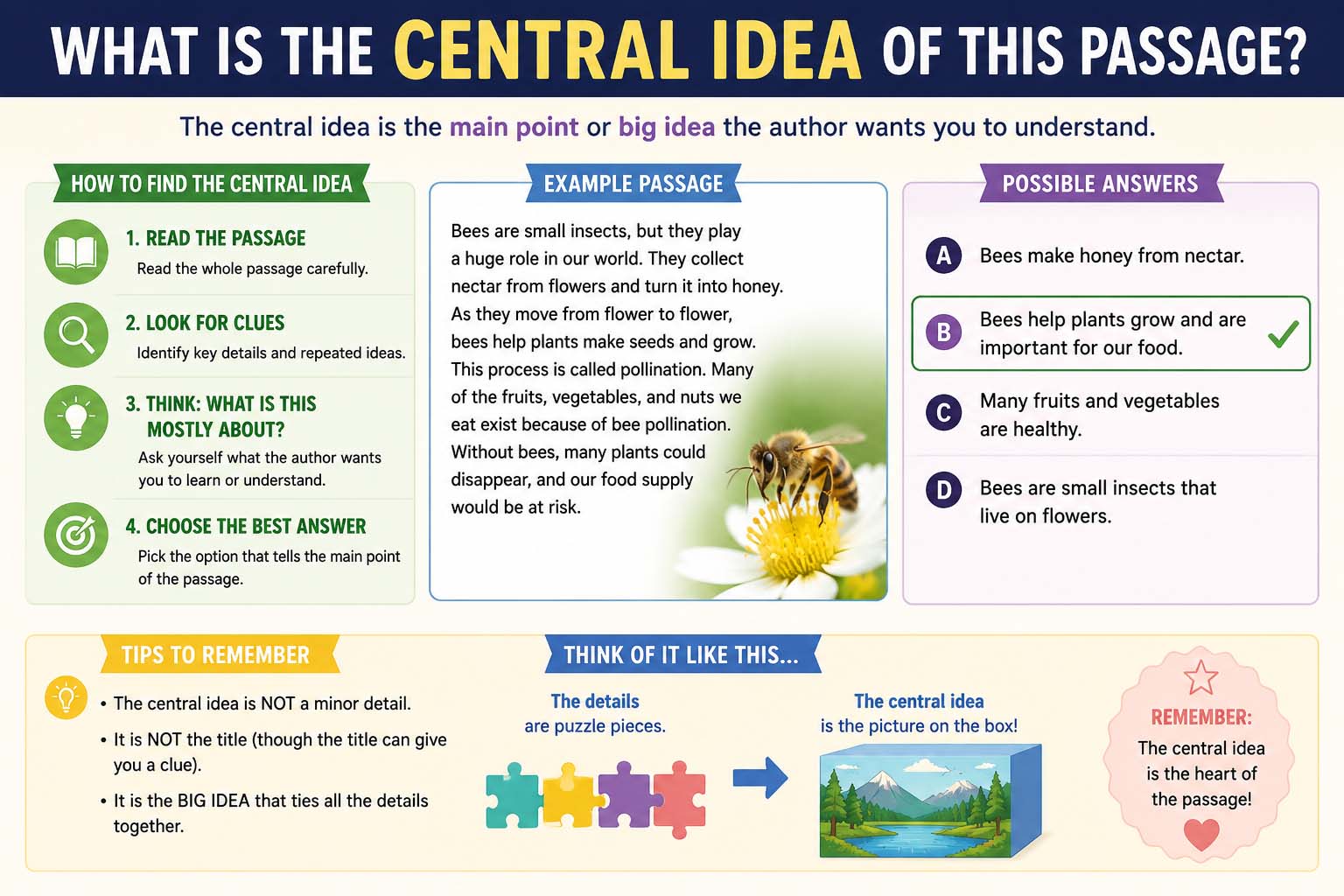
When students encounter the question “what is the central idea of this passage?”, they need to identify the most important message the author communicates. The central idea explains what a text says about its main topic, while supporting details provide facts, examples, and explanations that develop that message.
Reading comprehension is an essential skill in education and everyday communication. Whether you are reading a story, article, essay, or academic paper, recognizing the main idea helps you understand the author’s purpose and remember important information.
Although some passages state their central idea directly, others require readers to examine several details and draw a reasonable conclusion. Therefore, learning practical reading strategies can make this process easier.
This guide explains how to identify central ideas, distinguish them from topics, recognize supporting evidence, and answer comprehension questions accurately.
What Is the Central Idea of This Passage?
The central idea is the most important point or message an author communicates throughout a passage. It explains what the author wants readers to understand about the main subject.
For example, consider a passage describing how regular physical activity improves cardiovascular health, supports emotional well-being, and increases energy.
The topic is physical activity.
However, the central idea is more specific:
Regular physical activity supports both physical and mental health.
The examples about heart health, emotional well-being, and energy all support that message.
Therefore, identifying a central idea requires looking beyond individual facts to understand what the passage communicates as a whole.
What Is the Central Idea of This Passage? Understanding Its Meaning
When readers examine a passage, they should distinguish between its subject and its overall message.
The subject tells readers what the text discusses. In contrast, the central idea explains the most important point the author makes about that subject.
A central idea may appear in the introduction, conclusion, or an important topic sentence. However, authors do not always state it directly.
Instead, readers sometimes need to combine information from several paragraphs.
Reviewing Topic Sentence Examples can help readers recognize how individual paragraphs introduce points that support a larger message.
How Supporting Details Explain the Central Idea of a Passage
Supporting details provide evidence, examples, descriptions, and explanations that clarify the author’s main message.
For instance, a passage about climate change might describe rising temperatures, changing rainfall patterns, and effects on ecosystems.
These details could support the central idea that climate change affects environmental conditions around the world.
However, readers should not mistake one supporting example for the message of the entire passage.
The strongest central idea accounts for the most important details without becoming unnecessarily broad.
Why Identifying the Central Idea of a Passage Matters
Understanding the main message helps readers focus on meaningful information instead of becoming distracted by minor details.
As a result, readers can summarize texts more accurately and recognize how different ideas connect.
Students frequently encounter central idea questions in reading comprehension assignments and examinations. These questions assess whether students understand the passage as a whole rather than simply remember individual facts.
Learning How to Create a Study Guide can also help students organize main ideas and supporting details when preparing for exams.
Outside the classroom, this skill helps people interpret news articles, workplace documents, instructions, and educational materials.
How to Answer “What Is the Central Idea of This Passage?”
Finding the main message becomes easier when you follow a consistent reading process.
Step 1: Read the Entire Passage to Find the Central Idea
Begin by reading the passage from start to finish.
Avoid choosing a central idea after reading only the first sentence because later paragraphs may introduce essential information.
Instead, consider how the introduction, supporting paragraphs, and conclusion work together.
Step 2: Identify the Main Topic
Ask yourself:
What is this passage mainly about?
The answer may be a person, event, scientific concept, social issue, or general subject.
For example, a passage might discuss recycling.
However, recycling is only the topic. You still need to determine what the author says about it.
Step 3: Look for Repeated Ideas
Authors often develop their central message through related examples and explanations.
Therefore, pay attention to ideas that appear throughout the passage.
If several paragraphs describe how recycling reduces waste and conserves resources, those points probably contribute to the overall message.
Step 4: Examine Topic Sentences
Topic sentences often introduce the main point of individual paragraphs.
Read these sentences carefully and consider how they relate to one another.
For example, one paragraph might explain environmental benefits, while another describes resource conservation.
Together, these points can reveal the passage’s broader message.
Step 5: Summarize the Central Idea of the Passage in One Sentence
After reviewing the details, write a sentence that explains the most important message.
For example:
Recycling helps protect the environment by reducing waste and conserving natural resources.
This statement is more informative than simply writing “recycling.”
It also connects the major supporting details without listing every example.
Step 6: Check Your Answer Against the Text
Finally, reread the passage and ask whether your central idea accurately represents its main points.
A strong answer should:
- Explain the passage’s overall message.
- Include the main topic.
- Reflect the most important supporting details.
- Avoid focusing on one minor example.
- Avoid introducing information the author never discusses.
If your answer meets these conditions, it likely captures the central idea accurately.
Central Idea of a Passage vs. Main Topic: What’s the Difference?
Many readers confuse the central idea with the topic because both relate to what a passage discusses.
However, they serve different purposes.
The topic identifies the general subject. The central idea explains the author’s main message about that subject.
| Main Topic | Possible Central Idea |
|---|---|
| Social media | Social media improves communication but can also create challenges for users. |
| Exercise | Regular exercise supports physical health and emotional well-being. |
| Reading | Consistent reading practice helps people develop comprehension and vocabulary. |
| Recycling | Recycling reduces waste and helps conserve natural resources. |
| Technology in education | Digital tools can support learning when teachers use them effectively. |
These are illustrative examples rather than answers to specific passages.
The correct central idea always depends on what the actual text says.
Central Idea of a Passage vs. Theme
Central idea and theme are related, but they are not always identical.
The central idea describes the main point of a particular text.
A theme often expresses a broader insight about life, people, or society, especially in literary writing.
For example, a story’s central idea might concern a character overcoming difficulties through persistence.
Its theme could be that perseverance helps people face challenges.
Although these concepts overlap, readers should follow the wording of the question and the evidence in the passage.
What Is the Central Idea of This Passage? Practice Examples
Practicing with short examples can help students understand how authors develop their messages.
Example 1: A Passage About Healthy Eating
Consider this short passage:
Eating a variety of nutritious foods helps the body obtain essential nutrients. Fruits, vegetables, whole grains, and protein-rich foods contribute to a balanced diet. Making thoughtful food choices can support overall health.
Topic: Healthy eating
Central idea: Eating a balanced variety of nutritious foods supports overall health.
Supporting details: Different food groups provide nutrients, and thoughtful food choices contribute to a balanced diet.
Example 2: A Passage About Online Learning
Online learning allows students to access educational materials from different locations. However, students must manage their schedules and stay organized. Reliable technology and effective study habits can help learners succeed.
Topic: Online learning
Central idea: Online learning offers flexibility but requires organization and suitable resources.
Supporting details: Remote access, time management, and technology all contribute to the passage’s message.
Example 3: A Passage About Protecting Wildlife
Wildlife habitats face threats from pollution, deforestation, and human development. Conservation programs protect natural environments and support endangered species. Communities can also contribute by reducing pollution and supporting habitat restoration.
Topic: Wildlife conservation
Central idea: Protecting wildlife requires conservation efforts and responsible environmental practices.
Supporting details: Habitat threats, conservation programs, and community involvement explain the main message.
These examples show why a complete central idea usually communicates more than a single topic word.
What Is the Central Idea of This Passage? Exam Strategies
Students often encounter central idea questions in reading assessments.
A reliable strategy involves identifying the main topic, reviewing supporting details, and comparing possible answers.
Eliminate Answers That Are Too Narrow
Some answer choices describe only one example or paragraph.
For instance, if a passage discusses several benefits of reading, an answer focused only on vocabulary development may be too narrow.
Instead, choose the option that represents the entire passage.
Avoid Answers That Are Too Broad
Other answer choices make general statements that go beyond the text.
For example, a passage about reading habits does not necessarily support a statement about every aspect of education.
The correct answer should remain closely connected to the author’s actual message.
Watch for Unsupported Claims
An answer may sound reasonable but include information the passage never mentions.
Therefore, check whether the text provides evidence for the statement.
Do not choose an answer simply because it matches your existing knowledge of the topic.
Use a Short Summary Before Reviewing Choices
Try summarizing the passage in your own words before examining the answer options.
This technique can help you avoid attractive but misleading choices.
In addition, understanding What Is a Scholarly Source can help readers select reliable academic materials for more advanced reading practice.
The Role of Critical Thinking in Finding the Central Idea of a Passage
Critical thinking helps readers analyze information, recognize patterns, and evaluate relationships between ideas.
Some passages state their central ideas directly. Others communicate their messages through examples, comparisons, or descriptions.
In these situations, readers must infer the author’s main point from the available evidence.
For example, a passage might describe several community projects without explicitly stating their shared purpose.
Readers could examine the projects and determine whether the author emphasizes cooperation, environmental improvement, or another central message.
Practicing Critical Thinking Exercises can help students develop the reasoning skills needed to interpret more complex texts.
However, inferences should always reflect the passage rather than unsupported personal assumptions.
Finding the Central Idea of a Passage in Different Text Types
Different writing styles present information in different ways.
Consequently, readers may need to adjust their approach depending on the text.
Central Idea of an Informational Passage
Informational texts explain facts, processes, events, or concepts.
Their central ideas often summarize the most important explanation.
For example, a science passage might explain how plants use sunlight to produce energy through photosynthesis.
Central Idea of a Narrative Passage
Narrative texts tell stories through characters, events, and conflicts.
Readers should consider the main events and how they contribute to the story’s overall meaning.
However, they should distinguish between a plot summary and a broader theme when the question requires it.
Central Idea of a Persuasive Passage
Persuasive texts aim to convince readers to accept a particular position.
Therefore, identifying the author’s main claim is often essential.
For example, an essay might argue that schools should provide more opportunities for outdoor learning.
Supporting reasons and examples help explain that position.
How to Recognize the Central Idea of a Passage in Digital Content
Readers encounter large amounts of information through websites, news articles, blogs, and online educational materials.
As a result, identifying the main message can help them evaluate information more efficiently.
Start by examining the headline and introduction. Then, review the important sections and supporting evidence.
However, avoid relying on headlines alone because they may not fully represent the content.
When reading a longer article, summarize its main sections before identifying the overall message.
This approach helps students, researchers, and professionals process digital information without overlooking essential context.
Reading Comprehension and Central Idea of a Passage Practice
Improving comprehension requires regular practice and active engagement with texts.
Fortunately, students can develop stronger reading habits through manageable exercises.
Practice Summarizing Short Passages
Choose a short article or textbook section.
After reading, write one sentence explaining its main message.
Then, identify two or three details that support your summary.
This exercise strengthens the connection between the central idea and supporting evidence.
Highlight Important Information
Highlight repeated concepts, significant explanations, and topic sentences.
However, avoid marking every sentence because excessive highlighting makes important information harder to distinguish.
Instead, focus on details that help explain the author’s overall message.
Ask Questions While Reading
Active readers regularly question the information they encounter.
For example, ask:
- What is the author mainly discussing?
- What does the author want me to understand?
- Which details support the main point?
- What information appears repeatedly?
- Can I summarize the passage in one sentence?
These questions encourage deeper understanding rather than passive reading.
Review Your Understanding After Reading
After finishing a passage, explain its central idea without looking at the text.
Next, check your explanation against the original material.
If you overlooked an important point, revise your summary.
The Reading Rockets guide to comprehension instruction discusses reading comprehension strategies that can support students’ understanding of written texts.
Common Mistakes When Identifying the Central Idea of a Passage
Several mistakes can make central idea questions unnecessarily difficult.
Confusing the Topic With the Central Idea of a Passage
Writing only the subject of a passage does not fully explain its central idea.
Instead, describe what the author communicates about that subject.
Choosing One Supporting Detail
A memorable fact or example may seem important.
However, the central idea should connect the passage’s major details rather than repeat one isolated point.
Ignoring the Author’s Purpose
Authors may write to inform, explain, persuade, or entertain.
Understanding that purpose can help readers interpret the message more accurately.
Adding Personal Opinions
Readers sometimes choose answers based on their beliefs instead of the passage.
Therefore, rely on the author’s statements and supporting evidence.
Reading Only the Introduction
The opening paragraph may introduce the topic without fully explaining the central idea.
Read the entire passage before deciding on the best answer.
Final Thoughts on the Central Idea of a Passage
Understanding the question “what is the central idea of this passage?” begins with recognizing the author’s main message and examining the details that support it.
First, identify the topic. Next, look for repeated ideas, topic sentences, and important explanations. Finally, summarize the overall message in one clear sentence.
Remember that the central idea should represent the passage as a whole rather than one minor detail.
With regular practice, students can improve reading comprehension, develop stronger critical thinking skills, and answer central idea questions with greater confidence.