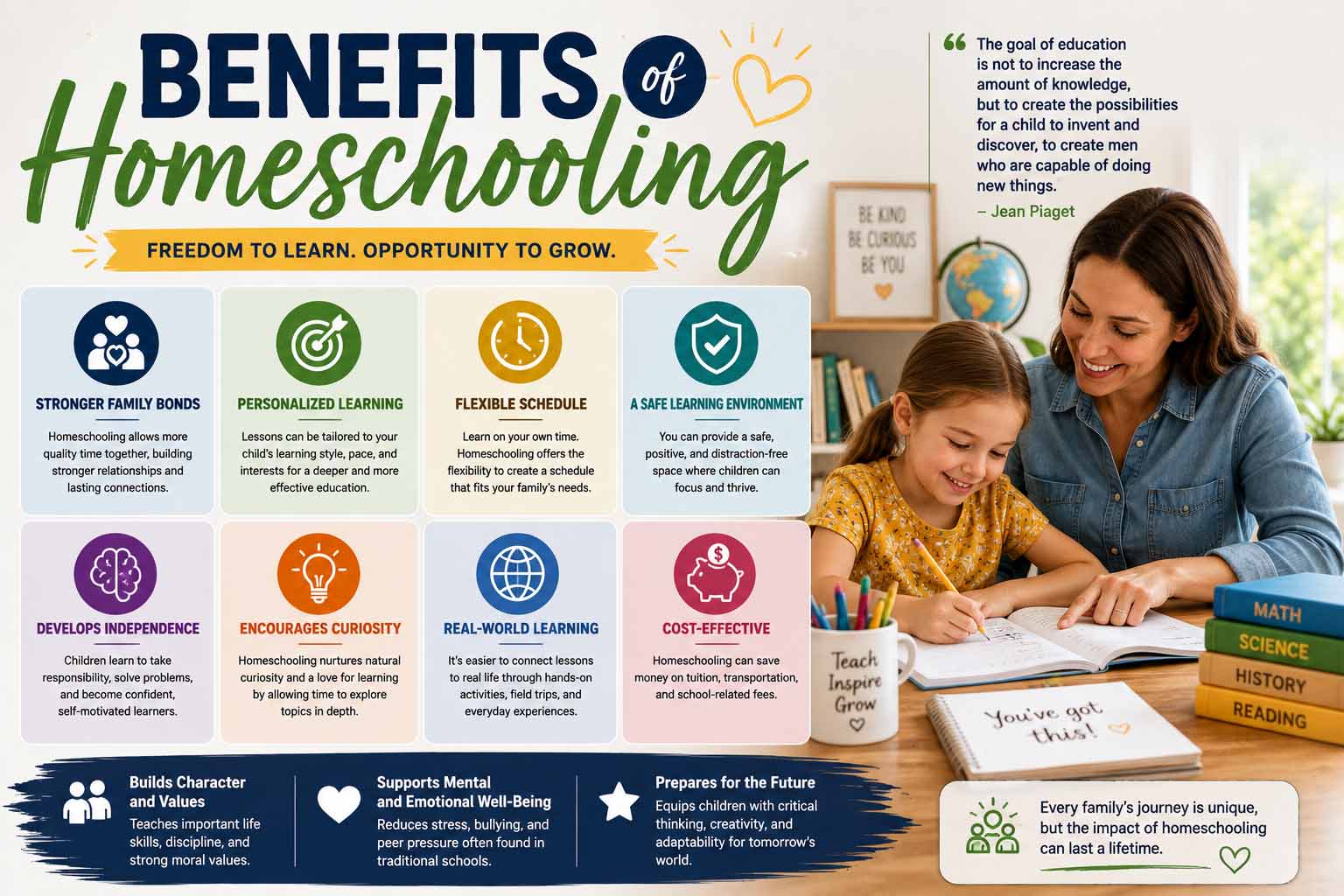
Families often consider homeschooling because traditional classrooms do not fit every learner in the same way. The benefits of homeschooling can include flexible scheduling, personalized lessons, more control over learning pace, and opportunities to connect schoolwork with real-life interests. However, homeschooling also requires planning, consistency, suitable resources, and regular attention to a student’s academic and social needs.
For some families, home education creates a calmer and more adaptable learning environment. For others, a conventional school provides structure, specialist teachers, extracurricular activities, and social opportunities that are difficult to reproduce at home.
So, homeschooling is not automatically better than classroom education. Instead, it is one of several educational models that can work well when it matches the learner, family schedule, resources, and long-term goals.
What Are the Benefits of Homeschooling?
When people ask what are the benefits of homeschooling, they usually want to know whether learning at home can improve academic progress, flexibility, confidence, or family life.
The main advantage is customization.
A homeschool program can be adjusted around a student’s pace, strengths, interests, and learning challenges. Instead of following exactly the same lesson schedule as 20 or 30 classmates, a learner can spend more time on difficult topics and move more quickly through material they already understand.
That flexibility affects almost every part of home education.
Still, families should compare homeschooling with other types of schools before deciding. Public schools, private schools, charter schools, online schools, and specialized programs can offer very different learning environments, so homeschooling is only one possible option.
Personalized Learning Can Match the Student
Traditional classrooms usually need to move a whole group through a curriculum at roughly the same pace.
Homeschooling can work differently.
If a student understands multiplication quickly but struggles with fractions, the family can shorten the multiplication review and spend extra time practicing fractions.
Likewise, a strong reader may move into more advanced books without waiting for the rest of a class.
Instead, personalized learning lets the difficulty level match the student more closely.
Parents can also experiment with different teaching methods. A visual learner might use diagrams and videos, while a hands-on learner may understand science better through experiments and building projects.
As a result, lessons can focus less on keeping pace with a group and more on actual understanding.
Flexible Scheduling Is One of the Biggest Benefits of Homeschooling
A traditional school day usually follows fixed arrival times, class periods, breaks, and holidays.
Homeschooling gives families more control over when learning happens.
Some students work best early in the morning. A flexible schedule can account for those differences while still keeping schoolwork consistent.
However, flexibility works best when it still includes routine.
If every day becomes completely unpredictable, students may struggle to develop study habits. Therefore, many successful homeschool schedules use a regular starting time or daily learning blocks without copying a conventional school timetable minute by minute.
Students Can Learn at Their Own Pace
One student may need three days to understand a new concept. Another may understand it in 20 minutes.
In a homeschool setting, both situations can be handled without as much pressure from the pace of a larger class.
If a learner needs more practice, the lesson can slow down.
If the student has mastered the material, the family can move forward instead of repeating unnecessary worksheets.
This can be especially helpful in subjects that build step by step, such as mathematics, grammar, science, or foreign languages.
However, moving quickly should still involve mastery. Skipping foundational concepts simply because a student finds repetition boring can create gaps later.
Regular reviews, quizzes, projects, and discussions can help confirm that progress is real.
Homeschooling Can Encourage Independent Study Skills
Home education often asks students to take more responsibility for their own learning as they get older.
For example, an elementary student may need close guidance, while a teenager might manage weekly assignments, reading schedules, research projects, and deadlines more independently.
That gradual shift can build useful academic habits.
Students may learn to organize materials, estimate how long work will take, identify gaps in their understanding, and ask for help when needed.
A practical tool such as How to Create a Study Guide can become useful here because older homeschool students often need to organize information independently before quizzes, exams, or major projects.
The goal is not to leave students alone with textbooks. Instead, independence develops gradually while parents or instructors continue providing support.
More Time for Hands-On Learning
Homeschooling can make it easier to use museums, libraries, parks, science centers, historical locations, kitchens, gardens, workshops, and community programs as learning environments.
A lesson about plant biology might include growing vegetables.
A physics lesson might involve building a simple machine.
A history unit could include visiting a museum and comparing primary sources.
Hands-on activities can make abstract concepts more concrete. They also give students opportunities to practice observation, problem-solving, communication, and planning.
For example, Critical Thinking Exercises can fit naturally into science experiments, debates, reading discussions, and everyday problem-solving rather than appearing only as separate worksheets.
Interests Can Become Part of the Curriculum
One of the more creative benefits of homeschooling is the ability to connect academic subjects with a student’s interests.
Suppose a student loves airplanes.
Mathematics can include speed, distance, and fuel calculations. Science can cover aerodynamics and weather. History can examine the development of aviation, while writing assignments can focus on famous pilots or aircraft design.
The same approach can work with music, animals, robotics, sports, art, cooking, or almost any serious interest.
Interest-led learning does not mean abandoning core subjects. Instead, it uses a student’s curiosity as a doorway into those subjects.
This can make learning feel more relevant and may increase motivation.
Benefits of Homeschooling Online
The benefits of homeschooling online have expanded as educational platforms, video lessons, virtual tutoring, digital textbooks, and learning management systems have become more accessible.
Online programs can provide structure for parents who do not want to create every lesson themselves.
Some platforms offer recorded instruction, while others include live classes with teachers and classmates. Many also provide quizzes, progress tracking, assignments, and digital feedback.
This can be useful in subjects where a parent does not feel confident teaching advanced material.
For instance, a high school student may take online calculus or chemistry while completing literature and history lessons with a parent.
However, online learning should not turn into an entire day of passive screen time.
Students still benefit from books, writing by hand, conversation, physical activity, experiments, creative projects, and time away from devices.
Homeschooling Can Make Language Learning More Flexible
Foreign-language study benefits from frequent practice.
At home, families can build shorter language sessions into several days each week rather than relying on only a few classroom periods.
Students can combine textbooks with audio lessons, videos, conversation practice, children’s books, apps, and cultural activities.
For example, families exploring the benefits of learning spanish might add Spanish labels around the home, cook recipes from Spanish-speaking countries, or schedule conversation practice with a fluent speaker.
This kind of repeated exposure can help language learning feel like part of daily life rather than a single school subject.
Socialization Can Be Designed More Intentionally
One common concern about homeschooling is social development.
Home education removes the automatic daily contact that comes with attending a traditional school, so families generally need to create social opportunities intentionally.
That may include homeschool groups, sports teams, music lessons, clubs, faith communities, volunteering, neighborhood activities, library programs, co-ops, or community classes.
These environments can expose students to people of different ages rather than only same-age classmates.
Still, social opportunities vary widely by location and family circumstances.
A student who rarely participates in group activities may have fewer chances to practice teamwork, conflict resolution, leadership, and friendship skills. Therefore, socialization should be planned as thoughtfully as mathematics or reading.
Families Can Spend More Time Together
Homeschooling often increases the amount of time parents and children spend together.
For some families, that creates stronger communication and more shared experiences.
Parents may become more familiar with how their child learns, what causes frustration, and which subjects spark curiosity.
Siblings can also spend more time together, especially when projects or field trips involve several ages.
However, spending more time together can also create tension.
Parents may need to separate the role of teacher from everyday family life and recognize when everyone needs a break.
Clear expectations, independent work periods, and activities outside the home can help maintain a healthier balance.
Homeschooling May Reduce Certain Classroom Pressures
Some students find large classrooms distracting or stressful.
At home, students may experience fewer interruptions, less peer comparison, and more freedom to ask questions without worrying about embarrassment.
That can help some learners rebuild confidence after struggling academically.
Students can also work in quieter surroundings if noise and movement make concentration difficult.
However, removing every challenge is not the goal.
Children still need practice working with others, meeting deadlines, handling feedback, managing frustration, and adapting to environments they cannot fully control.
A strong homeschool program should gradually develop those skills rather than avoiding them.
Benefits of Homeschooling in Florida and Other Locations
Families searching for the benefits of homeschooling in Florida may be interested in the same educational advantages discussed elsewhere: flexible schedules, customized instruction, online learning options, and greater control over curriculum.
However, legal requirements are location-specific.
Homeschool rules can differ between countries, states, provinces, and even educational programs. Requirements may involve notices, recordkeeping, evaluations, testing, attendance documentation, or other procedures.
Therefore, families should check the current requirements issued by their education authority before starting a homeschool program.
Legal compliance should be treated separately from educational preference. A teaching approach may work well for a family, but the program still needs to satisfy the rules that apply where the student lives.
Possible Challenges of Homeschooling
A balanced discussion of the benefits of homeschooling should also consider the work involved.
The first challenge is time.
Planning lessons, teaching, checking assignments, arranging activities, and tracking progress can require a major commitment from a parent or guardian.
Cost can also matter.
Families may pay for curricula, books, devices, tutors, sports, laboratory materials, educational trips, or online courses.
Social planning requires effort as well.
Meanwhile, parents may find certain advanced subjects difficult to teach without outside help.
None of these issues means homeschooling cannot work. Instead, they highlight why preparation matters.
Successful programs often combine parent instruction with libraries, tutors, co-ops, online courses, community programs, and other resources.
How to Decide Whether Homeschooling Fits Your Family
Start with the student’s needs rather than the idea of homeschooling itself.
Consider academic performance, motivation, social needs, attention style, interests, and long-term goals.
Then look at the practical side.
Who will teach? How much time is available each day? What curriculum will be used? How will progress be measured? Where will social and extracurricular activities happen?
It can help to create a trial weekly schedule before making a major change.
For example:
| Area | Question to Ask |
|---|---|
| Academics | Can we teach or access instruction for core subjects? |
| Schedule | Who will supervise learning each day? |
| Social life | Which regular group activities are available? |
| Resources | What books, technology, and courses are needed? |
| Assessment | How will we measure progress? |
| Legal requirements | What rules apply where we live? |
| Long-term planning | How will we handle higher grades or college preparation? |
A clear plan can reveal strengths and gaps before the school year begins.
Frequently Asked Questions About Homeschooling
Is homeschooling better than regular school?
Not for every student. Homeschooling offers flexibility and customization, while traditional schools may provide specialist teachers, established extracurricular programs, facilities, and daily peer interaction. The better option depends on the learner and family.
Can homeschooled students go to college?
Yes. Homeschooled students can pursue college and other forms of higher education. However, application requirements vary, so families should maintain appropriate academic records and check each institution’s admissions policies.
How many hours should homeschooling take each day?
There is no universal number. Younger children often need less formal instructional time than older students, while projects, reading, physical education, field trips, and independent work may extend learning beyond scheduled lessons.
Is online school the same as homeschooling?
Not always. local homeschool rules. The exact distinction depends on the program and location.
Do homeschool students need tests?
Assessment requirements vary by jurisdiction and educational program. Even when standardized testing is not required, regular assessment helps families identify strengths, gaps, and areas that need more practice.
Making Homeschooling Work as a Learning System
The strongest benefits of homeschooling come from flexibility with purpose. Personalized pacing, hands-on projects, independent study, online resources, and interest-based learning can all support students when they are organized around clear academic goals.
At the same time, homeschooling works best when families plan for the parts that do not happen automatically at home. Students still need feedback, social interaction, physical activity, challenging material, reliable routines, and opportunities to learn from people outside their immediate family.
For parents considering the switch, start by defining what problem you want homeschooling to solve. Then compare curriculum options, local requirements, available time, learning resources, and social opportunities. A thoughtful plan is far more useful than trying to recreate a traditional classroom inside the house.