
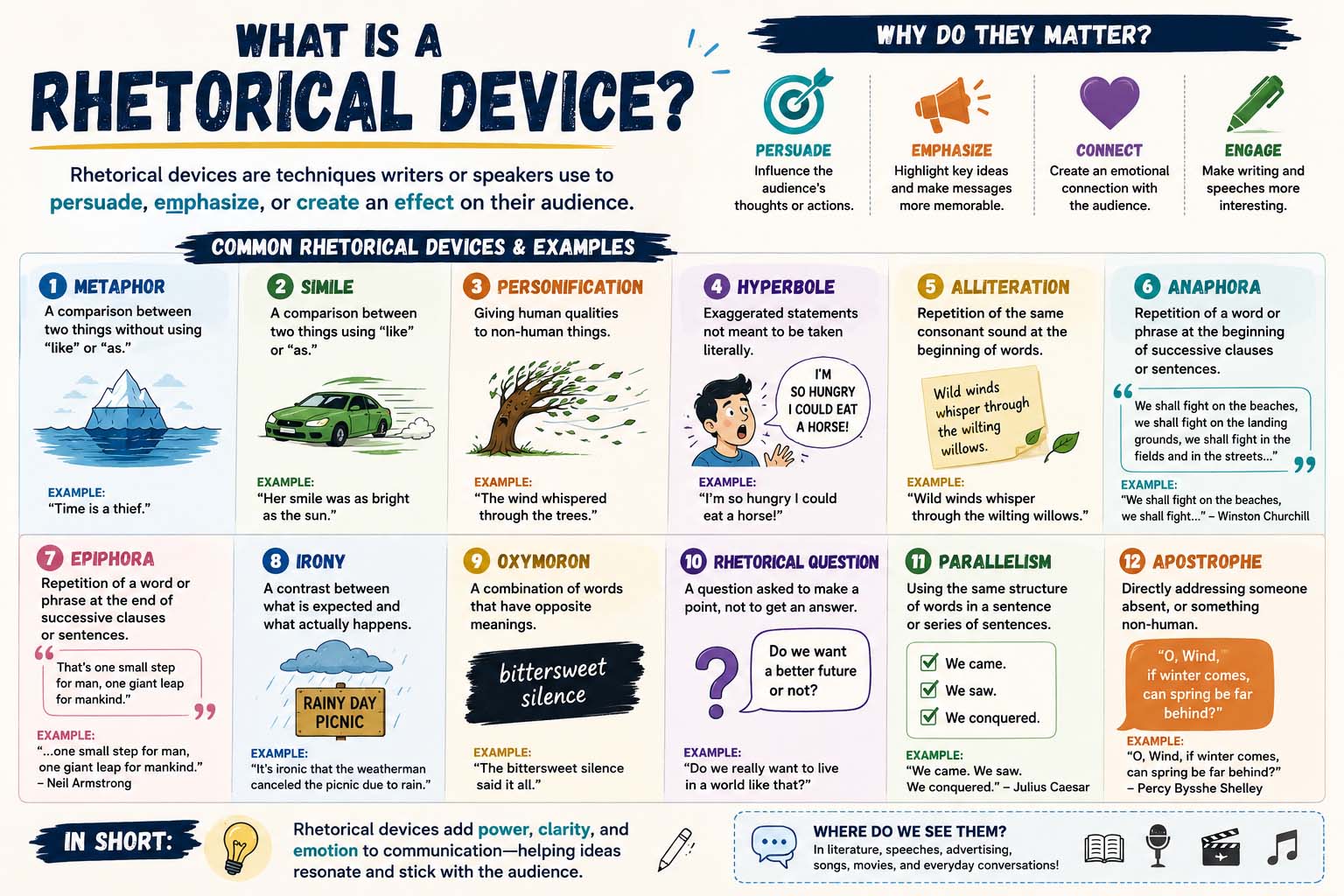
Have you ever read a line that stuck in your mind long after you finished the page? Often, a rhetorical device is the reason. So, what is a rhetorical device? It is a deliberate language technique that a writer or speaker uses to create an effect, such as emphasis, emotion or persuasion.
Common examples include metaphors, similes, repetition, rhetorical questions and alliteration. For example, read this line: “Can anyone really ignore the importance of education?” This is a rhetorical question. In fact, the speaker does not expect an answer. Instead, the question makes the audience think.
What Is a Rhetorical Device?
In simple terms, a rhetorical device is a purposeful choice of words, sounds, sentence patterns or comparisons. According to Merriam-Webster, rhetoric is the study of writing or speaking for communication or persuasion, and the named techniques give people a way to discuss it.
Also, these techniques appear in both speech and writing. Some create emotion, while others strengthen an argument or make a hard idea easier to picture. As a result, they make communication clearer and easier to remember.
What Is a Rhetorical Device in Writing?
In writing, a rhetorical device helps a writer hold attention and share ideas more effectively. For example, a writer may use repetition to stress a point or a metaphor to explain an abstract idea.
Read this line: “Never give up. Never stop learning. Never stop improving.” The repeated word “never” adds emphasis and gives the statement a determined tone.
Also, writers can combine these techniques with other methods, such as a strong hook in an essay. As a result, academic writing becomes more engaging without changing the main idea.
What Is a Rhetorical Device in Literature?
In literature, authors also use these techniques to build characters, show emotion, create images and express themes. For example, poets and novelists often use metaphors to help readers see an idea from a new angle.
One famous example is the line “All the world’s a stage”, from Shakespeare’s As You Like It. In other words, this metaphor compares the world to a stage. Therefore, readers think of life as a performance in which people play different roles.
Overall, for students, spotting these techniques makes literary analysis easier and more meaningful.
Common Rhetorical Device Examples at a Glance
Use this table for a quick review.
| Device | What it does | Example |
|---|---|---|
| Metaphor | Compares two things directly | Time is a thief. |
| Simile | Compares using “like” or “as” | She runs like the wind. |
| Repetition | Repeats words or patterns for emphasis | Work hard, think hard and study hard. |
| Rhetorical question | Makes the audience think | Who wouldn’t want to succeed? |
| Alliteration | Repeats beginning consonant sounds | Peter Piper picked peppers. |
Rhetorical Device Examples Explained
Metaphor
In short, a metaphor uses one thing in place of another to make a comparison. For example, “Time is a thief” suggests that time takes valuable moments away from us. Therefore, the metaphor makes an abstract idea easier to imagine.
Simile
By contrast, a simile compares two unlike things, often with “like” or “as.” In “She runs like the wind,” the writer compares the runner’s speed to the wind. As a result, the reader gets a clearer, more vivid picture.
Repetition
Likewise, repetition means using a word, phrase, sound or sentence pattern more than once on purpose. For example, “Work hard, think hard and study hard” repeats a pattern, so it is easy to remember. In persuasive writing, repetition can also reinforce the main message.
Rhetorical Question
Next, a rhetorical question is asked to prompt thought, not to get a direct answer. For example, “Who wouldn’t want to succeed?” points to the obvious appeal of success. As a result, the speaker’s point feels more direct.
Alliteration
Finally, alliteration repeats the same beginning consonant sounds in nearby words. For example, in “Peter Piper picked peppers,” the repeated “p” sound gives the line a rhythm that is easy to remember.
More Examples to Learn
Besides the five above, several other devices are worth learning. The definitions below follow Merriam-Webster:
- Anaphora: repeating a word or expression at the start of successive phrases or sentences.
- Epistrophe: repeating a word or expression at the end of successive phrases or sentences, as in “of the people, by the people, for the people.”
- Hyperbole: extravagant exaggeration, such as “mile-high ice-cream cones.”
- Oxymoron: a combination of contradictory words, such as “cruel kindness.”
- Onomatopoeia: a word that imitates a sound, such as “buzz.”
How to Identify a Rhetorical Device Step by Step
Many students find this hard at first. Fortunately, a simple process helps.
- First, read the passage carefully, and notice unusual wording, repeated phrases, questions and emotional language.
- Next, check for comparisons. If the comparison uses “like” or “as,” it may be a simile. However, if it states the comparison directly, it may be a metaphor.
- Then look for repetition of words, sounds, patterns or ideas.
- After that, ask why the writer used the device. Does it persuade, create emotion, stress an idea or build an image?
- Finally, explain the effect on the reader or listener.
For example, here is a short analysis. Device: repetition. Example: “We will work, we will learn, we will succeed.” Effect: the repetition adds emphasis and a confident, motivating tone.
This last step matters most in school assignments, because simply naming a device does not explain how it works. Instead, describe its purpose and effect in the passage.
Why a Rhetorical Device Matters in Everyday Life
Rhetorical devices are not limited to books and classrooms. In fact, you meet them in advertisements, speeches, movies, songs and social media. For example, the slogan “Just do it” is short and direct, so it carries a strong motivating message. Similarly, song lyrics often use metaphor, repetition and imagery to express feelings.
In addition, speakers and writers choose devices to suit their audience and purpose. For instance, the Purdue Online Writing Lab lists five elements of any rhetorical situation: the text, the author, the audience, the purposes and the setting. Therefore, a device works best when it fits all five.
Knowing this also connects to lessons on rhetorical choices examples, which show how authors make deliberate decisions for an audience.
Tips for Learning Devices
- First, read many kinds of text, including books, poems, speeches, articles and advertisements.
- Next, make flashcards with the device on one side and its definition and example on the other.
- Then write your own examples, such as a metaphor about school or a simile about friendship.
- Finally, focus on the purpose of each device, not just its definition.
Also, good paragraphs give your devices a clear place to work. For example, these topic sentence examples show how to open a paragraph well. Likewise, knowing the basics of text structure shows how a writer organizes ideas around those devices.
Common Mistakes Students Make
- Confusing devices with basic grammar rules.
- Naming a device without explaining its effect.
- Using too many devices in your own essay.
- Choosing a device just to sound impressive.
First, remember that devices are deliberate choices, while grammar rules are conventions. Also, “This is a metaphor” is not enough for an analysis, so explain what the metaphor compares and why it matters. Finally, use a device only when it strengthens your meaning, tone or argument, because too many can sound forced.
Frequently Asked Questions
What is a rhetorical device?
Simply put, it is a deliberate language technique used to persuade, stress an idea, create emotion or produce another specific effect.
What is a rhetorical device in writing?
In writing, a rhetorical device helps authors add clarity, emphasis, emotion, persuasion and memorability.
What is a rhetorical device in literature?
In literature, authors use devices to develop themes, create images, express emotions and suggest deeper meanings.
What are the most common rhetorical devices?
For example, common ones are metaphors, similes, repetition, rhetorical questions and alliteration.
How can I identify a rhetorical device?
First, look for unusual wording, comparisons, repetition, questions, sound patterns and emotional language. Then ask why the writer used the technique and what effect it has.
Are rhetorical devices used only in literature?
No. They also appear in speeches, advertisements, movies, conversations, social media and music.
Key Takeaways on What Is a Rhetorical Device
Overall, understanding what a rhetorical device is helps you read, write and speak with more skill. In addition, these techniques help writers build stronger arguments, clearer messages and memorable lines. Moreover, spotting them helps students become better readers and critical thinkers.
Next time you meet a metaphor in a poem, repetition in a speech or a rhetorical question in an advertisement, ask one question: why did the writer use this technique? As a result, you will understand how language influences an audience.