Have you ever wondered why some people are unemployed even when businesses are hiring? The answer is that unemployment isn’t caused by a single problem. Economists classify joblessness into different categories to explain why people are out of work. Learning the 4 types of unemployment helps students understand how labor markets function and why unemployment rates change over time.
Whether you’re preparing for an economics exam or simply want to understand current economic news, knowing these categories will make the topic much easier to follow. Each type has different causes, affects the economy in different ways, and often requires different solutions.
What Is Unemployment?
Unemployment occurs when people who are willing and able to work cannot find a job despite actively looking for employment.
Economists usually measure unemployment by calculating the percentage of the labor force that is unemployed but actively seeking work. People who are retired, full-time students who are not looking for work, or those who have stopped searching for jobs are generally not counted in the official unemployment rate.
Understanding unemployment is essential because it reflects the overall health of an economy. High unemployment can reduce consumer spending, slow business growth, and lower national income.
Before exploring what are the 4 types of unemployment, it’s helpful to understand that no economy completely eliminates unemployment. Even strong economies always have some workers moving between jobs or changing careers.
What Are the 4 Types of Unemployment?
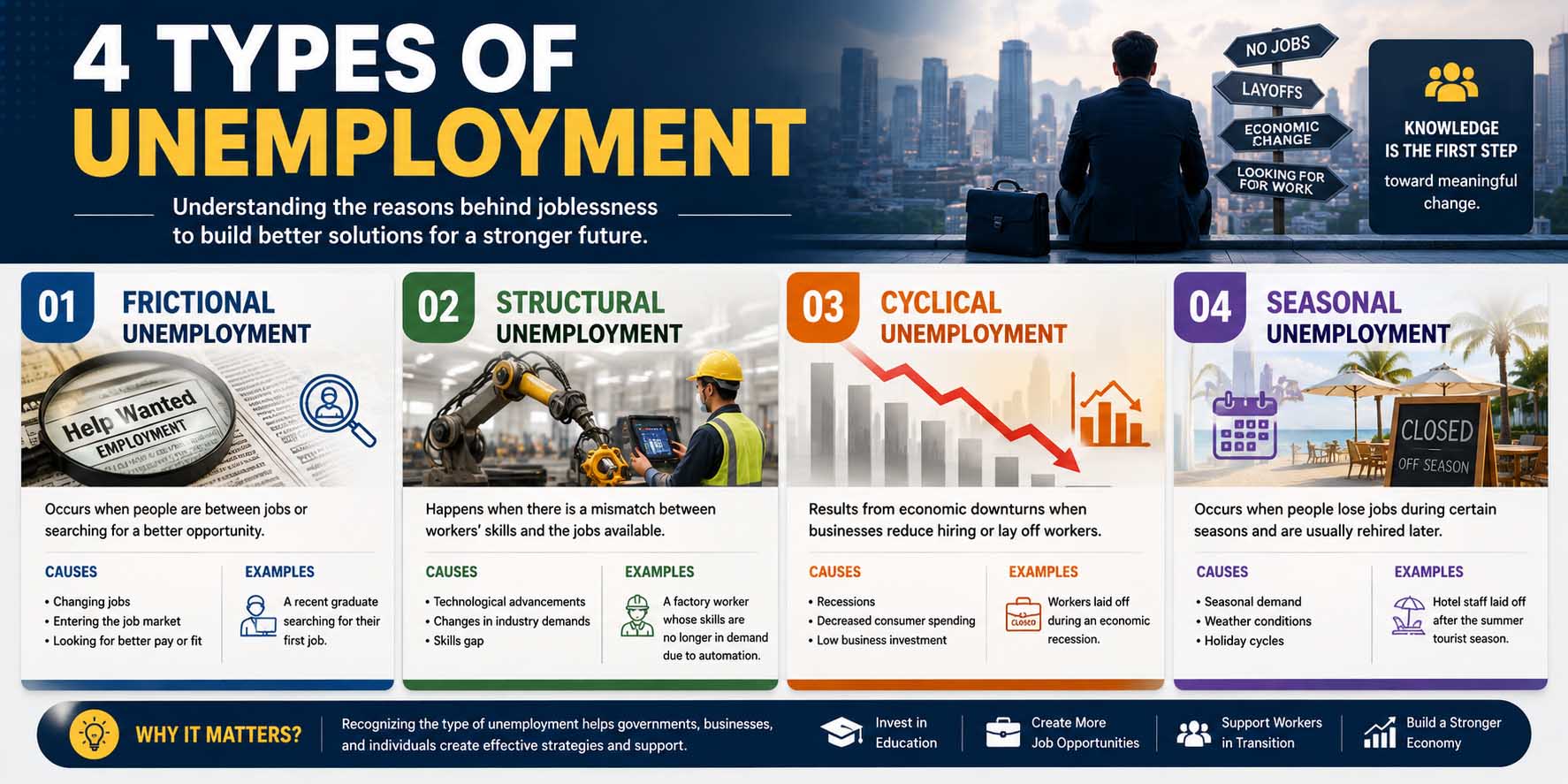
When students ask, “What are the 4 types of unemployment?”, economists usually identify these four categories:
- Frictional unemployment
- Structural unemployment
- Cyclical unemployment
- Seasonal unemployment
Each type has different causes, lasts for different lengths of time, and responds to different economic conditions.
Quick Comparison of the 4 Types of Unemployment
| Type | Main Cause | Usually Temporary? | Example |
|---|---|---|---|
| Frictional | Workers changing jobs | Yes | A graduate searching for their first job |
| Structural | Skills no longer match available jobs | Often longer-term | Factory workers replaced by automation |
| Cyclical | Economic downturns | Usually depends on the economy | Layoffs during a recession |
| Seasonal | Seasonal demand changes | Yes | Ski resort employees during summer |
This table provides a quick overview before examining each category in more detail.
4 Types of Unemployment Economics: Why They Matter
In 4 types of unemployment economics, understanding the cause of unemployment is just as important as measuring it.
For example, unemployment caused by a recession requires different solutions than unemployment caused by changing technology or seasonal business cycles.
Governments, businesses, and economists study unemployment to make better policy decisions, improve workforce planning, and support economic growth.
Students who already understand What Is a Business often find unemployment easier to understand because hiring decisions depend heavily on business performance and labor demand.
Frictional Unemployment
This is generally considered the most natural type of unemployment because people regularly:
- Graduate from school
- Move to a new city
- Change careers
- Leave one employer for another
- Re-enter the workforce after a break
During these transitions, workers may spend several weeks or months searching for the right opportunity.
Example of Frictional Unemployment
Imagine a university graduate earning a business degree.
After graduation, they begin applying for marketing positions. Although several companies are hiring, finding the right role takes two months.
During this period, the graduate is frictionally unemployed.
This type of unemployment doesn’t usually indicate a weak economy. Instead, it reflects the normal movement of workers between jobs.
Why Frictional Unemployment Can Be Healthy
A small amount of frictional unemployment is actually a positive sign.
It means workers are taking time to find positions that better match their skills, interests, and career goals rather than accepting the first available job.
Over time, better job matches can improve productivity for both employees and employers.
Structural Unemployment
Structural unemployment occurs when workers’ skills no longer match the jobs available in the economy.
Unlike frictional unemployment, this problem often lasts longer because workers may need new education, training, or experience before finding another job.
Technology, automation, changing consumer preferences, and globalization are common causes.
Example of Structural Unemployment
Suppose a manufacturing company replaces several manual production lines with advanced robotics.
Employees who previously performed those tasks may lose their jobs because the company now needs workers with technical skills to operate and maintain automated equipment.
Without additional training, these workers may remain unemployed for an extended period.
Common Causes of Structural Unemployment
Several factors contribute to structural unemployment, including:
- Automation
- Artificial intelligence
- Industry decline
- New technologies
- Changes in consumer demand
- Business relocation
- Global competition
These changes reshape labor markets over time.
Students studying nature of business often notice that businesses constantly adapt to changing markets, which can create new jobs while making others less common.
How Governments Reduce Structural Unemployment
Structural unemployment often requires long-term solutions rather than short-term financial assistance.
Governments and educational institutions may support workers through:
- Job retraining programs
- Technical education
- Career counseling
- Apprenticeships
- Workforce development initiatives
These programs help workers develop skills that match current labor market demands.
Economic policies also influence employment opportunities. For example, some supply side policies encourage businesses to invest, expand operations, and create new jobs, which may help reduce certain forms of unemployment over time.
Comparing Frictional and Structural Unemployment
Although these two categories sometimes seem similar, they differ in several important ways.
| Feature | Frictional Unemployment | Structural Unemployment |
|---|---|---|
| Main Cause | Job transitions | Skills mismatch |
| Duration | Usually short-term | Often longer-term |
| Worker Skills | Still in demand | May require retraining |
| Typical Solution | Job searching | Education and reskilling |
| Economic Health | Can occur in strong economies | Often linked to economic or technological change |
Understanding these differences is essential because exam questions often ask students to distinguish between the two.
Study Tips for Remembering the First Two Types
Many students confuse frictional and structural unemployment. A simple memory trick can help.
- Frictional = Finding a new job. Think of the “F” in both words.
- Structural = Skills no longer fit the job market. Think about changes in the structure of the economy.
Creating your own examples also makes these concepts easier to remember during exams.
For instance, a recent graduate searching for work represents frictional unemployment, while a worker whose industry has been transformed by automation represents structural unemployment.
Cyclical Unemployment
Cyclical unemployment happens when the economy slows down.
During an economic downturn or recession, businesses often experience lower sales. As revenue falls, some companies reduce production, delay expansion plans, or lay off employees to lower costs.
Unlike frictional unemployment, cyclical unemployment is closely tied to the overall performance of the economy.
Example of Cyclical Unemployment
Imagine a furniture manufacturer that sells fewer products during a recession. Since customer demand has dropped, the company temporarily closes one production line and lays off part of its workforce.
Those employees are experiencing cyclical unemployment because the lack of jobs is caused by weaker economic activity rather than a mismatch of skills.
How the Economy Affects Cyclical Unemployment
When the economy begins to recover:
- Consumer spending increases.
- Businesses receive more orders.
- Companies expand production.
- Employers begin hiring again.
As a result, cyclical unemployment usually declines during periods of economic growth.
Business expansion can also be supported by factors such as External Economies of Scale, where improvements in infrastructure, skilled labor availability, or supplier networks make it easier for companies to grow and create jobs.
Seasonal Unemployment
Seasonal unemployment occurs when jobs are available only during certain times of the year.
Many industries depend on weather, tourism, holidays, or agricultural seasons. Workers in these industries may have regular periods without work before demand returns.
Example of Seasonal Unemployment
A ski resort hires hundreds of employees during the winter season.
Once winter ends, many of those workers leave their jobs because customer demand falls sharply until the following season.
Other examples include:
- Lifeguards during summer
- Holiday retail staff
- Farm workers during harvest
- Tax preparers during tax season
- Tour guides in popular vacation destinations
Seasonal unemployment is expected in industries with predictable demand changes throughout the year.
Comparing All Four Types of Unemployment
The easiest way to remember the 4 types of unemployment is to focus on what causes each one.
| Type | Main Reason | Example |
|---|---|---|
| Frictional | Looking for a new job | Recent graduate applying for positions |
| Structural | Skills no longer match available jobs | Factory worker replaced by automation |
| Cyclical | Economic slowdown | Retail employee laid off during a recession |
| Seasonal | Time of year affects demand | Ski instructor working only in winter |
Rather than memorizing definitions alone, try connecting each type to a real-life situation.
Why Understanding Unemployment Matters
Learning about unemployment isn’t only useful for economics exams.
It also helps explain:
- Government economic policies
- News about recessions
- Hiring trends
- Career planning
- Business decision-making
For example, someone considering different types of entrepreneurship should understand how economic conditions can influence hiring, customer demand, and business growth.
Recognizing these relationships helps students connect classroom concepts with real-world events.
Common Mistakes Students Make
Many students lose marks because they confuse the different categories of unemployment.
Here are a few common errors.
Mixing Up Frictional and Structural Unemployment
Remember:
- Frictional unemployment involves workers changing jobs.
- Structural unemployment involves workers whose skills no longer match available jobs.
The key difference is whether retraining is needed.
Assuming All Unemployment Is Negative
Not every form of unemployment signals economic trouble.
Frictional unemployment is a normal part of a healthy labor market because people regularly search for better opportunities.
Forgetting That Causes Matter
When answering exam questions, always explain why unemployment exists.
The cause determines which type of unemployment is being described.
A Simple Study Framework
If you’re preparing for a quiz or exam, use this four-step method.
Step 1: Learn the Definitions
Understand each type in your own words instead of memorizing textbook sentences.
Step 2: Create One Example for Each Type
Personal examples are easier to remember than abstract definitions.
For example:
- Frictional: A graduate looking for their first job.
- Structural: A cashier replaced by self-checkout technology.
- Cyclical: A hotel reducing staff during a recession.
- Seasonal: A beach lifeguard working only in summer.
Step 3: Compare the Causes
Ask yourself one question:
Why is the person unemployed?
That answer usually identifies the correct category.
Step 4: Practice with Real News
When reading business or economic news, try identifying which type of unemployment is being discussed.
This habit strengthens both your understanding and your exam confidence.
Frequently Asked Questions
What are the 4 types of unemployment?
The four main types are:
- Frictional unemployment
- Structural unemployment
- Cyclical unemployment
- Seasonal unemployment
Each has different causes and requires different solutions.
Which type is most common?
There isn’t one answer for every country.
During stable economic periods, frictional unemployment is common because people naturally change jobs.
During recessions, cyclical unemployment usually increases.
Which type lasts the longest?
Structural unemployment often lasts longer because workers may need education or training before finding new employment.
Is seasonal unemployment always expected?
Yes. Industries such as tourism, agriculture, and holiday retail often experience predictable hiring patterns every year.
Why do economists separate unemployment into different types?
Different causes require different responses.
For example, a recession may require economic stimulus, while structural unemployment is often addressed through education, workforce training, and job placement programs.
Key Takeaways for Students
Understanding the 4 types of unemployment gives you a stronger foundation in economics and helps you make sense of employment trends discussed in the news.
Instead of memorizing definitions, focus on the reason someone is unemployed. Ask yourself whether they’re between jobs, missing the right skills, affected by an economic downturn, or working in a seasonal industry. Once you identify the cause, choosing the correct category becomes much easier.
As you continue studying economics, connect unemployment to broader topics like business growth, government policy, and labor markets. Building these connections will improve your understanding and make exam questions easier to answer.