
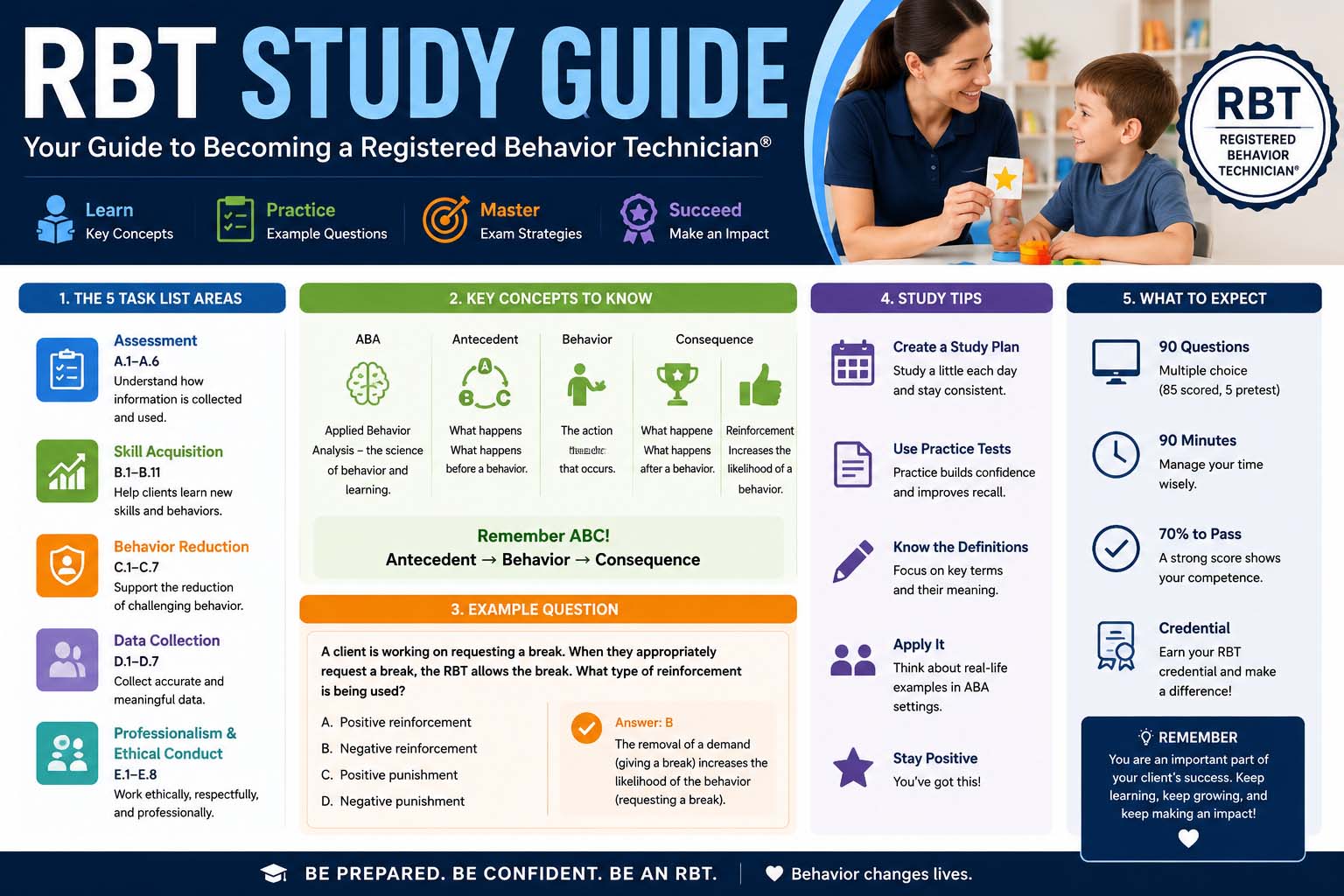
First, becoming a Registered Behavior Technician (RBT) is an important step for individuals interested in applied behavior analysis (ABA) and supporting people with developmental and behavioral needs. Indeed, whether you are preparing for training, the competency assessment, or the certification exam, having a reliable RBT study guide can help improve your understanding and confidence.
Overall, the RBT credential demonstrates knowledge of behavior analysis principles and practical skills used under the supervision of qualified professionals. Because the certification process includes both an assessment and an examination, proper preparation is essential.
In this guide, you will find key concepts, study strategies, competency assessment expectations, and practical tips to help you prepare successfully.
What Is an RBT?
Simply put, a Registered Behavior Technician is a paraprofessional who helps deliver behavior-analytic services to clients. According to the Behavior Analyst Certification Board (BACB), RBTs work under the direction and close supervision of a qualified supervisor.
In practice, RBTs commonly assist with behavior intervention programs, data collection, skill development activities, client support, and behavioral observations.
Also, many RBTs work in schools, clinics, homes, healthcare settings, and autism support programs. As a result, the certification helps demonstrate foundational knowledge in applied behavior analysis.
Why Use an RBT Study Guide?
First, an organized RBT study guide helps learners focus on the most important concepts tested during certification.
In addition, a good study guide offers structured learning, better information retention, increased confidence, improved exam readiness, and a stronger understanding of ABA principles.
Moreover, students who study consistently often perform better than those who rely solely on last-minute preparation. For that reason, learning how to create a study guide can also help organize certification topics more effectively.
Understanding the RBT Certification Process
Before beginning exam preparation, it is important to understand the certification pathway.
First, you complete the required 40-hour training. Second, you pass the competency assessment. Third, you apply for examination eligibility through your BACB account. Fourth, you pass the certification exam. Finally, you begin working under supervision.
Also, since January 1, 2026, the 40-hour training must follow the BACB’s 2026 curriculum. Therefore, always confirm the current requirements with the BACB before you start.
Overall, each step contributes to developing professional knowledge and practical skills.
RBT Exam Study Guide: Key Topics
First, a strong RBT exam study guide focuses on several major content areas.
Measurement and Data Collection: First, RBTs must understand how to collect and record data accurately. For example, common concepts include frequency recording, duration recording, interval recording, and data tracking systems. As a result, accurate data helps supervisors make informed decisions.
Assessment Support: Next, RBTs assist supervisors during assessments. In particular, responsibilities may include gathering information, observing behaviors, and recording results. Therefore, understanding the assessment process is essential for certification success.
Skill Acquisition: Then, RBTs teach new skills such as communication skills, academic skills, social skills, and daily living skills. Consequently, students should understand common teaching strategies used in ABA programs.
Behavior Reduction: Finally, behavior reduction focuses on decreasing challenging behaviors safely and ethically. For instance, topics often include antecedents, consequences, reinforcement strategies, and behavior intervention plans. Because these concepts are frequently tested, review them carefully.
RBT Competency Assessment Study Guide
Generally, the RBT competency assessment study guide portion of preparation focuses on practical demonstrations rather than written questions.
In other words, the competency assessment evaluates whether candidates can perform important RBT tasks correctly. Specifically, common assessment areas include professional conduct, data collection, skill implementation, and behavior intervention procedures.
First, candidates demonstrate ethical and professional behavior. Second, assessors evaluate data recording accuracy. Third, candidates show their ability to implement teaching procedures. Fourth, RBTs demonstrate appropriate responses to behavioral situations.
What to Expect During the Competency Assessment
Indeed, many students feel nervous about this step. However, preparation can significantly reduce anxiety.
For example, the assessment may require candidates to demonstrate skills, answer questions, explain procedures, and follow supervisor instructions. In short, the goal is to verify that candidates can perform essential tasks in realistic settings.
Therefore, practicing beforehand often improves confidence and performance.
RBT Competency Assessment Study Guide PDF Resources
In fact, many learners search for an RBT competency assessment study guide PDF to support their preparation.
While study materials vary, useful resources generally include task checklists, practice scenarios, data collection examples, terminology reviews, and competency outlines.
Above all, students should always use materials that align with current certification requirements and official guidance. Additionally, combining multiple study resources often provides the most complete preparation.
RBT Study Guide Free Resources
Of course, many candidates look for an RBT study guide free resource before purchasing study materials.
For example, helpful free study options include practice quizzes, flashcards, study groups, educational videos, and concept summaries.
However, while free resources can be valuable, they should complement—not replace—official training and professional guidance. Also, using multiple learning methods often improves retention.
Important ABA Concepts to Learn
Indeed, several ABA concepts appear frequently in training, assessments, and exams.
Positive Reinforcement: Simply