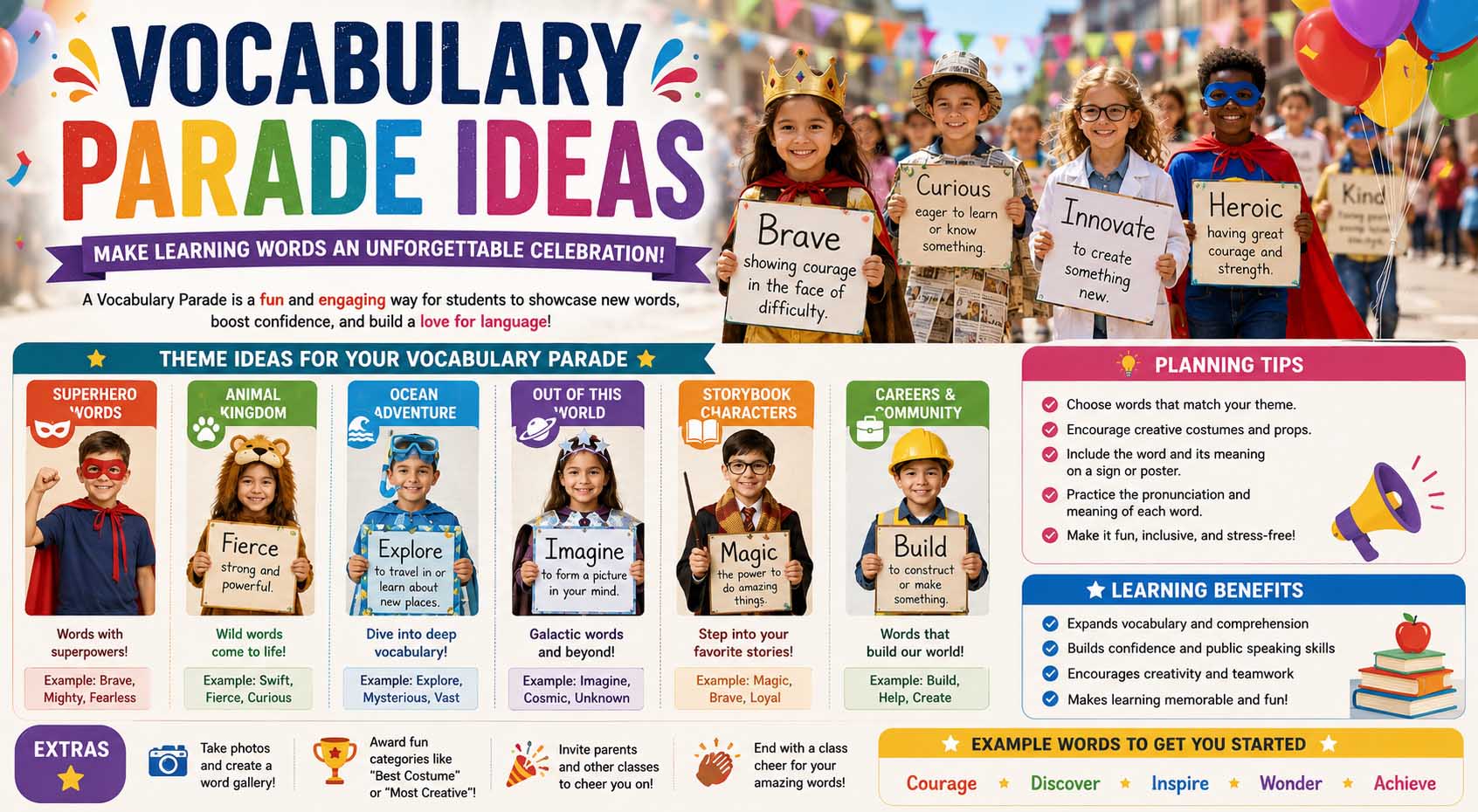
A vocabulary parade turns learning new words into something students can actually see, wear, and remember. Instead of simply memorizing definitions, students choose a word and create a costume that represents its meaning. The best vocabulary parade ideas do not need expensive supplies or complicated designs. A clever word, a few visual clues, and a clear word card can create a memorable costume while strengthening vocabulary skills.
Teachers can use vocabulary parades with elementary students, middle school learners, or even older classes by adjusting the difficulty of the words. Meanwhile, parents can help children create costumes from cardboard, paper, old clothes, craft supplies, and household items.
The real goal is not to create the fanciest outfit. Instead, students should understand their chosen word well enough to explain why every part of the costume represents its meaning.
What Is a Vocabulary Parade?
A vocabulary parade is a classroom or school activity in which students dress as vocabulary words.
For example, a student representing camouflage might wear clothing covered with leaves and green paper. Meanwhile, someone representing transparent could use clear plastic materials as visual clues.
Usually, students display the vocabulary word somewhere on their costume. They may also include its definition, synonyms, antonyms, or an example sentence.
As a result, the activity combines reading, speaking, creativity, and vocabulary development.
A parade can also encourage students to think about how words are constructed. For instance, learning What Is a Root Word? can help students recognize connections among related words and choose more meaningful vocabulary for their costumes.
Easy Vocabulary Parade Ideas for Students
Simple costumes often work best because students can clearly communicate the meaning without spending hours on construction.
Here are some easy vocabulary parade ideas that can be made with basic materials:
| Vocabulary Word | Simple Costume Idea | Meaning |
|---|---|---|
| Colorful | Attach many colored paper shapes to a shirt | Full of different colors |
| Fragile | Wear a sign saying “Handle With Care” | Easily broken or damaged |
| Nocturnal | Dress in dark colors with moon and star cutouts | Active mainly at night |
| Ancient | Dress like an old artifact or historical object | Very old |
| Gigantic | Carry oversized cardboard objects | Extremely large |
| Tiny | Attach miniature objects to clothing | Very small |
| Stormy | Add paper clouds, rain, and lightning | Having storm-like weather |
| Musical | Attach paper notes to a shirt | Related to music |
| Circular | Cover clothing with paper circles | Shaped like a circle |
| Reflective | Use safe reflective materials or mirror-like paper | Able to reflect light |
Students should still be able to move safely while wearing the costume. Therefore, avoid designs that block vision, drag along the floor, or contain sharp objects.
Vocabulary Parade Costume Ideas Using Household Materials
You do not need to buy a ready-made costume. In fact, homemade designs often encourage more thinking because students must decide how to represent an abstract word visually.
“Abundant”
Attach many copies of one lightweight item, such as paper leaves, stars, or circles, to an old shirt.
The large quantity demonstrates that abundant means existing in large amounts.
“Symmetrical”
Divide a shirt visually down the middle. Then, place matching shapes in the same positions on both sides.
This design gives students an immediate visual representation of symmetry.
“Illuminate”
Wear dark clothing covered with yellow paper light bulbs, stars, or safe battery-powered lights.
Then, place the word prominently across the front.
“Disorganized”
Attach paper labels, mismatched shapes, upside-down letters, and safely secured school-supply cutouts in an intentionally messy arrangement.
However, students should still explain the definition instead of relying entirely on the costume.
Activities like this also work well with types of context clues, since classmates can use the costume’s visual information to infer an unfamiliar word before hearing its definition.
Vocabulary Parade Ideas by Grade Level
The right vocabulary should match the student’s reading level.
A kindergarten student may learn more from a concrete word such as fuzzy, while an older student can successfully represent an abstract word such as contradictory.
Kindergarten and First Grade
Choose familiar words with meanings that are easy to visualize.
Good options include:
- Fuzzy
- Bright
- Tiny
- Loud
- Sleepy
- Round
- Spotted
- Happy
- Shiny
- Striped
For younger students, parents and teachers can help with cutting and attaching materials. Still, the child should understand the word and participate in creating the concept.
Early vocabulary activities can support broader literacy instruction as well. Teachers exploring how to teach phonics can connect spoken words, sounds, printed vocabulary, and classroom activities rather than treating each literacy skill as completely separate.
Second and Third Grade
At this stage, students can handle more descriptive words.
For example, try:
- Enormous
- Invisible
- Curious
- Precious
- Ancient
- Frigid
- Tropical
- Grumpy
- Delicate
- Vibrant
For frigid, for example, a student could wear winter clothing and paper snowflakes. Meanwhile, vibrant might use bright colors and energetic patterns.
Fourth and Fifth Grade
Older elementary students can work with more challenging concepts.
Possible words include:
- Extraordinary
- Elaborate
- Peculiar
- Optimistic
- Chaotic
- Transparent
- Radiant
- Suspicious
- Abundant
- Versatile
At this level, ask students to provide synonyms, antonyms, and example sentences along with the costume.
Creative Vocabulary Parade Costume Ideas
Students who want something more unusual can choose words that require interpretation rather than simply dressing as an object.
“Contradictory”
Divide the costume into opposing halves.
For example, one side could say “YES” while the other says “NO.” Another option is to use hot and cold imagery on opposite sides.
“Metamorphosis”
Create a costume that transitions from a caterpillar on one side to a butterfly on the other.
As a result, classmates get a strong visual clue that metamorphosis involves transformation.
“Multicolored”
Cover a plain shirt with strips or shapes in many colors.
Rather than simply creating a rainbow costume, the student can explain that the prefix “multi-” means many.
“Personification”
Students studying types of figurative language and examples can turn literary vocabulary into parade costumes. For personification, for instance, a student could create a smiling sun with arms and a speech bubble to show a nonhuman object receiving human characteristics.
“Unpredictable”
Create a costume where no two sections follow the same pattern. For example, use unexpected combinations of shapes, numbers, letters, and colors.
The randomness itself becomes part of the definition.
Science Vocabulary Parade Costume Ideas
A vocabulary parade can easily move beyond language arts.
Teachers can use science vocabulary parade costume ideas to review concepts from biology, earth science, physics, weather, or space.
“Photosynthesis”
Dress in green and attach a large paper leaf to the front.
Then, use arrows labeled sunlight, carbon dioxide, and water to represent some of the inputs involved in photosynthesis.
“Orbit”
Place a large sun symbol on the costume and attach a planet model or illustration showing a path around it.
However, keep any projecting pieces lightweight and safely secured.
“Evaporation”
Create blue water droplets near the bottom of a shirt and smaller droplets or arrows moving upward.
As a result, the costume can visually show liquid water becoming water vapor.
“Pollination”
Dress as a flower and add a lightweight bee cutout moving between flowers.
Then, explain how pollen can move from one flower to another.
“Magnetic”
Use paper drawings of magnets and metal objects instead of attaching actual heavy objects.
For instance, arrows can show attraction between the items.
Cross-curricular costumes help students recognize that vocabulary learning happens in every subject, not just English class.
Turn Word Parts Into Costume Clues
Students do not always need to represent the whole word with one picture. Instead, prefixes, suffixes, roots, and syllables can become parts of the costume.
For example, a student wearing multicolored could emphasize “multi” by showing many colors. Likewise, submarine could highlight “sub-” as meaning under or below.
Breaking longer words into types of syllables can also help younger learners pronounce and remember challenging vocabulary before presenting it during the parade.
This strategy works especially well when students must explain their costumes afterward. Instead of saying only, “My word means this,” they can explain how parts of the word provide clues to its meaning.
For teachers who want to strengthen the learning behind the activity, Reading Rockets provides practical guidance on vocabulary instruction, including approaches that help students develop word knowledge.
How to Make a Vocabulary Parade Costume Step by Step
First, choose a word that the student genuinely understands or can learn well.
Next, write a simple definition in the student’s own words. Then, brainstorm objects, colors, actions, shapes, and symbols associated with that definition.
After that, check what materials are already available at home or in the classroom. Useful supplies may include:
- Cardboard
- Construction paper
- Markers
- Felt
- Old T-shirts
- String or ribbon
- Paper plates
- Recyclable boxes
- Aluminum foil
- Fabric scraps
- Safe tape or glue
Then, create one or two strong visual clues rather than covering the costume with unrelated decorations.
Finally, make the vocabulary word large enough for classmates and teachers to read.
Before parade day, the student should practice saying the word, definition, and a sentence using it correctly.
Easy Vocabulary Parade Costume Ideas for Last-Minute Projects
Sometimes students remember the assignment the evening before the parade. Fortunately, a simple costume can still communicate a word effectively.
For polka-dotted, attach paper circles to a plain shirt.
For geometric, add paper triangles, squares, circles, and rectangles.
Meanwhile, temporary can be represented with removable sticky notes or paper pieces labeled “Here Today, Gone Tomorrow.”
These costumes work because the concept is clear. Therefore, complicated construction is unnecessary.
Making the Parade an Actual Learning Activity
A costume parade becomes much more educational when students interact with the words.
For example, teachers can give each student a vocabulary observation sheet. As classmates walk past, learners can record unfamiliar words and predict their meanings based on costume clues.
Afterward, students can compare their guesses with the actual definitions.
Another option is a synonym challenge. In this activity, each student must find another parade word with a similar meaning to their own.
Teachers can also ask students to write a short paragraph using three or four words they saw during the parade.
As a result, the activity continues building vocabulary even after the costumes come off.
Common Vocabulary Parade Mistakes
The most common mistake is choosing an object instead of a vocabulary concept.
For example, simply dressing as a cat may not provide much vocabulary learning. However, representing nocturnal with a cat, owl, moon, and nighttime imagery focuses attention on a descriptive word.
Another mistake is creating an impressive costume without learning the definition. Therefore, students should be able to explain their word confidently.
Likewise, avoid costumes that depend entirely on expensive store-bought clothing. Instead, focus on translating the word’s meaning into clear visual clues.
Finally, keep safety in mind. Costumes should allow students to walk, sit, see, and use stairs normally.
Vocabulary Parade Ideas FAQs
What Are Good Words for a Vocabulary Parade?
Good words are easy enough for the student to understand but interesting enough to represent visually. For example, descriptive words such as vibrant, enormous, transparent, nocturnal, symmetrical, and chaotic work especially well.
What Is the Easiest Vocabulary Parade Costume?
Words with obvious visual characteristics are usually easiest. For instance, colorful, striped, tiny, gigantic, circular, spotted, and shiny can all be created with basic craft materials.
Can a Vocabulary Parade Include Science Words?
Yes. For example, words such as photosynthesis, orbit, evaporation, pollination, habitat, magnetic, and metamorphosis can turn the parade into a cross-curricular learning activity.
Does the Vocabulary Word Need to Appear on the Costume?
That depends on the teacher’s instructions. However, displaying the word prominently usually helps classmates connect the visual clues with its spelling and meaning.
What Should Students Say During the Parade?
A simple presentation can include the word, its definition, and one example sentence. In addition, older students can explain synonyms, antonyms, word parts, or why they designed the costume in a particular way.
How Can Teachers Make a Vocabulary Parade More Challenging?
For example, teachers can assign grade-level academic words, require students to explain roots or affixes, or have classmates infer definitions before they are revealed.
Make the Word the Star of the Costume
The strongest vocabulary parade ideas start with meaning rather than decoration. First, choose a word the student can understand. Then, turn its definition into a few clear visual clues and build the costume from simple materials.
Meanwhile, teachers can extend the activity with definition cards, context-clue games, example sentences, and word-part challenges. That way, the parade becomes more than a fun dress-up day.
Whether a student chooses a simple word such as fuzzy or a challenging one such as metamorphosis, the same principle applies: if the costume helps classmates understand and remember the word, it has done its job.