
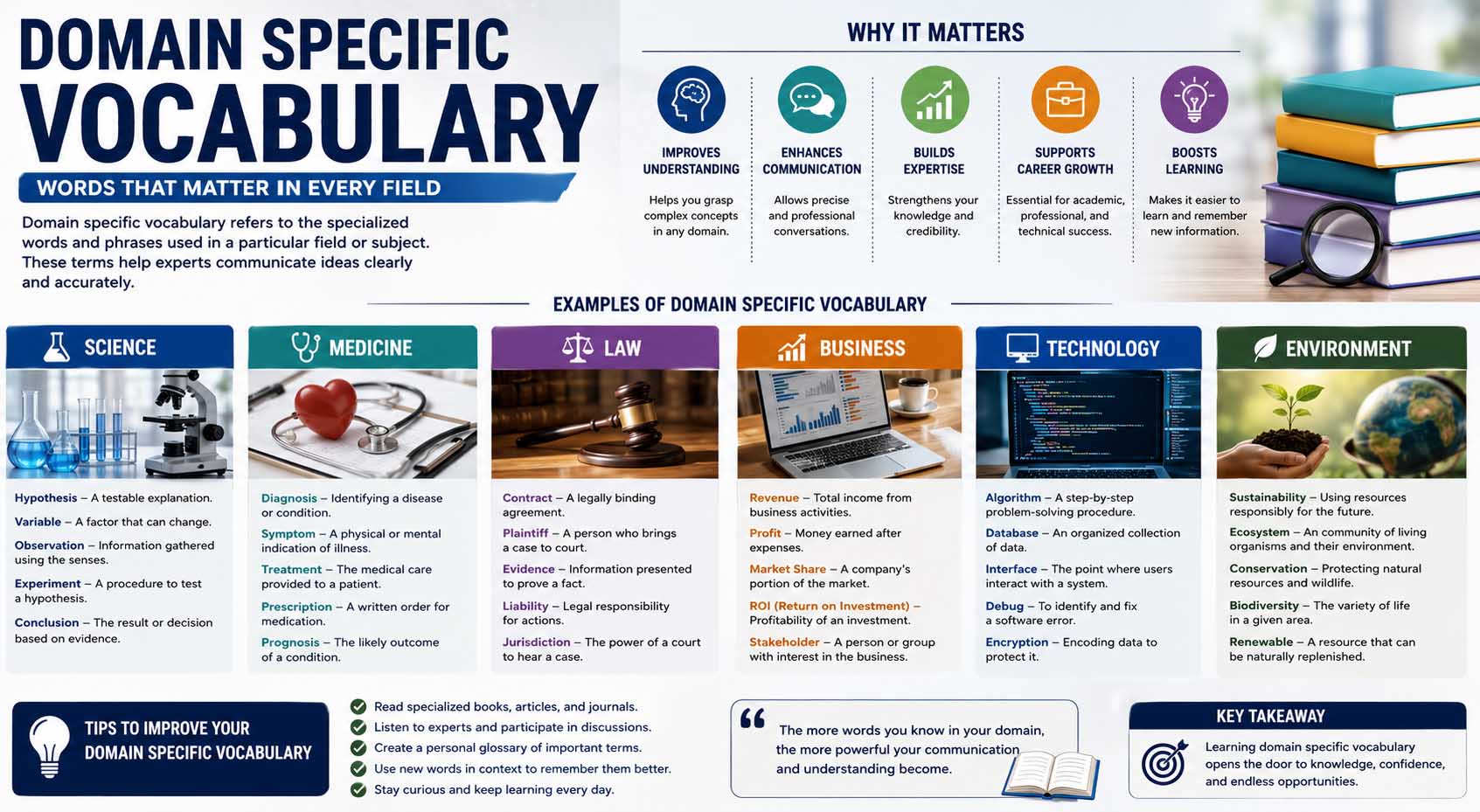
Have you ever opened a science textbook and found words such as photosynthesis, mitochondria, or ecosystem that you rarely hear in everyday conversations? These terms are examples of domain specific vocabulary—words and phrases that have specialized meanings within a particular subject, profession, or field of study. Understanding them helps students read textbooks more confidently, follow lessons, discuss academic ideas, and explain what they have learned.
At first, specialized vocabulary can make a new topic seem harder than it really is. However, once students learn how these words work, unfamiliar passages become easier to understand. Better yet, students can use several simple strategies to figure out new terms instead of memorizing every definition without context.
What Is Domain Specific Vocabulary?
If you are wondering what is domain specific vocabulary, the simplest answer is vocabulary closely connected to a particular subject or area of knowledge.
For example, fraction, denominator, and quadrilateral belong to mathematics. Meanwhile, habitat, organism, and photosynthesis belong to science.
A student may understand everyday English perfectly but still need to learn the specialized language used in a biology, economics, geography, or computer science class.
Therefore, a useful domain specific vocabulary definition is:
Words or phrases that have specialized meanings and are mainly used within a particular academic subject, profession, industry, or field.
The word “domain” simply refers to an area of knowledge. Consequently, each domain develops vocabulary that allows people to communicate ideas accurately.
Domain-Specific Vocabulary vs. Everyday Vocabulary
Not every difficult word is domain-specific.
Everyday vocabulary includes words people commonly use across many situations, such as happy, house, friend, and walk. Academic vocabulary includes words that appear across different school subjects, such as analyze, compare, interpret, and evaluate.
Domain-specific vocabulary, however, is tied more closely to a particular field.
Here is a quick comparison:
| Vocabulary Type | Examples | Where It Is Used |
|---|---|---|
| Everyday vocabulary | house, walk, food | Daily conversations |
| General academic vocabulary | analyze, compare, evaluate | Many school subjects |
| Domain-specific vocabulary | numerator, photosynthesis, legislature | Particular subjects or fields |
The boundaries are not always perfect. For instance, some specialized words eventually become familiar to the general public. Still, asking whether a word has a precise meaning within a particular field is a useful way to identify domain-specific language.
Examples of Domain Specific Vocabulary by Subject
The easiest way to understand the concept is to look at different school subjects.
Science Vocabulary
Science uses many specialized terms because scientists need precise language to describe processes, structures, measurements, and relationships.
Examples include:
- Photosynthesis
- Mitochondria
- Ecosystem
- Evaporation
- Molecule
- Gravity
- Velocity
- Cell membrane
For example, photosynthesis does not simply mean that a plant grows. Instead, it describes a specific biological process in which light energy helps produce chemical energy from carbon dioxide and water.
That precision makes specialized vocabulary useful rather than unnecessarily complicated.
Mathematics Vocabulary
Math also has a large collection of subject-specific terms.
Examples include:
- Numerator
- Denominator
- Hypotenuse
- Integer
- Coefficient
- Parallel
- Quadrilateral
- Probability
A word such as coefficient carries a specific mathematical meaning. Therefore, students need more than a general sense of the word to solve problems correctly.
Language Arts Vocabulary
English and literature classes have their own specialized terminology.
Examples include:
- Metaphor
- Alliteration
- Protagonist
- Foreshadowing
- Stanza
- Narrator
- Personification
- Theme
Although students may encounter some of these terms outside school, their precise academic meanings help readers analyze texts.
Learning the types of context clues can also help students work out unfamiliar vocabulary when a sentence or surrounding paragraph provides hints about meaning.
History and Social Studies Vocabulary
History, civics, economics, and geography introduce another set of specialized terms.
Examples include:
- Democracy
- Legislature
- Constitution
- Industrialization
- Inflation
- Migration
- Sovereignty
- Urbanization
These words often represent large ideas rather than physical objects. As a result, students usually understand them better when teachers connect definitions with historical events or real-world examples.
Technology Vocabulary
Technology has become a particularly vocabulary-heavy field because new systems and concepts regularly introduce new terminology.
Examples include:
- Algorithm
- Database
- Encryption
- Bandwidth
- Processor
- Operating system
- Cloud computing
- Programming language
Someone beginning computer science may recognize the word cloud, for instance, yet its technological meaning differs from its everyday weather-related meaning.
Why Domain Specific Vocabulary Matters in Reading
Students do not learn specialized words simply to pass vocabulary quizzes.
Instead, these terms unlock the meaning of academic texts.
Imagine reading a paragraph explaining how cells create energy while not understanding words such as mitochondria, glucose, or cellular respiration. Even if every connecting word makes sense, the central idea may remain unclear.
As a result, vocabulary knowledge directly affects comprehension.
This connection also explains why vocabulary is included when educators discuss the 5 pillars of reading alongside other foundational reading skills. As readers progress into more advanced subjects, vocabulary becomes especially valuable because textbooks increasingly assume knowledge of subject-specific terminology.
Still, knowing a definition alone is not always enough. Students should understand how a term works inside the subject.
For example, memorizing “denominator = bottom number” may help temporarily. However, understanding what a denominator represents within a fraction provides much stronger mathematical knowledge.
For broader guidance on helping students build word knowledge, Reading Rockets explains practical approaches to vocabulary instruction.
How to Identify Domain Specific Vocabulary in a Text
Students can learn to recognize specialized words instead of waiting for teachers to point them out.
Look for Words Repeated Throughout a Chapter
If an unfamiliar term appears repeatedly in a textbook chapter, it may be central to the topic.
For example, a biology chapter may repeatedly use organism, habitat, population, and ecosystem.
Repeated terms deserve attention because understanding them may unlock several paragraphs at once.
Notice Bold or Italicized Terms
Textbooks often highlight key vocabulary with bold print, italics, sidebars, or vocabulary boxes.
Therefore, scan the page before reading closely. Identifying these terms early gives you a preview of the concepts the chapter will explain.
Check Captions and Diagrams
Specialized vocabulary often appears beside diagrams, maps, charts, and illustrations.
A labeled diagram can make a difficult term easier to understand because it connects the word with a visual example.
Ask Whether the Word Has a Specialized Meaning
Some domain-specific words look completely ordinary.
For instance, cell can refer to a small room, a mobile phone, or the basic structural unit of living organisms.
Therefore, context determines which meaning applies.
Using Word Parts to Understand Specialized Terms
Long academic terms become less intimidating when students recognize meaningful word parts.
Prefixes, roots, and suffixes can provide useful clues.
For example, consider biology:
- bio relates to life.
- -logy relates to study.
Therefore, understanding common roots can make unfamiliar academic vocabulary easier to approach.
Students asking What Is a Root Word? can benefit from learning that roots often carry the central meaning of a larger word, while prefixes and suffixes modify that meaning.
Consider photosynthesis. The element photo- relates to light, which provides a clue about the concept before the student learns the complete scientific definition.
Word-part analysis will not explain every unfamiliar term. Still, it gives learners another strategy besides immediately reaching for a dictionary.
Domain Specific Vocabulary and Decoding
Vocabulary knowledge and word reading are related, but they are not identical skills.
Decoding in reading refers to using knowledge of letters, sounds, and spelling patterns to read written words. A student might successfully pronounce evaporation without actually knowing what evaporation means.
Likewise, a learner may understand a word when hearing it but struggle to recognize it in print.
Therefore, students benefit from practicing both pronunciation and meaning when learning specialized vocabulary.
For instance, say the word aloud, break it into manageable parts, read it inside a sentence, and then explain the concept in your own words.
That combination builds stronger understanding than copying a definition several times.
How to Learn Domain Specific Vocabulary Faster
Memorizing a long list the night before a test is rarely the most effective approach. Instead, spread vocabulary practice across several short study sessions.
Create a Vocabulary Notebook
Divide each entry into four parts:
- Term
- Student-friendly definition
- Example
- Picture, diagram, or memory clue
For ecosystem, for instance, a student might write a simple definition and then sketch a pond containing plants, animals, water, and sunlight.
As a result, the visual connection can make the concept easier to recall.
Use the Word in Context
After learning a definition, write an original sentence that demonstrates the meaning.
For example:
“The pond ecosystem includes fish, plants, insects, water, microorganisms, and other interacting components.”
A meaningful sentence shows whether you truly understand the term.
Explain It Without Looking
Close your notes and teach the concept aloud as though explaining it to a younger student.
If you cannot explain the word simply, you probably need another example or a clearer definition.
Group Related Terms
Instead of learning words randomly, organize them by concept.
For a lesson about ecosystems, you might group:
- Producer
- Consumer
- Decomposer
- Food chain
- Habitat
- Population
Because these ideas connect, learning them together helps create a mental framework rather than several isolated definitions.
Classroom Strategies for Teaching Domain Specific Vocabulary
Teachers can make specialized terminology easier by introducing it before students encounter a difficult reading passage.
For instance, before a lesson about earthquakes, a teacher might preview tectonic plate, fault, epicenter, and seismic wave.
Students then encounter familiar terms while reading instead of stopping at every sentence.
Visuals also help. For example, diagrams, photographs, demonstrations, and physical models can turn abstract definitions into recognizable concepts.
Meanwhile, vocabulary games can make repeated practice less monotonous. Activities inspired by vocabulary parade ideas, word sorts, matching exercises, or classroom challenges can encourage students to connect terminology with definitions and examples.
However, activities should reinforce meaning rather than reward memorization alone.
Common Mistakes Students Make
One common mistake is copying dictionary definitions word for word without understanding them.
Dictionary language can sometimes be harder than the original term. Instead, rewrite definitions in simple language while preserving the correct meaning.
Another mistake is learning terms individually without considering relationships.
For example, learning predator and prey together makes more sense than studying each word weeks apart because the concepts interact.
Students may also ignore words they think they already know. Yet familiar words sometimes have specialized academic meanings.
Finally, avoid relying entirely on guessing from context. Context clues can be helpful, but they do not always provide enough information for a precise technical definition. When accuracy matters, verify the meaning using a textbook glossary, teacher-provided material, or reliable reference source.
Practical Study Routine for New Vocabulary
When you receive a new chapter, first scan its headings, highlighted terms, diagrams, and glossary entries.
Next, choose the words that appear central to the lesson.
Then:
- Read each word in context.
- Check its subject-specific definition.
- Rewrite that definition simply.
- Identify useful prefixes, roots, or suffixes.
- Create an example or visual.
- Connect it with related terms.
- Test yourself later without looking at your notes.
Finally, review the words again after a day or two.
Repeated retrieval usually gives you a much better sense of what you genuinely remember than repeatedly rereading a vocabulary list.
FAQs About Domain Specific Vocabulary
What Is Domain-Specific Vocabulary in Simple Terms?
It is specialized vocabulary associated with a particular subject or field. For example, numerator is associated with mathematics, while photosynthesis is associated with biology.
What Are Three Examples of Domain-Specific Words?
Examples include denominator in mathematics, ecosystem in science, and legislature in civics.
Why Do Authors Use Domain-Specific Vocabulary?
Authors use specialized terminology because it communicates subject-related ideas accurately and efficiently. In academic and professional writing, precise terminology can prevent confusion.
Is Academic Vocabulary the Same as Domain-Specific Vocabulary?
Not exactly. General academic words such as analyze, compare, and summarize can appear across many subjects. Domain-specific terms are more closely associated with one particular field.
How Can Students Identify Domain-Specific Words?
Look for repeated technical terms, bold vocabulary, glossary entries, diagram labels, and words that carry specialized meanings within the topic.
How Can Teachers Make Specialized Vocabulary Easier?
Teachers can preview key terms, use visuals, provide examples, connect new vocabulary with prior knowledge, and give students repeated opportunities to use the words in meaningful contexts.
Turn New Vocabulary Into Usable Knowledge
Learning domain specific vocabulary becomes easier when you stop treating specialized terms as isolated definitions. Instead, connect each new word with its subject, an example, a visual, related concepts, and a sentence that shows how it works.
When reading a new chapter, identify the essential terms first. Then, use context clues, word parts, diagrams, glossaries, and repeated practice to build understanding.
Most of all, test whether you can explain each term in your own words. Once you can use specialized vocabulary naturally while reading, writing, and discussing a topic, you have moved beyond memorization and started building real subject knowledge.