A sentence can mean much more than its individual words suggest. When someone says, “The classroom was a zoo,” they probably do not mean monkeys and lions were sitting at the desks. Instead, they are using a metaphor to describe a noisy or chaotic room. Learning the types of figurative language and examples makes it much easier to recognize these creative meanings in stories, poems, speeches, and everyday conversations.
Figurative language helps writers communicate ideas in memorable ways. Instead of always stating something literally, a writer can create comparisons, exaggerate for effect, give human qualities to objects, or use sounds to make a scene feel more vivid.
Once you understand the major forms, spotting them becomes much easier.
What Is Figurative Language?
Figurative language uses words in a way that goes beyond their most literal meaning. Writers use it to create imagery, emphasize ideas, express emotions, establish tone, or help readers understand something through comparison.
For example:
Literal: The water was very cold.
Figurative: The water was as cold as ice.
Both sentences communicate a similar idea. However, the second creates a stronger mental image.
Figurative language overlaps with the broader idea of rhetorical techniques. If you are studying how writers deliberately shape language, understanding What Is a Rhetorical Device? can help you see how figurative techniques fit into a larger set of writing choices.
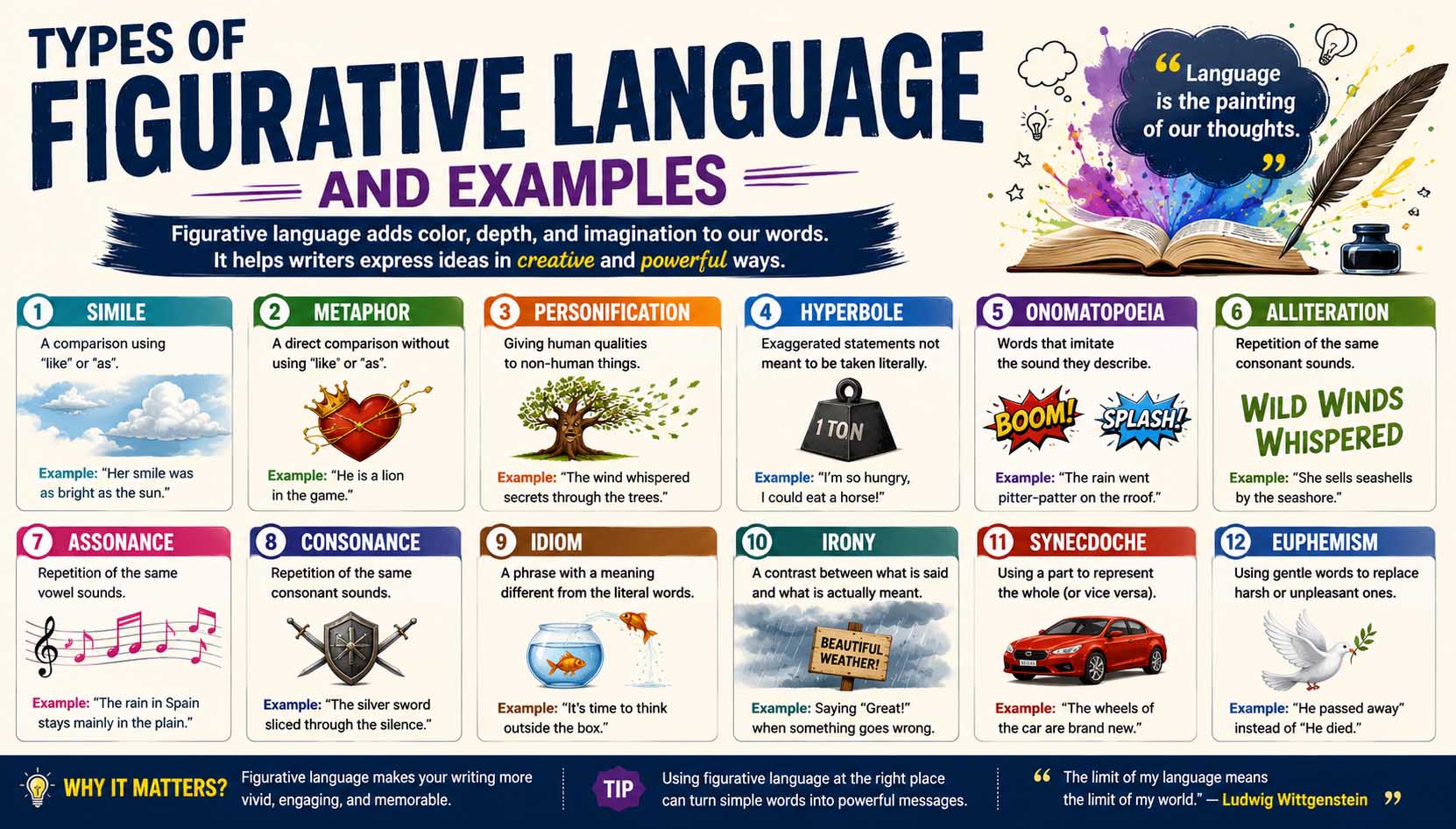
10 Types of Figurative Language and Examples
Students may encounter many literary techniques, but these ten appear frequently in school reading and writing.
| Type | Basic Meaning | Example |
|---|---|---|
| Simile | Comparison using “like” or “as” | Her smile was like sunshine. |
| Metaphor | Direct comparison | The test was a mountain. |
| Personification | Human traits given to nonhuman things | The wind whispered. |
| Hyperbole | Deliberate exaggeration | I waited forever. |
| Idiom | Phrase with a nonliteral meaning | Break the ice. |
| Onomatopoeia | Word that imitates a sound | The balloon popped. |
| Alliteration | Repeated beginning consonant sounds | Wild winds whistled. |
| Symbolism | Something represents a larger idea | A dove represents peace. |
| Irony | Contrast between expectation and reality | A fire station catches fire. |
| Oxymoron | Contradictory terms placed together | Deafening silence. |
These 10 types of figurative language and examples provide a useful starting point. However, categories sometimes overlap, so context matters when identifying a technique.
1. Simile
A simile compares two different things using words such as like or as.
For example:
“Her hands were as cold as snow.”
The writer is not claiming that the person’s hands are actually snow. Instead, the comparison helps the reader imagine how cold they feel.
Another example is:
“He ran like the wind.”
Here, speed is emphasized through comparison.
A useful classroom trick is to look for “like” and “as.” However, those words do not automatically create a simile. In “I like chocolate,” for instance, no comparison occurs.
2. Metaphor
A metaphor also compares two unlike things, but it does so directly rather than using “like” or “as.”
For example:
“Time is a thief.”
Time cannot literally steal. Still, the metaphor suggests that time takes moments, opportunities, or experiences away from us.
Another example is:
“The hallway was a river of students.”
The hallway is not literally a river. Instead, the metaphor creates an image of many students moving together.
Similes and metaphors are easy to confuse. Therefore, remember this simple distinction: a simile openly compares one thing like another, while a metaphor describes one thing as another.
3. Personification
Personification gives human actions, emotions, or characteristics to animals, objects, natural forces, or abstract ideas.
For example:
“The sun smiled down on the playground.”
The sun cannot actually smile. However, the human action creates a warm, cheerful feeling.
Another example is:
“The old floorboards complained beneath my feet.”
Floorboards cannot complain, yet the wording helps readers imagine their creaking sound.
Personification appears frequently in poetry because it can make nature, objects, and ideas feel alive.
Different Types of Figurative Language and Examples in Stories
Writers rarely use figurative language in isolation. Instead, several techniques may work together to create atmosphere, develop characters, or strengthen a scene.
For instance, imagine a story says:
“The storm marched toward the town while thunder growled like an angry animal.”
“Storm marched” uses personification because a storm cannot literally march.
Literary techniques can also support plot and character development. When analyzing types of conflicts in literature, for example, students may notice that metaphors and symbolism make internal or external struggles feel more vivid.
4. Hyperbole
Hyperbole is deliberate exaggeration used for emphasis, humor, or dramatic effect.
Consider:
“I have told you a million times.”
The speaker almost certainly has not repeated the message one million times. Instead, the exaggeration communicates frustration.
Another example is:
“My backpack weighs a ton.”
Again, the statement is not meant literally.
Students sometimes mistake hyperbole for inaccurate information. The key difference is intention. Hyperbole exaggerates so obviously that readers are expected to understand the nonliteral meaning.
5. Idiom
An idiom is an established expression whose meaning cannot always be understood by interpreting each word literally.
For example:
“Break the ice.”
In conversation, this often means making people feel more comfortable or starting an interaction rather than physically breaking frozen water.
Other familiar examples include:
- Hit the books
- Under the weather
- Piece of cake
- Spill the beans
- Cost an arm and a leg
Idioms can be especially challenging for language learners because their meanings depend heavily on cultural and linguistic familiarity.
When an unfamiliar phrase appears in a passage, students can often use surrounding information to work out its meaning. Learning types of context clues can therefore make unfamiliar figurative expressions easier to interpret.
6. Onomatopoeia
Onomatopoeia refers to words that imitate or suggest sounds.
Examples include:
“Buzz.”
“Crash.”
“Bang.”
“Hiss.”
“Splash.”
For instance:
“The bacon sizzled in the pan.”
The word “sizzled” helps the reader imagine the sound as well as the action.
Comic books often make onomatopoeia especially noticeable with words such as “BOOM!” and “POW!” However, novels and poems use the technique too.
7. Alliteration
Alliteration occurs when nearby words repeat beginning consonant sounds.
For example:
“Peter packed purple pencils.”
The repeated p sound creates a noticeable rhythm.
Another example is:
“Wild winds whipped across the water.”
Writers may use alliteration to make phrases memorable or create a particular sound effect. However, repetition should usually sound purposeful rather than accidental.
Alliteration concerns sound rather than simply repeated letters. Therefore, pronunciation matters when deciding whether a phrase uses the technique.
8. Symbolism
Symbolism occurs when an object, color, place, character, or action represents an idea beyond its literal role.
A dove, for example, may symbolize peace. Likewise, a journey might symbolize personal growth, while darkness can represent fear or uncertainty depending on the context.
Symbols do not always have one universal meaning. Instead, readers should examine how the writer uses them within the specific text.
Narrative perspective can influence that interpretation as well. Studying point of view examples helps students understand how the narrator’s position may shape the way objects, characters, and events are described.
9. Irony
Irony involves a meaningful contrast between what is expected and what actually happens or between what is said and what is meant.
One simple example would be a professional swimming instructor being afraid of water. The situation clashes with what readers would normally expect.
Verbal irony works differently. A person standing outside during a terrible storm might say, “Beautiful weather we’re having.”
The literal words sound positive, but the intended meaning is the opposite.
Students should avoid treating every surprising event as irony. Usually, there needs to be a clear contrast between expectation and reality.
10. Oxymoron
An oxymoron places apparently contradictory terms close together to create a particular effect.
Common examples include:
“Deafening silence.”
“Bittersweet.”
“Open secret.”
“Seriously funny.”
At first, the words seem incompatible. However, together they can communicate an idea that either word alone would not express as effectively.
For example, “bittersweet” can describe an experience that feels happy and sad at the same time.
All Types of Figurative Language and Examples: Are There More Than 10?
Yes. There is no single universally fixed list of all types of figurative language and examples because textbooks sometimes classify literary and rhetorical techniques differently.
Other terms students may encounter include metonymy, synecdoche, paradox, euphemism, understatement, apostrophe, imagery, and analogy.
For instance, understatement intentionally makes something seem less significant than it really is. If someone finishes an extremely difficult exam and says, “That was a little challenging,” the understatement may create humor.
Meanwhile, rhetorical analysis may require students to explain why an author selected a particular technique. Reviewing Rhetorical Choices Examples can help students move from simply naming a device to explaining its purpose and effect.
How to Identify Figurative Language Step by Step
First, read the complete sentence rather than focusing on one unusual word.
Next, ask whether the statement makes sense literally. If it does not, consider whether the writer intended a comparison, exaggeration, human characteristic, sound effect, symbol, or contrast.
Then, look for clues.
“Like” and “as” may suggest a simile. A direct comparison may indicate a metaphor. Human behavior assigned to an object often signals personification. Meanwhile, an extreme exaggeration may be hyperbole.
After identifying the technique, explain its effect.
For example, do not stop at:
“This is personification.”
Instead, write:
“The writer personifies the wind by saying it whispers, creating a quiet and slightly mysterious atmosphere.”
That second answer demonstrates understanding rather than simple identification.
Common Mistakes Students Make
One frequent mistake is assuming every comparison is a simile. Remember, a simile normally uses comparison words such as “like” or “as,” while a metaphor makes the comparison directly.
Another mistake is treating figurative language as decoration that has no effect on meaning. In strong writing, these techniques usually contribute to imagery, emotion, characterization, emphasis, tone, or theme.
Students also sometimes label every descriptive sentence as figurative. Yet literal descriptions can still be vivid.
Finally, avoid identifying a device without considering context. The same expression may function differently depending on who says it, what happens around it, and what the writer wants readers to understand.
Using a Types of Figurative Language and Examples PDF or Study Sheet
A types of figurative language and examples PDF can be useful for revision, especially before a reading or language arts test. However, memorizing definitions alone is rarely enough.
Create a simple three-column study sheet instead.
In the first column, write the technique. In the second, write its definition in your own words. Then, in the third, create an original example.
For instance:
Metaphor | Direct comparison | My bedroom is an icebox.
Creating your own examples forces you to apply the concept. As a result, you are more likely to recognize it later in an unfamiliar passage.
FAQs About Types of Figurative Language and Examples
What Are the Different Types of Figurative Language?
Simile, metaphor, personification, hyperbole, idiom, and symbolism are among the forms students frequently encounter. However, curricula vary, so learners may study other literary techniques as well.
What Is Literal and Figurative Language?
Literal language communicates its direct meaning. Figurative language uses comparisons, exaggerations, symbols, or other nonliteral techniques to communicate meaning beyond the exact words.
Is imagery a type of figurative language?
Imagery refers to language that appeals to the senses. It can include figurative devices, but imagery can also be created through precise literal description. Therefore, the terms are related but not identical.
Why do authors use figurative language?
Authors use it to create mental images, express emotion, emphasize ideas, establish tone, develop themes, and make writing more memorable.
How can I memorize different types of figurative language and examples?
Start with the major categories and create one original example for each. Then practice identifying them in short passages instead of relying only on definitions.
Turn Recognition Into Real Reading Skill
Learning the types of figurative language and examples becomes much easier once you stop treating them as a vocabulary list. Instead, look at what each technique does inside a sentence or passage.
First identify the device. Then explain the meaning it creates and why the writer may have chosen it.
With regular practice, similes, metaphors, personification, symbolism, irony, and other techniques become easier to recognize. More useful still, you begin to understand how writers use language to shape the way readers imagine, feel, and interpret a text.