
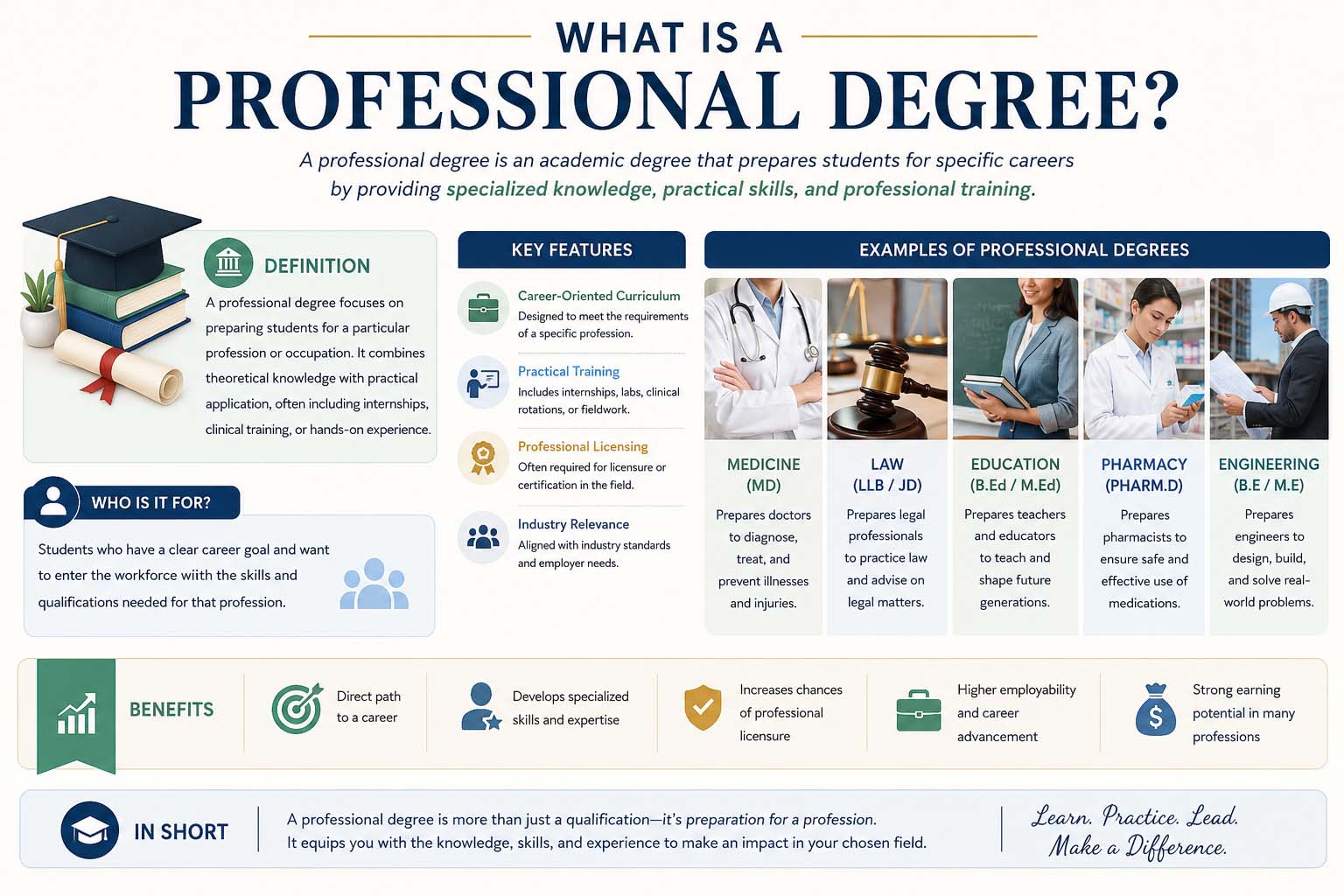
Simply put, a professional degree is an academic qualification designed to prepare students for a specific career or profession. In contrast to general academic degrees, professional degrees focus on practical skills, specialized knowledge, and the training needed to work in a particular field. For example, they include degrees in medicine, law, dentistry, and pharmacy. Therefore, if you are wondering what is a professional degree, think of it as career-focused preparation. In short, it combines academic learning with the training graduates need to meet the licensing requirements of their chosen profession.
As a result, professional programs focus heavily on practical skills, licensing requirements, and job readiness.
What Is a Professional Degree?
Basically, a professional degree is a type of academic degree designed to prepare students for a particular profession or career field. Usually, these degrees focus on practical training, industry skills, professional licensing, career preparation, and real-world application. As a result, they often lead directly to careers in regulated fields such as healthcare, law, and veterinary medicine.
What Is Considered a Professional Degree?
Traditionally, common professional degrees include the Doctor of Medicine (MD), Juris Doctor (JD), Doctor of Pharmacy (PharmD), and Doctor of Dental Surgery (DDS). In addition, the Doctor of Veterinary Medicine (DVM) and Doctor of Optometry (OD) belong in this group. Meanwhile, many people also call the Master of Business Administration (MBA), engineering degrees in licensed fields, and teaching certification programs professional because they prepare students for a career.
However, the answer depends on who is asking. For example, the federal government uses a narrower list for student loans, which the next section explains.
What Is Considered a Professional Degree Now?
In 2026, the meaning of professional degrees matters more than ever because of a new federal rule. According to Higher Ed Dive, the U.S. Department of Education finalized a list of 11 professional fields in April 2026. Specifically, the list covers pharmacy, dentistry, veterinary medicine, chiropractic, law, medicine, optometry, osteopathic medicine, podiatry, theology, and clinical psychology.
Most importantly, this list affects federal student loans that students take out on or after July 1, 2026. For instance, professional students can borrow up to $50,000 per year and $200,000 in total. In contrast, other graduate students can borrow up to $20,500 per year and $100,000 in total. Therefore, checking whether your program counts as professional is now an important step before you apply.
Meanwhile, career-focused programs that are not on the list, such as nursing, physical therapy, education, and accounting, count as other graduate programs. Likewise, the MBA and engineering degrees are not on the list. Still, universities and employers may continue to call many of these programs professional in everyday use.
Difference Between Academic and Professional Degrees
First, understanding the difference between academic and professional degrees is important for students planning their future. Specifically, the table below compares the main features.
| Academic Degree | Professional Degree |
|---|---|
| Focuses on theory and research | Focuses on career preparation |
| Often research-oriented | Practical and skill-based |
| Common for academic careers | Common for industry jobs |
| Examples: BA, BS, PhD | Examples: MD, JD, PharmD |
Overall, academic degrees build knowledge, while professional degrees build job-ready skills. Additionally, students who are still comparing levels can read about the difference between undergraduate and graduate programs.
What Is a First Professional Degree?
Simply put, a first professional degree is the first degree you need to enter a specific profession. For example, future physicians need an MD, many lawyers need a JD, and pharmacists need a PharmD. Because these degrees are the entry-level educational requirement for licensed professions, people call them “first professional.”
What Is No Longer a Professional Degree?
Over time, educational definitions change. For example, the 2026 federal rule leaves nursing, physical therapy, education, and accounting off the professional list. As a result, students in those programs face the lower graduate loan limits.
Even so, these programs still prepare students for important careers. Therefore, the change affects how loans work rather than the value of the degree. Because policies continue evolving as industries and job markets change, it helps to check the current rules before you enroll.
Why Students Choose Professional Degrees
First, professional degrees remain popular because they often provide direct career pathways. For instance, benefits may include clear job preparation, industry-specific training, and practical experience. Also, they can offer higher earning potential and professional licensing eligibility. As a result, many students prefer them because they connect education directly to employment opportunities.
Examples of Popular Professional Degrees
Medicine
First, medicine programs prepare students for healthcare careers through clinical and scientific training.
Law
Next, law degrees focus on legal systems, ethics, and courtroom practice.
Business Administration
In addition, business administration programs teach leadership, finance, operations, and management skills. However, the federal loan rule does not list them as professional programs.
Engineering
Likewise, engineering degrees often combine advanced mathematics with hands-on technical applications. Still, they are not on the federal list either.
Pharmacy
Finally, pharmacy students study medication science, patient care, and healthcare systems.
How to Choose the Right Professional Degree
Fortunately, choosing the right degree gets easier when you plan carefully. Besides, if you are still deciding whether to continue after a bachelor’s degree, learning What Is Grad School? can help you compare your options.
Step 1: Identify Career Goals
First, think about the type of work you want to do long-term.
Step 2: Research Licensing Requirements
Next, some careers require professional certification or exams, so research the licensing requirements.
Step 3: Compare Programs
Then, review the curriculum, internships, and accreditation.
Step 4: Consider Costs and Time
After that, professional programs can vary greatly in length and tuition, so compare the costs and the time.
Step 5: Evaluate Job Demand
Finally, research employment trends and salary expectations.
Overall, careful planning helps students make better educational decisions.
Skills Learned in Professional Degree Programs
Generally, professional degrees focus on practical workplace abilities. For example, students may develop leadership skills, technical expertise, communication abilities, and problem-solving techniques. In addition, they gain industry-specific knowledge and learn professional ethics. As a result, graduates transition into careers more smoothly. Likewise, building the right skills to put on resume helps graduates show employers what they can do.
Are Professional Degrees Worth It?
For many students, professional degrees offer strong long-term value. For instance, potential benefits include higher career stability, better salary opportunities, specialized expertise, industry recognition, and professional licensing access. However, students should also consider tuition costs, workload, and career requirements before choosing a program.
Challenges of Professional Degrees
Of course, professional programs can also be demanding. Typically, challenges include heavy coursework, long study hours, clinical or internship requirements, licensing exams, and higher educational expenses. Therefore, students often need strong time management and motivation to succeed.
Online Professional Degrees in 2026
Meanwhile, online learning continues growing rapidly. In fact, many universities now offer online professional programs in fields such as business, technology, healthcare administration, education, and cybersecurity. Moreover, hybrid learning models allow students greater flexibility while still gaining career-focused training.
Professional Degrees and Job Market Trends
Today, modern employers increasingly value specialized expertise. For example, industries such as healthcare, technology, finance, and engineering continue demanding highly trained professionals. Moreover, as automation and AI reshape industries, professional education remains important for competitive careers.
Tips for Students Considering Professional Degrees
First, research career outlooks carefully. Second, compare accredited schools and understand licensing requirements. Third, look for internship opportunities and build networking connections early. Overall, strong preparation improves long-term educational success.
FAQ About What Is a Professional Degree
What is a professional degree?
Basically, a professional degree prepares students for specific careers or licensed professions.
What is considered a professional degree?
Traditionally, degrees in medicine, law, pharmacy, and dentistry are common examples. In addition, the federal list for student loans also includes veterinary medicine, optometry, chiropractic, osteopathic medicine, podiatry, theology, and clinical psychology.
What is a first professional degree?
Simply put, it is the entry-level degree that a specific licensed profession requires.
What is no longer a professional degree?
Recently, the federal loan rule left nursing, physical therapy, education, and accounting off the professional list. Also, other older classifications have changed with educational policy updates.
Are professional degrees better than academic degrees?
Actually, neither is universally better. Instead, the best option depends on career goals and personal interests.
Conclusion
In short, understanding what is a professional degree helps students make smarter educational and career decisions. Overall, professional degrees focus on practical training, industry preparation, and career readiness in fields such as medicine, law, pharmacy, and veterinary medicine. Finally, because federal loan rules changed in 2026, check the current definition before you choose a program.