
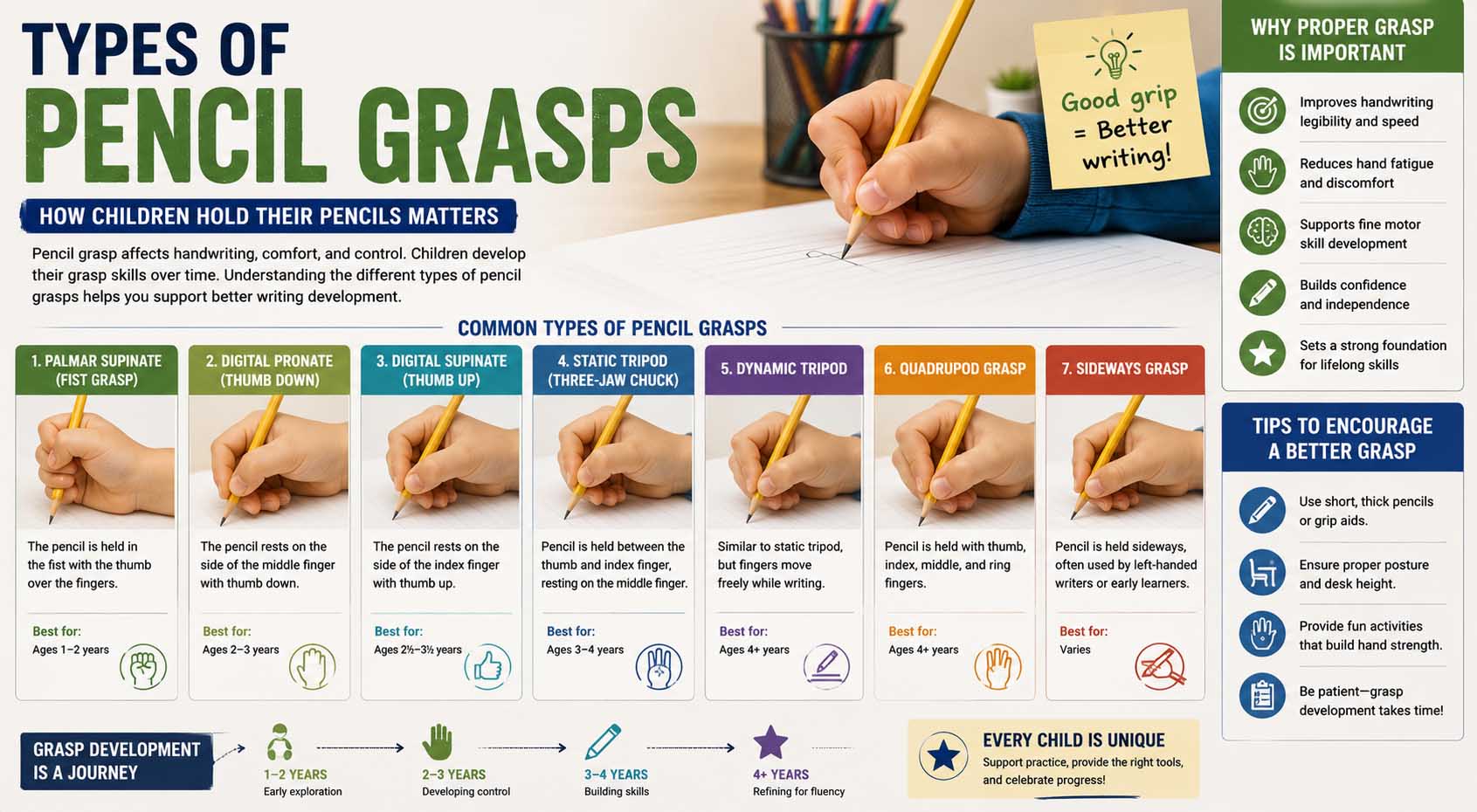
Watch a group of young children draw, and you will probably notice that they hold their pencils in several different ways. These types of pencil grasps often reflect normal stages of fine-motor development rather than a problem that needs correcting. As children gain hand strength, finger control, coordination, and practice, their grasp usually becomes more refined. However, there is no single pencil grip that every student must use to write successfully.
For parents and teachers, the key is understanding which grasp patterns are expected at different stages and whether a child’s grip allows comfortable, efficient writing. This guide explains common pencil grasps, how they develop, and when extra support may be useful.
What Is a Pencil Grasp?
A pencil grasp is simply the way a person positions and uses their fingers and hand to control a pencil, crayon, marker, or other writing tool.
Young children typically begin by moving a writing tool with much of the arm. Later, they gradually gain better control of the wrist, hand, and fingers. As a result, their pencil grip often changes naturally.
Posture, visual-motor skills, hand strength, coordination, letter formation, and practice also influence how comfortably and clearly a student writes.
Likewise, the writing task matters. For instance, drawing with a thick crayon requires different precision than writing several paragraphs with a pencil.
As handwriting becomes more advanced, students may also experiment with print and different types of cursive, yet a functional and comfortable grip remains more valuable than making every student’s fingers look identical.
Common Types of Pencil Grasps by Developmental Stage
The different types of pencil grasps are often discussed as developmental patterns. Children generally move from whole-hand grips toward more precise finger-controlled grasps.
However, development varies from child to child. Therefore, ages should be treated as broad guides rather than strict deadlines.
| Pencil grasp | General characteristics | Common developmental period |
|---|---|---|
| Palmar supinate | Pencil held in a closed fist | Toddler years |
| Digital pronate | Fingers hold pencil with palm facing downward | Early preschool |
| Four-finger grasp | Four fingers help stabilize pencil | Preschool years |
| Static tripod | Three-finger grip with movement mainly from wrist/hand | Preschool to early school years |
| Dynamic tripod | Thumb, index, and middle finger control pencil | School-age mature pattern |
| Dynamic quadrupod | Four fingers participate efficiently | School-age mature pattern |
These stages are not a test that every child must pass in exactly the same order. Instead, they provide a useful framework for understanding how fine-motor control may develop.
1. Palmar Supinate Grasp
The palmar supinate grasp is one of the earliest pencil-holding patterns. A young child wraps all fingers around a crayon or marker and holds it in a fist.
At this stage, movement usually comes from the shoulder and arm rather than the fingers. Therefore, large scribbles and broad marks are common.
This grasp is expected in very young children who are just beginning to explore drawing and writing tools. Rather than correcting it immediately, adults can offer safe opportunities to scribble, color, paint, and make marks.
Over time, improved hand control often encourages the child to use a more refined grip naturally.
2. Digital Pronate Grasp
With a digital pronate grasp, the child’s fingers hold the pencil while the palm generally faces downward toward the paper. Meanwhile, the pencil may extend toward the little-finger side of the hand.
Children using this grasp still rely heavily on arm movement. However, they are beginning to involve their fingers more than they did with a whole-fist grip.
This pattern commonly appears during early childhood. Therefore, it should not automatically be treated as an incorrect pencil grip in a young learner.
Instead, activities involving blocks, play dough, puzzles, drawing, and small objects can provide broader opportunities to develop hand control.
3. Four-Finger Grasp
A four-finger grasp uses the thumb and several fingers to control the pencil. Depending on the exact pattern, the pencil may rest against the ring finger while the other fingers provide support.
At first glance, this grip may look unusual to an adult who learned that only a tripod grip is “correct.” However, some four-finger patterns can develop into efficient functional grasps.
The more useful question is whether the student can control the pencil without excessive effort.
If handwriting is legible, the child writes at a suitable pace, and the hand remains comfortable, changing an established grip may offer little benefit.
4. Static Tripod Grasp
The static tripod resembles the classic three-finger pencil grip. The thumb and index finger control the pencil while it rests against the middle finger.
However, the word “static” means that finger movement remains limited. Instead, much of the movement comes from the wrist or forearm.
This grip can act as a bridge between early developmental grasps and more refined handwriting movements.
As coordination improves, some children naturally begin using smaller finger movements. Consequently, their static tripod may develop into a dynamic tripod.
5. Dynamic Tripod Grasp
The dynamic tripod is probably the pencil grasp most adults recognize as the traditional handwriting grip.
In this pattern, the thumb and index finger guide the pencil while it rests against the middle finger. Meanwhile, the ring and little fingers help stabilize the hand against the writing surface.
The fingers make small, controlled movements, so the student does not need to move the entire arm for each letter.
This grip can support efficient handwriting. However, it is not the only acceptable mature pencil grasp.
For that reason, teachers should avoid treating the dynamic tripod as a requirement when another grip works comfortably and effectively.
6. Dynamic Quadrupod Grasp
The dynamic quadrupod is another mature grasp pattern. Instead of using three fingers around the pencil, the writer uses four, typically involving the thumb, index, middle, and ring fingers.
Although it looks different from a tripod grasp, it can still provide good pencil control.
Research and occupational therapy practice generally focus more on function than on achieving one ideal-looking grip. Therefore, a student using a comfortable dynamic quadrupod does not necessarily need to change to a tripod.
This distinction helps parents understand why the types of grasps on pencil should be evaluated according to writing performance rather than appearance alone.
What Are Types of Immature Pencil Grasps?
The phrase types of immature pencil grasps usually refers to patterns that rely more heavily on the whole hand, wrist, or arm and provide less refined finger control.
Examples can include the palmar supinate and digital pronate grasps. Static grasp patterns may also represent transitional development depending on a child’s age and skills.
Still, “immature” does not mean “bad.” A grasp may be completely appropriate for a young child’s developmental stage.
Concerns become more relevant when an older student struggles with handwriting tasks, experiences pain or fatigue, uses excessive pressure, or cannot keep up with classroom writing despite instruction and practice.
Why Pencil Grasp Develops Over Time
Handwriting requires several abilities to work together. First, children need enough stability through the shoulder, arm, and wrist. Then, they gradually develop finer control within the hand and fingers.
Muscles and tendons around the forearm and wrist help provide this stable base. For example, the extensor carpi radialis longus contributes to wrist movement and stability, although pencil control depends on many muscles working together rather than any single muscle.
Visual-motor coordination also matters because children must connect what they see with the movements they make.
Meanwhile, practice helps the brain and hand coordinate increasingly precise movements. That is why frequent opportunities to draw and write usually make more sense than repeatedly telling a young child to reposition every finger.
Types of Pencil Grasps Occupational Therapy May Assess
When discussing types of pencil grasps occupational therapy professionals evaluate, the focus is usually broader than simply identifying the grip.
An occupational therapist may observe how a student sits, stabilizes the paper, controls the pencil, forms letters, spaces words, and completes age-appropriate classroom tasks.
They may also consider:
- Hand dominance
- Fine-motor coordination
- Finger movement
- Pencil pressure
- Writing speed
- Hand fatigue or pain
- Posture
- Visual-motor integration
- Legibility
- Ability to complete classroom work
Therefore, occupational therapy assessment is about function. A grip that looks unconventional may not require intervention if it supports effective writing.
On the other hand, a traditional-looking tripod grasp does not guarantee good handwriting if the student struggles with other underlying skills.
How Parents and Teachers Can Support a Functional Pencil Grasp
Adults can encourage handwriting development without constantly repositioning a child’s fingers.
Offer appropriately sized writing tools
Young children may find short crayons or pencils easier to control because the smaller tool can encourage finger use. However, the tool should still be comfortable and safe for the child’s age.
Build fine-motor skills through play
Activities such as using play dough, building with small blocks, threading beads, opening containers, and using child-safe tongs can develop coordination.
Likewise, drawing on different surfaces gives children varied opportunities to control writing tools.
Make handwriting practice meaningful
Repeatedly copying letters can become frustrating. Instead, children can write labels, short notes, names, shopping lists, captions, or answers to simple questions.
Interesting classroom tasks, including age-appropriate Critical Thinking Exercises, can also create genuine reasons to write while students practice organizing ideas and recording responses.
Watch pencil pressure
Some students grip pencils tightly and press heavily against the paper. As a result, their hands may become tired quickly.
Encourage relaxed writing rather than repeatedly demanding a specific finger position. Meanwhile, short breaks may help during longer writing assignments.
Common Pencil-Grip Mistakes Adults Make
One common mistake is assuming every unusual grip must be corrected. In reality, several mature grasp patterns can support functional handwriting.
Another mistake is comparing children too closely. Fine-motor skills develop at different rates, so one preschooler’s grasp may look different from another’s.
Likewise, forcing a grip change too early can make writing frustrating. Young children often benefit more from drawing, coloring, manipulating objects, and developing general hand skills.
Finally, adults sometimes focus entirely on the fingers while overlooking posture, paper position, pencil pressure, and writing endurance.
A functional approach considers the whole writing task.
When Might a Child Need Extra Help?
A different-looking pencil grip by itself is not necessarily a reason for concern. However, extra support may be worth considering when handwriting difficulties interfere with school participation.
For example, talk with a teacher, pediatric healthcare professional, or occupational therapist if a child regularly experiences hand pain, extreme fatigue, difficulty controlling writing tools, or significant trouble completing age-appropriate written work.
Likewise, seek guidance if handwriting challenges occur alongside broader fine-motor difficulties.
A professional can assess the child’s individual abilities and determine whether targeted support would be useful.
Frequently Asked Questions
What are the main types of pencil grasps?
Common developmental patterns include palmar supinate, digital pronate, four-finger, static tripod, dynamic tripod, and dynamic quadrupod grasps. However, terminology can vary slightly among educational and therapy resources.
What is the best pencil grasp?
There is no single best grip for every student. A good pencil grasp allows the writer to control the pencil efficiently, produce readable work, and write without unnecessary pain or fatigue.
Is the tripod grasp the only correct grip?
No. Although the dynamic tripod is a common mature grasp, the dynamic quadrupod and some other patterns can also be functional.
Should I correct my child’s pencil grip?
Not necessarily. Consider the child’s developmental stage and writing function first. If the grip causes pain, poor control, fatigue, or major classroom difficulty, professional guidance may be useful.
At what age should children have a mature pencil grasp?
Pencil grasp develops gradually throughout early childhood, and children do not all reach mature patterns at the same age. Therefore, adults should look at overall fine-motor development and writing performance rather than expecting a specific grip by an exact birthday.
Can pencil grips or special tools help?
Sometimes. Commercial pencil grips may help certain students with positioning or comfort. However, they are not automatically necessary, and the most suitable option depends on the student’s needs.
Focus on Comfortable, Effective Writing
Understanding the types of pencil grasps helps parents and teachers see handwriting development as a gradual process rather than a race toward one “perfect” grip. Early whole-hand grasps can develop into more refined patterns as children gain strength, coordination, and experience.
Therefore, focus first on whether a student can write comfortably, clearly, and efficiently. Provide plenty of opportunities for drawing, fine-motor play, and meaningful writing, while avoiding unnecessary pressure to make every hand look the same. If pain, fatigue, or persistent handwriting difficulties interfere with learning, an occupational therapist or other qualified professional can help identify what support the student actually needs.