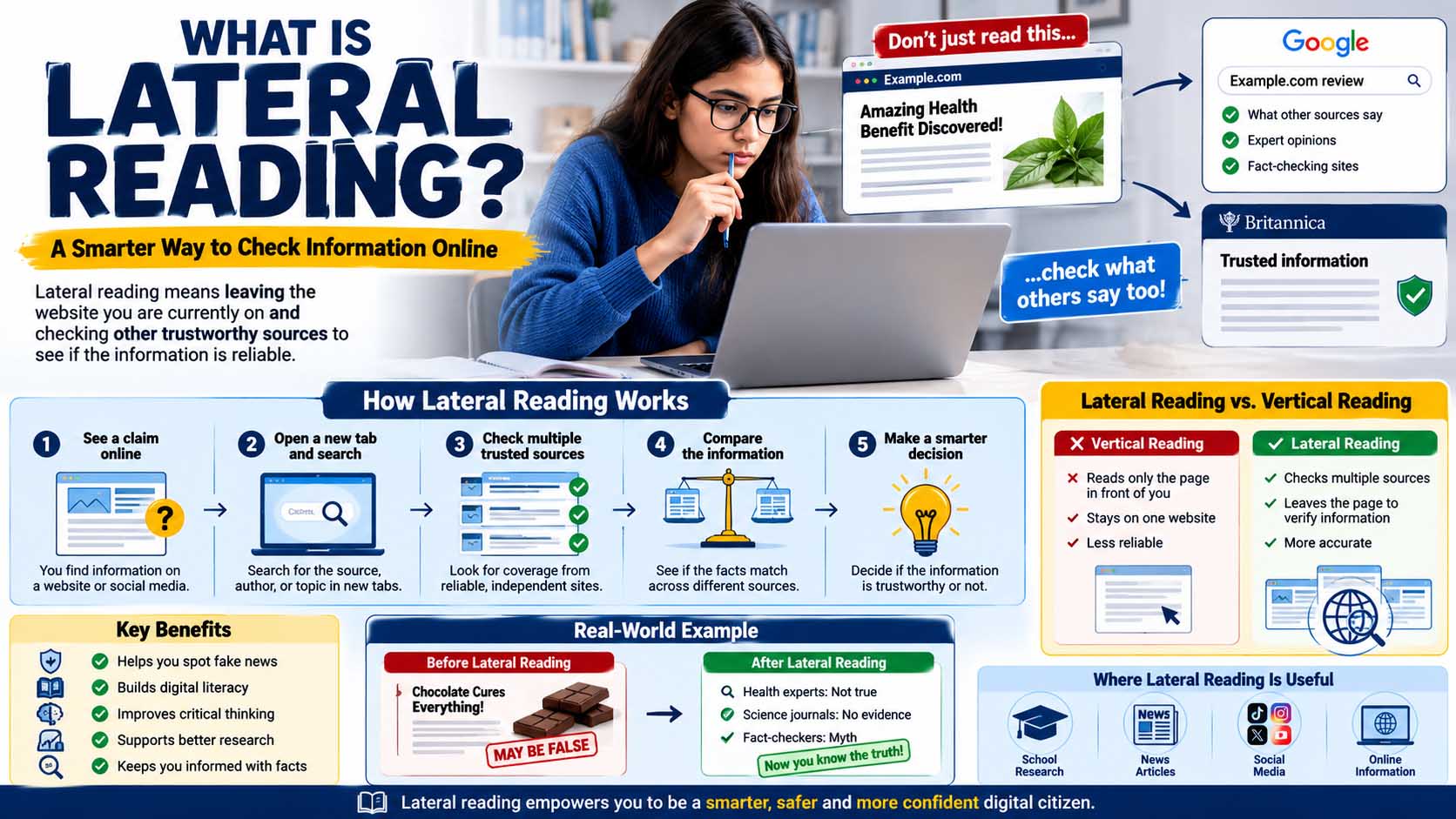
If you have ever opened a website and wondered whether you should trust it, learning what is lateral reading can help. Lateral reading is a research strategy in which you leave the original webpage and open other sources to investigate who created it, what others say about it, and whether its claims are supported elsewhere. Instead of judging a page only by how professional it looks, you compare information across the web before deciding whether the source is credible.
What Is Lateral Reading in Simple Terms?
In simple terms, lateral reading means reading across websites rather than staying inside one page.
Imagine that you find an article making a surprising claim. A traditional approach might involve reading the entire article, checking its references, studying the “About Us” page, and looking closely at the website design.
Lateral reading takes a different approach.
Instead, you open a new tab and search for information about the publisher, author, organization, or claim. Then, you compare what independent sources say.
This method is especially useful online because a website can look polished without being accurate. Professional design, confident language, and impressive logos do not automatically prove credibility.
So, when students ask what is lateral reading in simple terms, the easiest answer is this: leave the page, investigate the source elsewhere, and compare what you find.
Why Lateral Reading Matters Online
The internet gives students quick access to enormous amounts of information. However, not all of that information has been reviewed, verified, or written by experts.
Some websites publish accurate educational content. Meanwhile, others may contain outdated information, misleading claims, advertising disguised as advice, satire, propaganda, or unsupported opinions.
Because of this, source evaluation has become a major academic skill.
Lateral reading helps because it shifts attention away from appearance and toward evidence.
For example, a website might describe itself as an independent research institute. Instead of accepting that description, you can search for the organization in another tab.
You might discover that universities, government agencies, reputable news organizations, or professional associations describe the group very differently.
This habit also works well alongside Critical Thinking Exercises, since both approaches encourage learners to question assumptions, compare evidence, and avoid accepting claims too quickly.
Why the Strategy Is Useful
Students often learn lateral reading as part of digital and information literacy.
One major benefit is efficiency.
Rather than spending a long time analyzing every detail on a questionable page, a reader may learn more by checking the source elsewhere.
The Digital Inquiry Group’s Civic Online Reasoning resources on evaluating online information focus on three useful questions: who is behind the information, what evidence supports it, and what other sources say.
Lateral reading can help you answer questions such as:
- Who owns or funds this website?
- Do independent sources describe the organization as credible?
- Are other trustworthy sources reporting the same claim?
- Has the claim been corrected or challenged?
- Is the evidence current?
- Does the website have a clear purpose or bias?
These questions make source evaluation more practical.
They also help students move beyond a simple “trust it or don’t trust it” mindset.
Instead, students learn to judge credibility based on context and evidence.
How Lateral Reading Works Step by Step
The process is simple, although good judgment improves with practice.
Step 1: Pause Before Trusting the Page
First, avoid assuming the page is reliable simply because it looks professional.
A modern website can still contain weak information.
Likewise, an older-looking webpage may contain excellent research.
Therefore, treat appearance as one small clue rather than proof.
Step 2: Identify the Source
Next, look for the author, organization, publisher, or institution responsible for the content.
If no clear source is listed, that is already useful information.
However, do not stop there.
Open another browser tab and search for the source independently.
Step 3: Investigate the Source Elsewhere
Search for the organization or author using independent websites.
For example, if a page claims to come from a research institute, check whether universities, government agencies, professional organizations, or established publications recognize that institute.
If you are researching academic material, understanding what is a scholarly source can also help you distinguish peer-reviewed or academically reviewed information from general web content.
Step 4: Check the Main Claim
Now, search for the specific claim.
If several trustworthy sources report the same information, confidence in the claim may increase.
However, if only one questionable site makes the claim, that should make you more cautious.
Step 5: Trace Evidence to Its Original Source
Whenever possible, follow statistics, quotes, studies, or reports back to their original source.
A website may accurately cite a study.
However, it may also misrepresent the study’s findings.
Therefore, checking the original research can reveal whether the claim matches the evidence.
Lateral Reading vs. Vertical Reading
Lateral reading becomes easier to understand when compared with vertical reading.
Vertical reading means staying on one webpage and examining it from top to bottom.
You might study:
- The page design
- The author’s biography
- The references
- The writing quality
- The “About” page
- The website’s contact information
Those details can still be useful.
However, the website itself controls them.
Lateral reading adds outside context.
| Reading Method | Main Approach | Best Use |
|---|---|---|
| Vertical reading | Examines one webpage closely | Understanding the content itself |
| Lateral reading | Checks independent sources in other tabs | Evaluating credibility and context |
Strong research often uses both methods.
First, investigate the source laterally. Then, if the source appears credible and relevant, read the content more closely.
A Practical Lateral Reading Example
Suppose a student is writing a report about sleep and academic performance.
The student finds a website making a dramatic claim about how sleep affects exam performance.
The page looks impressive.
It includes charts, statistics, and scientific-sounding language.
However, instead of copying the claim immediately, the student uses lateral reading.
First, they search for the website’s organization.
Next, they discover that the site is operated by a company selling sleep supplements.
That does not automatically make the information false, but it creates a potential conflict of interest.
Then, the student searches for the specific claim.
If they cannot find support for it from reliable academic or health sources, they have a reason to investigate further.
Finally, they trace the website’s cited research back to the original source and compare the study with the site’s interpretation.
This process helps the student avoid relying on a potentially misleading claim.
The example shows why source context matters as much as polished presentation.
Asking Better Questions While Reading Laterally
Strong lateral readers know what to ask.
Different types of questions can reveal different problems with a source.
For example, factual questions might ask, “Who funds this organization?”
Purpose questions might ask, “Is this page trying to inform, persuade, sell, entertain, or provoke?”
These questions help students move from passive reading to active investigation.
As a result, they become less likely to accept information simply because it appears first in search results.
Using Lateral Reading in the Classroom
Teachers can use lateral reading in many subjects.
In history, students can compare websites discussing a historical event.
In science, they can investigate claims about nutrition, climate, medicine, or technology.
Meanwhile, English and media-literacy classes can use lateral reading to examine persuasive writing, bias, and source credibility.
A useful classroom activity is to give students two websites covering the same topic.
Then, ask them to open new tabs and investigate both sources.
Students can compare:
- Ownership
- Funding
- Author expertise
- Publication history
- Citations
- Outside reputation
- Agreement with stronger sources
Afterward, the class can discuss which source deserves more trust and why.
This approach teaches students to defend their judgments with evidence.
Connection With General Reading Skills
Lateral reading is different from basic literacy instruction.
For example, the simple view of reading explains reading development through the interaction of decoding and language comprehension.
Lateral reading comes later.
A student must already be able to understand written information before evaluating its credibility across multiple sources.
Likewise, decoding in reading focuses on turning printed words into spoken language or meaning, while lateral reading focuses on judging information quality.
Still, these skills are connected.
Strong readers need both comprehension and evaluation.
As students get older, reading becomes less about simply understanding what a text says and more about deciding whether the text deserves trust.
Common Source-Evaluation Mistakes
One common mistake is assuming that the first search result must be the best source.
Search rankings do not guarantee accuracy.
Another mistake is trusting a website because it ends in a familiar domain such as .org.
A .org address does not automatically mean a group is neutral or reliable.
Students also sometimes rely too heavily on the “About Us” page.
That page can provide useful information, but it represents how the organization describes itself.
Lateral reading asks what independent sources say instead.
Another mistake is checking only whether multiple websites repeat the same claim.
Sometimes, many sites copy information from one weak original source.
Therefore, tracing a claim back to its origin matters.
How to Use Lateral Reading for School Research
When working on an assignment, start lateral reading early.
Do not wait until after writing your paper to check your sources.
Instead, evaluate each source before taking detailed notes.
A simple research routine looks like this:
- Find a possible source.
- Identify the publisher and author.
- Search for them in another tab.
- Check whether reliable sources recognize them.
- Verify major claims elsewhere.
- Follow important citations to original evidence.
- Decide whether the source is suitable for your assignment.
This process may feel slower at first.
However, it can save time because you avoid building an assignment around weak sources.
When Lateral Reading Is Especially Helpful
Lateral reading is useful whenever credibility matters.
However, it becomes especially valuable when the information:
- Makes a surprising claim
- Involves health or science
- Discusses politics or public policy
- Includes statistics without clear context
- Comes from an unfamiliar organization
- Makes strong emotional appeals
- Tries to sell a product
- Contradicts several established sources
- Appears during a breaking news event
In these situations, verification should come before sharing or citing the information.
Frequently Asked Questions
What Is Lateral Reading?
Lateral reading is the practice of leaving a webpage and checking other sources to evaluate the page’s author, organization, claims, evidence, and reputation.
Is Lateral Reading the Same as Fact-Checking?
They are closely related but not identical. Fact-checking focuses mainly on whether a claim is accurate, while lateral reading also investigates who created the information and how trustworthy the source is.
Why Do Students Use Lateral Reading?
Students often use online sources for research. Therefore, lateral reading helps them identify weak, biased, misleading, or unsupported information before relying on it.
Can You Use Lateral Reading With Social Media?
Yes. You can investigate an account, organization, image, quotation, or claim using outside sources before accepting or sharing it.
Should You Still Read the Original Webpage Carefully?
Yes, once you have investigated the source. Lateral reading does not replace close reading. Instead, it helps you decide whether a source deserves your time and trust.
A Simple Habit That Makes Research Stronger
Learning what is lateral reading gives students a practical way to judge online information without relying on appearances. Instead of staying on one page and accepting its claims, open new tabs, investigate the source, compare evidence, and trace important information back to reliable origins.
That small change in reading behavior can make school research more accurate and thoughtful. Better yet, the habit remains useful far beyond the classroom. Whenever you encounter a surprising statistic, unfamiliar website, viral claim, or persuasive article, lateral reading gives you a clear next move: check what other reliable sources say before deciding what to believe.