
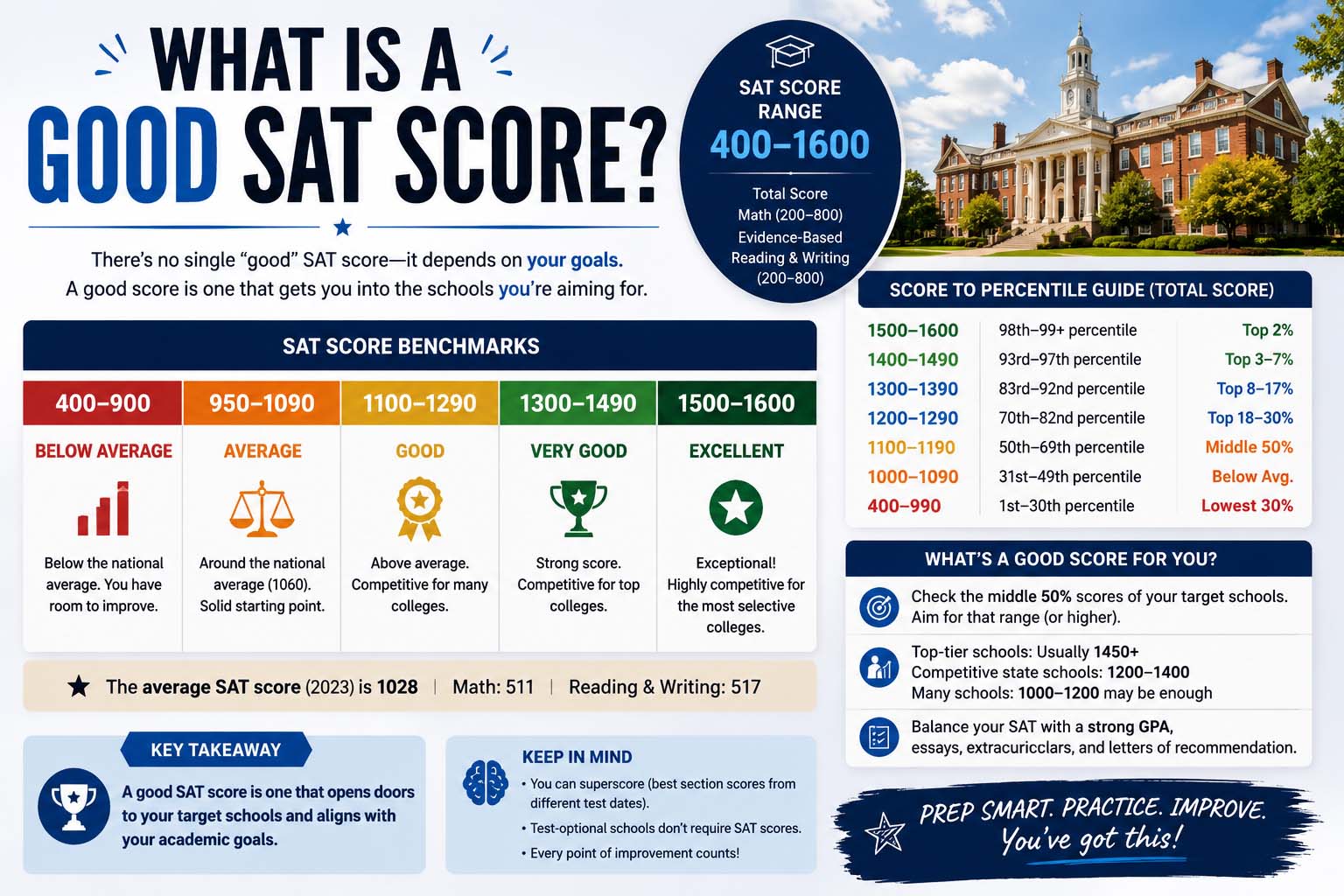
First, if you’ve recently taken the SAT or are getting ready for test day, you’ve probably asked yourself, what is a good SAT score? Also, the answer depends on your goals. For example, a score that is excellent for one college may be average for another.
In fact, the right target also depends on your academic record, extracurricular activities, and the schools on your application list. However, there isn’t one “perfect” SAT score. Instead, a good SAT score is one that helps you become a competitive applicant for the colleges you want to attend. Also, this guide explains SAT score ranges, what colleges look for, and how you can set a realistic goal.
How the SAT Scoring System Defines a Good SAT Score
First, the SAT is a college admissions test that measures skills in reading, writing, and mathematics. Also, the total SAT score ranges from 400 to 1600 and includes two sections. Next, the test gives Reading and Writing a score from 200 to 800. Likewise, Math earns a score from 200 to 800.
Therefore, your combined score determines how competitive your application may be for different colleges. Also, many students receive percentile information, which compares their performance with other test takers. In addition, the College Board’s BigFuture guide explains that a good score depends on the colleges on your list.
What Is a Good SAT Score?
First, a good SAT score depends on the colleges where you plan to apply. For example, here’s a general guide.
| SAT Score | Competitiveness |
|---|---|
| 400–900 | Below average for many four-year colleges |
| 900–1050 | Average range |
| 1050–1200 | Good for many colleges |
| 1200–1400 | Strong score for competitive universities |
| 1400–1500 | Excellent score |
| 1500–1600 | Outstanding score for highly selective schools |
Instead, compare your score with the typical students your target colleges admit rather than with every student.
What Is a Good Score on the SAT?
Because students hear different answers from friends, teachers, and online forums, many ask, what is a good score on the SAT? Therefore, a practical definition is simple. First, a good SAT score makes you a competitive applicant. Also, a higher score may strengthen scholarship opportunities. Finally, the best score matches or exceeds your target school’s middle 50% SAT range.
For example, if a college reports that its students typically score between 1180 and 1300, earning a 1280 places you near the upper end of that range.
Also, as you compare admission requirements, you’ll need to understand What Is a Transcript? because colleges review both your academic record and your standardized test scores together.
What Is a Good SAT Score for College?
Because no single score works for every institution, what is a good SAT score for college depends on the type of school you’re considering.
Community Colleges
First, many community colleges have open admissions and may not require SAT scores at all. Also, if you’re considering this path, learning about the benefits of community college can help you understand why many students choose this affordable option before transferring to a university.
Public Universities
Next, many public universities consider scores between 1100 and 1300 competitive. However, selective campuses often expect higher scores.
Private Universities
Meanwhile, private colleges vary widely. For example, some admit students with scores around 1100, while highly selective institutions often expect scores above 1400.
Highly Selective Universities
Finally, schools with competitive admissions frequently enroll students whose SAT scores fall well above the national average. Also, remember that grades, course rigor, essays, recommendation letters, and extracurricular activities influence admissions decisions.
What Is a Good SAT Score for Ivy League Schools?
First, students interested in elite universities often ask, what is a good SAT score for Ivy League admissions. Although no score can promise admission, the pattern is fairly clear. For example, scores of 1450–1500 are competitive at some Ivy League schools. Next, scores of 1500–1550 are very competitive. Finally, scores of 1550–1600 are exceptional.
However, even perfect scores do not guarantee admission because these schools use a holistic review process. Also, admissions officers consider GPA, challenging coursework, leadership, community service, research, essays, and recommendation letters. Therefore, an outstanding SAT score strengthens an application, but it cannot replace other important achievements.
What Is a Good SAT Score 2026?
First, students preparing for upcoming admissions cycles often search for what is a good SAT score 2026. Although admission standards can change slightly from year to year, general score expectations remain fairly stable.
Also, as of 2026, these benchmarks remain useful. First, a score of 1350+ is competitive for many selective universities. Next, 1450+ is strong for highly competitive institutions. Finally, 1500+ places students among the highest-performing test takers.
Therefore, always check the latest admissions profile for each college because score ranges differ across schools.
How Colleges Use Test Results
First, SAT scores are only one part of your college application. For example, admissions offices may review high school GPA, course difficulty, SAT or ACT scores, personal essays, activities and leadership, volunteer experience, and recommendation letters. Also, some colleges remain test-optional, meaning students may choose whether to submit SAT scores.
Setting a Realistic Goal
Instead of chasing the highest possible score, choose a target that fits your college list. Then, follow these steps:
- First, make a college list, and separate schools into reach schools, match schools, and safety schools.
- Next, find average SAT scores, because most colleges publish the middle 50% SAT scores for the students they admit. Also, aim to score near the upper end whenever possible.
- Then, build a study plan that focuses on your weakest section while maintaining your strengths.
- After that, take practice tests, because they help you improve timing, identify mistakes, build confidence, and track progress.
- Finally, retake the test if you want a higher score, since many students improve their scores after additional preparation. Also, a second attempt often produces better results because students become more familiar with the test format.
Average vs. Good vs. Excellent SAT Scores
Next, this quick comparison helps put scores into perspective.
| Score Range | General Meaning |
|---|---|
| 900–1050 | Around average |
| 1050–1200 | Good for many colleges |
| 1200–1400 | Strong application for numerous universities |
| 1400–1500 | Excellent |
| 1500–1600 | Exceptional |
However, these ranges are general guidelines rather than strict cutoffs.
Common Mistakes Students Make
First, many students worry more about their SAT score than necessary. Therefore, here are some common mistakes to avoid.
For example, some students believe one test determines everything. However, your SAT score matters, but colleges evaluate your complete application.
Also, others compare themselves with friends. Instead, focus on your own goals, because different colleges have different admission standards.
Likewise, some students ignore percentiles. In fact, a percentile often provides more useful context than the score alone because it shows how your performance compares with other students.
Finally, some students wait too long to prepare. However, starting early allows time to improve gradually rather than cramming.
Study Strategies That Work
First, improving your SAT score usually comes from consistent practice rather than last-minute studying. For example, even 30–45 minutes of focused practice several days each week can produce noticeable improvement.
Also, review your mistakes. Instead of counting correct answers, study why incorrect answers happened. Then, patterns often appear after several practice tests.
Besides, learn time management. In fact, many students know the material but lose points because they spend too much time on difficult questions. Therefore, practice working under realistic time limits.
Moreover, reading newspapers, nonfiction books, and academic articles strengthens comprehension and vocabulary over time. Finally, review algebra, geometry, and data analysis regularly. As a result, mastering the basics often leads to larger score gains than memorizing advanced shortcuts.
College Planning Beyond the Test
First, your SAT score fits into a much larger college planning process. Also, as you explore future educational options, you may wonder What Is a Professional Degree? if you’re interested in careers such as law, medicine, or pharmacy. As a result, understanding long-term education pathways can help you choose colleges that align with your career goals.
Besides, application timing matters as well. For example, learning the difference between early action and early decision helps you decide when to submit applications and whether applying early matches your college strategy.
Later, you might even consider What Is Grad School? if your career requires a master’s degree, doctorate, or another advanced credential. Also, building strong study habits now can support success at every stage of higher education.
Frequently Asked Questions
Is a 1200 a good SAT score?
In fact, a 1200 is a solid score, and many colleges and universities see it as competitive.
Is a 1400 a good SAT score?
Indeed, a 1400 is an excellent score and makes you a competitive applicant at many selective schools.
Is a 1500 SAT score good enough for Ivy League schools?
Generally, a 1500 is highly competitive. However, admissions decisions also depend on grades, essays, activities, and recommendations.
Should I retake the SAT?
Still, retaking the exam may be worthwhile if your score falls below the average for your target colleges and you believe additional preparation will help.
Do all colleges require SAT scores?
However, many colleges now offer test-optional admissions, so applicants can decide whether to submit SAT scores.
Key Takeaways
First, a good SAT score is the one that helps you reach your college goals. While scores above 1200 are competitive for many schools, scores above 1400 strengthen applications to selective universities. Therefore, your target should always match the colleges on your list rather than someone else’s expectations.
Next, create a study schedule, take official practice tests, and review your mistakes carefully. Also, compare your score with the admission profile of each college you plan to apply to. As a result, steady preparation and realistic goals can help you earn a score that supports your next step toward higher education.