
Have you ever wondered why some writing flows smoothly while other writing sounds choppy? Often, complex sentence examples are the answer, because they connect ideas in a clear and logical way. Whether you write an essay, prepare for an exam or improve your everyday English, complex sentences make your writing stronger and easier to follow.
First, you will learn what a complex sentence is and how to spot one. Next, you will see many examples for school, subjects and daily life, along with comma rules, common mistakes and quick practice.
What Is a Complex Sentence?
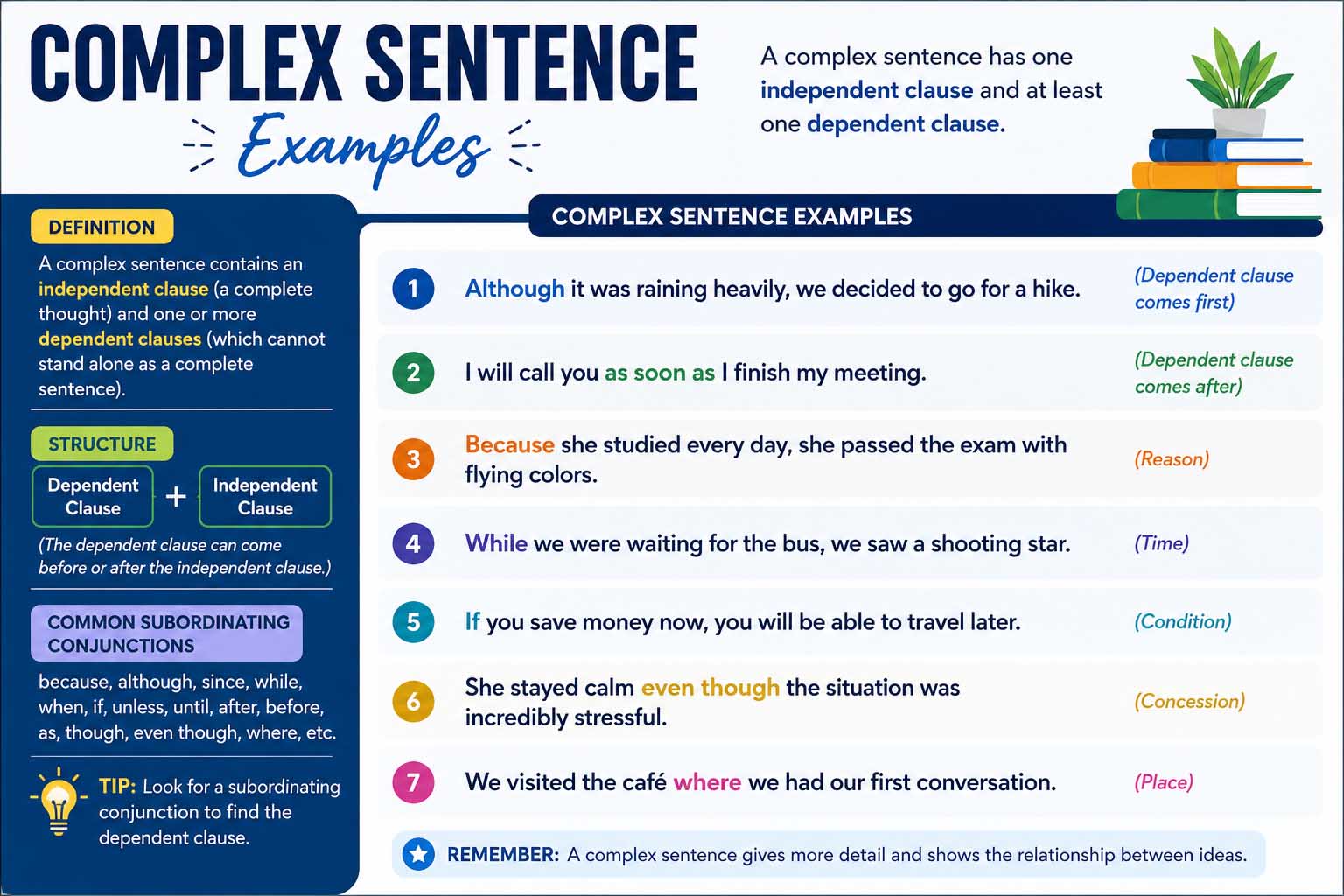
A complex sentence has one independent clause and at least one dependent clause. An independent clause is a complete thought that can stand alone. In contrast, a dependent clause cannot stand alone, because it begins with a word that makes it rely on the main clause.
According to a college writing center guide, the dependent clause includes a subordinating conjunction, such as “although,” “after,” “because,” “before,” “even though,” “since,” “unless” or “while.” Here are two versions of the same idea:
- Because it was raining, we stayed inside.
- We stayed inside because it was raining.
Both sentences mean the same thing. However, the dependent clause moves, and that changes the punctuation.
Clear sentences also support clear paragraphs. For example, it helps when you study what text structure is, because organized writing depends on connecting ideas from one sentence to the next.
Why Complex Sentence Examples Matter
Complex sentences show how ideas relate. Compare these two versions:
- Short sentences: I was tired. I finished my homework.
- Complex sentence: Although I was tired, I finished my homework.
The second version explains the link between the two ideas. As a result, complex sentences help writers explain reasons, show contrast, describe time, state conditions and vary their style.
Writers who use only short sentences often sound repetitive. Therefore, mixing simple and complex sentences creates a more natural flow.
Subordinating Conjunctions in Complex Sentence Examples
The conjunction you choose decides how the two clauses relate. Use this table as a quick guide:
| Relationship | Common conjunctions | Example |
|---|---|---|
| Reason | because, since | Since the bus was late, we missed the meeting. |
| Contrast | although, even though, while | Although he was nervous, he gave a great speech. |
| Time | after, before, when, while | When the rain stopped, the children played outside. |
| Condition | if, unless | Unless you ask, no one will know you need help. |
Changing the conjunction changes the meaning. For instance, “Nick watched cartoons after he did his homework” means something very different from the same sentence with “before.”
How to Identify a Complex Sentence
Use this quick process:
- First, look for a subordinating conjunction, such as “because,” “although” or “when.”
- Next, find the clause that begins with it. That clause cannot stand alone.
- Then check that the rest of the sentence is a complete thought.
- Finally, if both parts are present, you have a complex sentence.
For example, in “Since the library was closed, we studied at home,” the independent clause is “we studied at home.” The dependent clause is “Since the library was closed.” Without the independent clause, the sentence would be incomplete.
Easy Complex Sentence Examples for Everyday English
Here are simple examples you may hear or use every day. Notice that each one has one complete idea and one supporting clause.
| Dependent clause | Independent clause |
|---|---|
| Although I was hungry | I waited until dinner. |
| Because she practiced daily | she improved quickly. |
| After the movie ended | we walked home. |
| While I cooked | my brother set the table. |
| If you study consistently | you will feel more confident. |
| Before school started | I reviewed my notes. |
| Even though it was difficult | they finished the project. |
| When the rain stopped | the children played outside. |
Complex Sentence Examples for School Assignments
Teachers often expect more than simple sentences in essays. These examples suit school writing:
- Many countries keep investing in renewable energy because it reduces pollution.
- Although history contains many conflicts, it also teaches valuable lessons.
- Since technology changes rapidly, students should keep learning new skills.
- The class discussed the results after the experiment ended.
- While reading the novel, I noticed several recurring themes.
- Even though the assignment was challenging, everyone completed it on time.
- If schools encourage curiosity, students become more independent learners.
- Scientists reach stronger conclusions when they collect more evidence.
As a result, sentences like these make academic writing sound more polished.
Complex Sentence Examples by Subject
Once you know the structure, you can use it in almost any subject.
Science
- Plants cannot survive long in complete darkness because they need sunlight.
- Since water expands when it freezes, pipes may burst in winter.
- After the chemical reaction ended, the solution changed color.
History
- Although the battle was won, the war continued for several years.
- Cities became wealthier because trade routes expanded.
- After the treaty was signed, both countries reduced military activity.
Literature
- Although the main character appeared confident, she secretly feared failure.
- Readers questioned every event since the narrator was unreliable.
- After I read the final chapter, I understood the author’s message.
Everyday Life
- I got soaked on the way home because I forgot my umbrella.
- Although my phone battery was low, I finished the call.
- When my friend arrived, we started cooking dinner.
Complex vs. Simple and Compound Sentences
Students often confuse the sentence types. This table shows the difference:
| Type | Clauses | Example |
|---|---|---|
| Simple | One independent clause | I went home. |
| Compound | Two independent clauses joined by “and,” “but” or “or” | I felt sick, so I went home. |
| Complex | One independent clause and at least one dependent clause | Because I felt sick, I went home. |
| Compound-complex | Two or more independent clauses and at least one dependent clause | Because I felt sick, I went home, and I rested all day. |
Complex sentences give more context, so your ideas become clearer. Meanwhile, you can read more about the last type in this guide to compound-complex sentences.
Comma Rules for Complex Sentences
Punctuation depends on which clause comes first. According to the same college writing center guide, the rule is simple.
- When the dependent clause comes first, use a comma: Although it rained, we continued hiking.
- When the independent clause comes first, a comma is usually not needed: We continued hiking although it rained.
Also, some dependent clauses begin with “who,” “which” or “that” instead of a subordinating conjunction, as in “The student who finished first helped the others.” These are still dependent clauses.
Common Mistakes Students Make
Complex sentences become easier once you know what to avoid.
- Leaving out the independent clause. “Because I was late.” is a fragment. Instead, write “Because I was late, I missed the bus.”
- Piling on too many clauses. Long sentences with several dependent clauses become confusing, so keep each sentence focused on one main idea.
- Misplacing commas. Remember to add a comma after an opening dependent clause.
- Using the wrong conjunction. “Because” and “although” show opposite relationships, so choose carefully.
Practice: Build Your Own Sentences
The fastest way to improve is regular practice. Start with a simple sentence, ask a question about it, and then combine the answer with the sentence.
- Simple sentence: I stayed home. Question: Why? Answer: Because I felt sick. Combined: Because I felt sick, I stayed home.
- Simple sentence: We celebrated. Question: When? Answer: After we finished the project. Combined: After we finished the project, we celebrated.
Now try these pairs. Combine each one into a complex sentence before you read the answers.
- I finished my homework. I watched television afterward.
- She practiced every day. She became an excellent pianist.
- The weather improved. We went hiking.
- He felt nervous. He gave an outstanding speech.
Possible answers:
- After I finished my homework, I watched television.
- Because she practiced every day, she became an excellent pianist.
- When the weather improved, we went hiking.
- Although he felt nervous, he gave an outstanding speech.
Using Complex Sentences in Essays
Complex sentences help essays sound organized and thoughtful. For example, instead of “Recycling helps the environment. Many people still do not recycle,” you could write, “Although recycling helps the environment, many people still do not recycle.” This version connects the ideas more effectively.
Also, use complex sentences to add evidence and explanation after a clear opening line. These topic sentence examples show how to start a paragraph well. Likewise, these introduction paragraph examples show how writers combine hooks with varied sentence structures.
At the same time, do not make every sentence complex. Strong writing mixes short, medium and longer sentences to keep readers interested.
Tips for Better Sentence Writing
- Start with short ideas before you combine them.
- Choose a conjunction that clearly shows the relationship.
- Read each sentence aloud to check the flow.
- Keep each sentence focused on one main point.
- Practice rewriting simple sentences into complex ones.
Reading helps too. For example, learning the types of context clues improves comprehension, and better reading leads to better writing because you notice how experienced authors build sentences.
Frequently Asked Questions
Are they difficult to learn?
No. Once you understand independent and dependent clauses, complex sentences become much easier with practice.
Can a sentence start with a dependent clause?
Yes. For example, “Although it was late, we continued studying.” Simply add a comma after the dependent clause.
Do you always need a comma?
No. If the dependent clause follows the independent clause, a comma is usually not needed, as in “We continued studying although it was late.”
What is the difference between complex and compound sentences?
A complex sentence has one independent clause and at least one dependent clause. In contrast, a compound sentence has two independent clauses joined by a word such as “and,” “but” or “or.” A compound-complex sentence combines both structures.
Why do teachers encourage them?
They help students explain ideas clearly, show how concepts relate and write more smoothly.
Key Takeaways on Complex Sentence Examples
Learning complex sentence examples is one of the easiest ways to improve your writing. First, start with one independent clause. Next, add a related dependent clause, and then choose the right subordinating conjunction.
The goal is not to make every sentence long. Instead, make each sentence meaningful, easy to understand and connected to the ideas around it. As a result, regular practice will help you write more naturally and feel more confident in every assignment.