
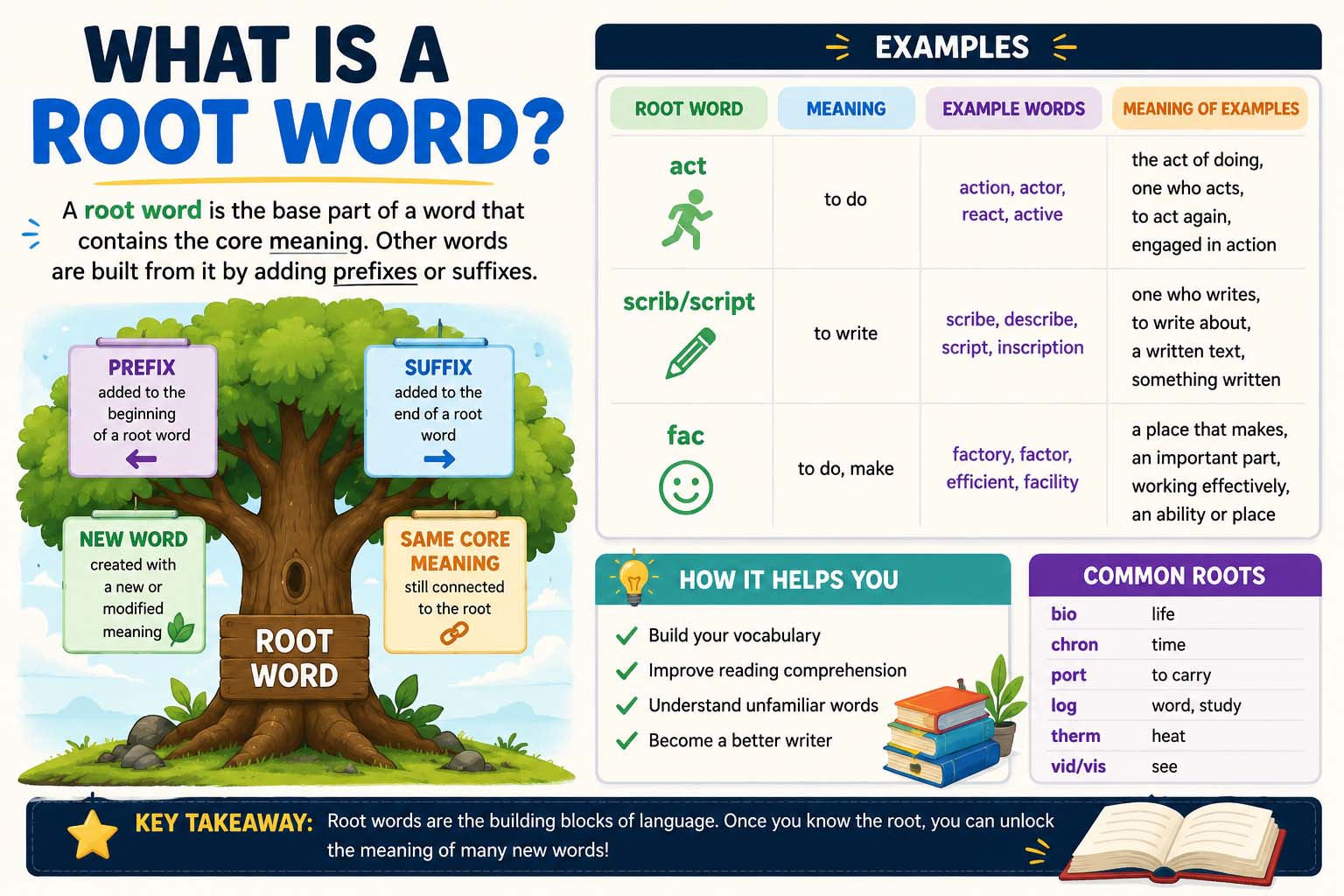
Have you ever noticed that “help” sits inside “helpful,” “helpless” and “helping”? That shared part is a root. So, what is a root word? A root word is the basic part of a word that carries its main meaning. Other words are built from it by adding parts at the start or the end.
Learning roots helps with vocabulary, spelling and reading. Therefore, this guide gives a simple definition, clear examples and an easy method for finding the root of any word.
What Is a Root Word?
A root word is the core of a word. It holds the most basic meaning, and other words grow from it. For example, “help” is the root of helpful, helpless and helping. Also, prefixes and suffixes attach to a root to change its meaning or its job in a sentence.
The root of a word is the part that remains after you remove its prefixes and suffixes. For example, take “unhappiness.” First, remove un- at the start. Then remove -ness at the end. The root “happy” remains, although the y changes to i when -ness is added.
Similarly, “replay” has the prefix re- and the root “play.” The root tells you the action, and the prefix tells you it happens again.
Roots are often called base words. However, some teachers treat the two terms as slightly different. You will see how in the section on free and bound roots.
Root Word Examples
Here are some common roots and the words built from them.
| Root | Meaning | Example words |
|---|---|---|
| act | do | action, active, actor |
| form | shape | inform, reform, formation |
| write | put words on paper | rewrite, writer, writing |
| play | take part in a game or fun | replay, player, playful |
| move | change place | remove, movement, moved |
In practice, the root is the shared part you see in each row. Because the words in each row share a root, they also share a core idea. As a result, one root can help you understand many words at once.
Free and Bound Roots
Not every root can stand alone. A free root is a complete word by itself, such as “help,” “play” or “just.” In contrast, a bound root only works with a prefix or suffix.
For example, the Latin root “dict” means “to say.” It is not an English word alone, but it appears in “diction.” Likewise, the Latin root “aud” means “to hear,” and it appears in “audio,” “audible” and “auditorium.” Bound roots often come from Latin or Greek. However, some Greek roots, such as “scope,” can stand alone or join other roots, as in “microscope” and “telescope.”
Some teachers also use the term “base word” for a complete word that can take prefixes and suffixes, such as “meter.” Others treat the two terms as the same. Therefore, follow the wording your teacher uses.
Root Word vs. Prefix and Suffix
Three parts build most English words:
- Root: the core meaning, such as “read.”
- Prefix: a part added at the start, such as re- (again) in “reread.”
- Suffix: a part added at the end, such as -ing in “reading.”
Prefixes and suffixes carry meaning too. For example, un- means “not” in “unusual,” and -est means “the most” in “smartest.” For more examples, see this Reading Rockets guide to roots, suffixes and prefixes.
Together, roots, prefixes and suffixes create thousands of English words.
How to Find the Root Word in 3 Steps
- First, look for a prefix at the start, such as un-, re-, pre- or dis-. For example, remove pre- from “preview,” and “view” remains.
- Next, look for a suffix at the end, such as -ing, -ed, -ly or -ful. For example, remove -ly from “carefully” to get “careful.” Then remove -ful to reach “care.”
- Then ask which part holds the core meaning. That part is usually the root.
Finally, check your answer. Say the root aloud, and see whether related words share it. For example, “disagreement” breaks into dis- (not), “agree” and -ment, so the root is “agree.”
Common Latin and Greek Roots
Many school words come from Latin and Greek, so these roots are worth learning first.
| Root | Meaning | Language | Example words |
|---|---|---|---|
| port | carry | Latin | transport, portable, import, export |
| spect | look | Latin | inspect, respect, spectator, perspective |
| dict | say | Latin | predict, diction, dictate |
| aud | hear | Latin | audio, audible, auditorium |
| bio | life | Greek | biology, biography, biodegradable |
| tele | far | Greek | telephone, telescope |
| geo | earth | Greek | geography, geology |
| chron | time | Greek | chronology, synchronize |
Because “port” means carry, words like import, export and transport all relate to carrying something. Therefore, knowing one root can unlock a whole family of words.
Why Roots Help Reading and Writing
Once you know what is a root word, you can break down hard words. For example, you may meet “predictable” for the first time. Pre- means “before” and “dict” means “say,” so you can guess that it describes something you can tell in advance.
Roots help writing too. They show how words connect, so you can choose precise words and avoid repeating the same one. For instance, the root “spect” links inspect, spectator and perspective.
Roots work best together with the big picture. For example, finding the central idea of a passage can confirm your guess about a hard word.
Tips to Learn Roots Faster
- First, learn common Latin and Greek roots, such as bio (life), tele (far), geo (earth) and chron (time).
- Next, make flashcards with the root on the front and the meaning and examples on the back.
- Then break new words into prefix, root and suffix.
- Also, read often, because books and articles show the same roots again and again.
Common Mistakes Students Make
- Memorizing roots without learning their meaning.
- Ignoring prefixes and suffixes, which can change the meaning a lot.
- Thinking every root stands alone, because bound roots like “dict” and “aud” do not.
- Forgetting spelling changes, such as “happy” becoming “happi-” in “happiness.”
Therefore, always check that the root you pick has a real meaning and appears in related words.
Practice Finding the Root Word
Now test yourself. Find the root before you read each answer.
- Unkind: the root is “kind,” and the prefix is un-.
- Careless: the root is “care,” and the suffix is -less.
- Rewriting: the root is “write,” with the prefix re- and the suffix -ing.
- Disagreement: the root is “agree,” with the prefix dis- and the suffix -ment.
- Helpful: the root is “help,” and the suffix is -ful.
As a result, regular practice makes this skill faster and easier.
Frequently Asked Questions
What is a root word?
It is the basic part of a word that carries its main meaning. Other words are built from it with prefixes and suffixes.
What is the root of a word?
The root is the core part that remains after you remove prefixes and suffixes. For example, the root of “unhappiness” is “happy.”
What is a word root?
A word root is the basic piece that a word is built from. It may come from English, Latin or Greek.
Is a base word the same as a root word?
Often, yes. Some teachers use the two terms to mean the same thing. However, others say a base word is a complete word, like “meter,” while a root may need a prefix or suffix, like “dict.”
Can a root stand alone?
Sometimes. Free roots such as “help” stand alone, while bound roots such as “aud” need a prefix or suffix.
Why are roots important?
They help you build vocabulary, guess new words, spell better and read with more confidence.
Key Takeaways About the Root Word
Knowing what is a root word is one of the most useful skills for vocabulary and reading. The root carries the core meaning, while prefixes and suffixes add detail.
First, find the prefix and the suffix. Next, name the root. Then use it to guess related words. As a result, you will understand new words faster and read with more confidence.