An AP Psychology study guide helps you prepare for the Advanced Placement Psychology exam in a clear, organized way. Specifically, it brings together the main units, key terms, research methods and exam skills in one place. As a result, you can review faster and feel more confident on test day.
However, the exam asks for more than memorized definitions. Therefore, you must also apply theories, analyze real situations and interpret research. So, this guide shows you how, step by step.
What Is AP Psychology?
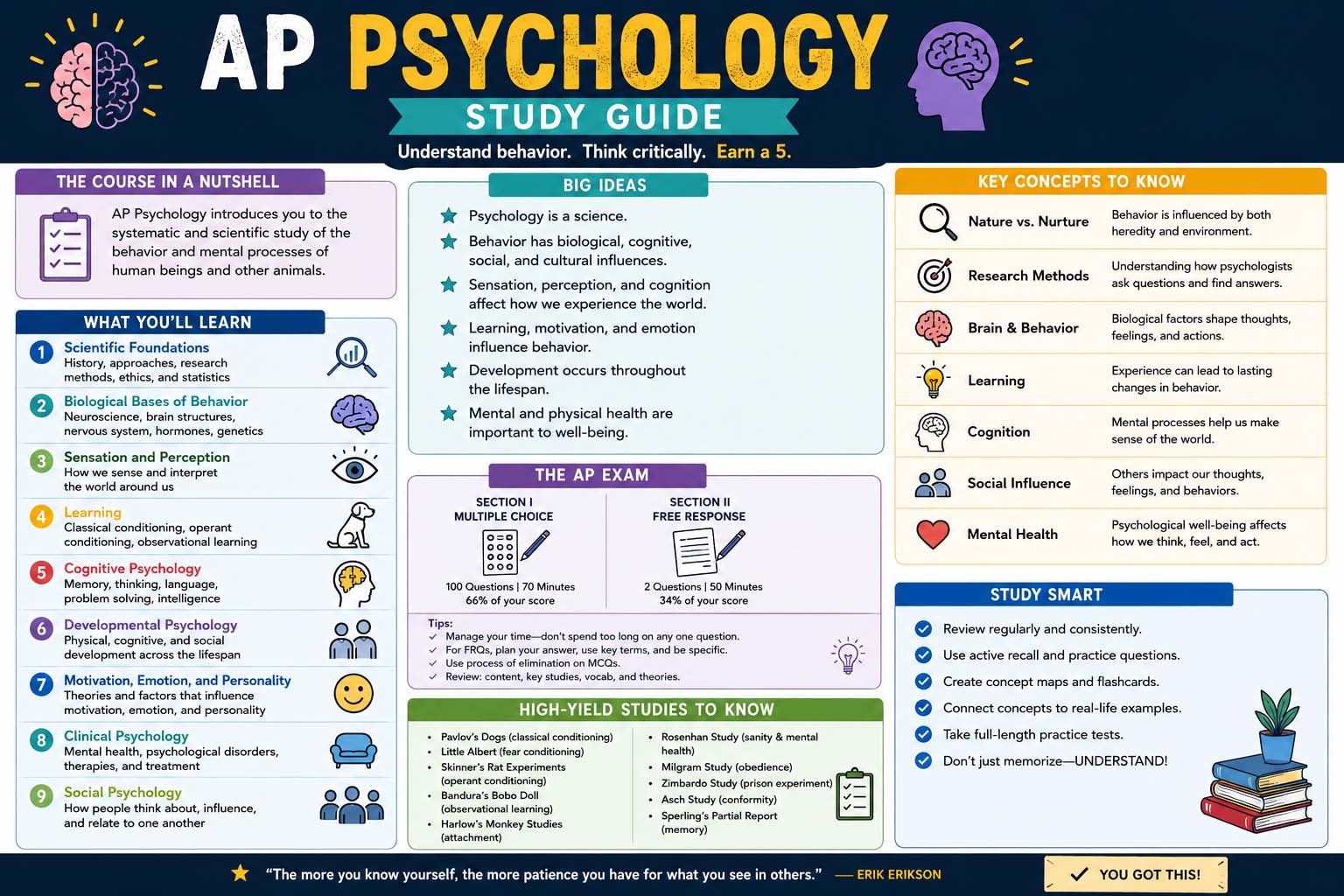
Simply put, AP Psychology is a college-level high school course about the science of behavior and mental processes. In this course, you study topics such as:
- First, the brain and the body
- Memory, thinking and learning
- Next, human development across the lifespan
- Personality, motivation and emotion
- Also, mental health and psychological disorders
- Finally, social behavior and group influence
Moreover, the course builds critical thinking exercises and scientific reasoning skills. Depending on your score, you may also earn college credit.
AP Psychology Study Guide: Exam Format
First, learn how the test works. According to the College Board’s AP Psychology exam page, students take the exam digitally in the Bluebook app. It has two sections:
| Section | Questions | Time | Score weight |
|---|---|---|---|
| Multiple choice | 75 | 90 minutes | 66.7% |
| Free response | 2 | 70 minutes | 33.3% |
In the free-response section, the two questions differ. For example, the first is an article analysis question based on one summarized research study. In contrast, the second is an evidence-based question that uses three summarized sources on one topic. Overall, each is worth up to 7 points.
Because of this format, strong results need both content knowledge and clear thinking. Also, the College Board has updated the course, so always check that your notes match the current version.
AP Psychology Study Guide: 5 Key Units
Currently, the revised course has five units. Moreover, each unit makes up roughly 15% to 25% of the multiple-choice section. Therefore, a balanced review matters more than studying only your favorite topics.
| Unit | Main topics |
|---|---|
| 1. Biological Bases of Behavior | Heredity and environment, sleep, sensation |
| 2. Cognition | Perception, thinking, memory, intelligence |
| 3. Development and Learning | Lifespan development, conditioning, language |
| 4. Social Psychology and Personality | Attribution, attitudes, personality, motivation, emotion |
| 5. Mental and Physical Health | Health psychology, disorders, treatment |
However, research methods and data skills no longer have their own unit. Instead, they appear in all five units, so you will practice them throughout the course.
AP Psychology Unit 1 Study Guide: Biological Bases
This unit explains how biology shapes thoughts and actions. For this reason, review how heredity and environment interact, how sleep works and how the senses collect information.
In addition, learn the major brain areas, such as the frontal lobe, the amygdala and the hippocampus. Overall, diagrams and labeling exercises can help these ideas stick.
AP Psychology Unit 2 Study Guide: Cognition
Cognition covers how people perceive, think, remember and solve problems. First, start with perception and decision-making. Next, study the three memory stages:
- Sensory memory first holds information for a very short time.
- Short-term memory then stores information briefly.
- Long-term memory finally keeps knowledge and experiences for years.
Finally, review encoding, storage, retrieval, forgetting and intelligence, since memory questions appear often.
AP Psychology Unit 3 Study Guide: Development and Learning
Here you study how people change over time and how they learn. For example, key figures include Jean Piaget (cognitive development), Erik Erikson (psychosocial stages) and Lawrence Kohlberg (moral development).
Learning is just as important. For instance, Ivan Pavlov described classical conditioning, B.F. Skinner studied operant conditioning and Albert Bandura explained observational learning. Therefore, practice spotting each type in real-life examples.
AP Psychology Unit 4 Study Guide: Social Psychology and Personality
This unit looks at how people influence one another. For example, topics include attribution, attitudes, conformity and obedience. In addition, the classic studies by Solomon Asch and Stanley Milgram are worth knowing.
It also covers four personality theories: psychoanalytic, humanistic, social-cognitive and trait. Furthermore, you review motivation and emotion.
AP Psychology Unit 5 Study Guide: Mental and Physical Health
This unit explains how psychologists describe, classify and treat disorders. For instance, common examples include anxiety disorders, depression, bipolar disorder and schizophrenia. In each case, know the symptoms, likely causes and treatment approaches.
Additionally, health psychology and positive psychology belong here.
AP Psychology Study Guide: Research Methods
Research skills now show up in every unit, so master them early. Know these methods:
- Experiments test cause-and-effect relationships.
- Surveys also collect information from large groups.
- Naturalistic observation then studies behavior in real-world settings.
- Case studies finally give an in-depth look at one person or group.
For instance, learning how to write a case study can help you understand that method better. Additionally, be ready to explain independent and dependent variables, sampling, ethics, and the difference between correlation and causation.
How to Use This AP Psychology Study Guide: 6-Step Plan
A clear plan keeps you on track. Therefore, follow these steps:
- Review the course framework. First, list all five units and their topics.
- Create a weekly schedule. Next, assign one unit or topic to each study session.
- Use active recall. Then test yourself instead of rereading your notes.
- Practice vocabulary. For this, flashcards work well for the many psychology terms.
- Complete practice questions. After that, try multiple-choice and free-response sets often.
- Review weak areas. Finally, spend extra time on the topics that feel hard.
Study Tips for AP Psychology
- Make flashcards. First, they are great for vocabulary review.
- Draw concept maps. Visual learning also improves understanding.
- Teach a friend. For example, explaining a topic aloud reinforces what you know.
- Practice FRQs. Also, free-response questions test how well you apply ideas and use evidence.
- Study in short sessions. In general, regular reviews beat last-minute cramming.
Consistency leads to stronger long-term memory. Likewise, learning how to create a study guide for each unit makes your revision more organized.
Example AP Psychology Question
Question: A student receives praise after finishing homework and then begins studying more often. Which learning principle does this show?
Answer: Positive reinforcement.
Explanation: In this case, the praise makes the behavior more likely to happen again. Thus, application questions like this one reward understanding, not just memorization.
Common Mistakes Students Make
- Memorizing without understanding. Instead, the exam rewards application, not just definitions.
- Ignoring research methods. However, these concepts appear in every unit.
- Skipping FRQ practice. After all, writing skills matter on exam day.
- Studying only favorite topics. Instead, give every unit enough time.
Overall, avoiding these mistakes improves your results.
Frequently Asked Questions
What is the best AP Psychology study guide?
Generally, the best guide combines unit reviews, vocabulary practice, active recall and official practice questions.
How hard is AP Psychology?
Many students find the course manageable. However, success requires steady studying and strong concept application.
What should I study first?
First, start with the basics, such as psychological perspectives and research methods. Then move through the five units in order.
Is AP Psychology mostly memorization?
No. You must also analyze situations, apply concepts and use evidence from research.
What should I do after the exam?
Afterward, look ahead to your goals. For example, learn what is a fellowship to see how funding can support future study.
Key Takeaways on the AP Psychology Study Guide
In short, a strong AP Psychology study guide helps you organize your preparation and focus on what the exam really tests. By reviewing all five units, practicing research methods and answering application questions, you can approach the exam with confidence.