Understanding what is a scholarly source is important for students, researchers, and anyone who wants reliable information. Scholarly sources are materials written by experts and reviewed by professionals before publication. These sources are often used in schools, colleges, universities, and academic research because they provide trustworthy and evidence-based information. When writing essays, research papers, or academic assignments, using scholarly sources helps improve the quality and credibility of your work.
A scholarly source usually includes research findings, detailed analysis, references, and citations. These materials are written in a formal tone and are supported by facts instead of personal opinions. Journals, academic books, and research articles are common examples of scholarly sources. Learning how to identify these materials can help readers avoid misinformation and improve academic success.
What Is Considered a Scholarly Source
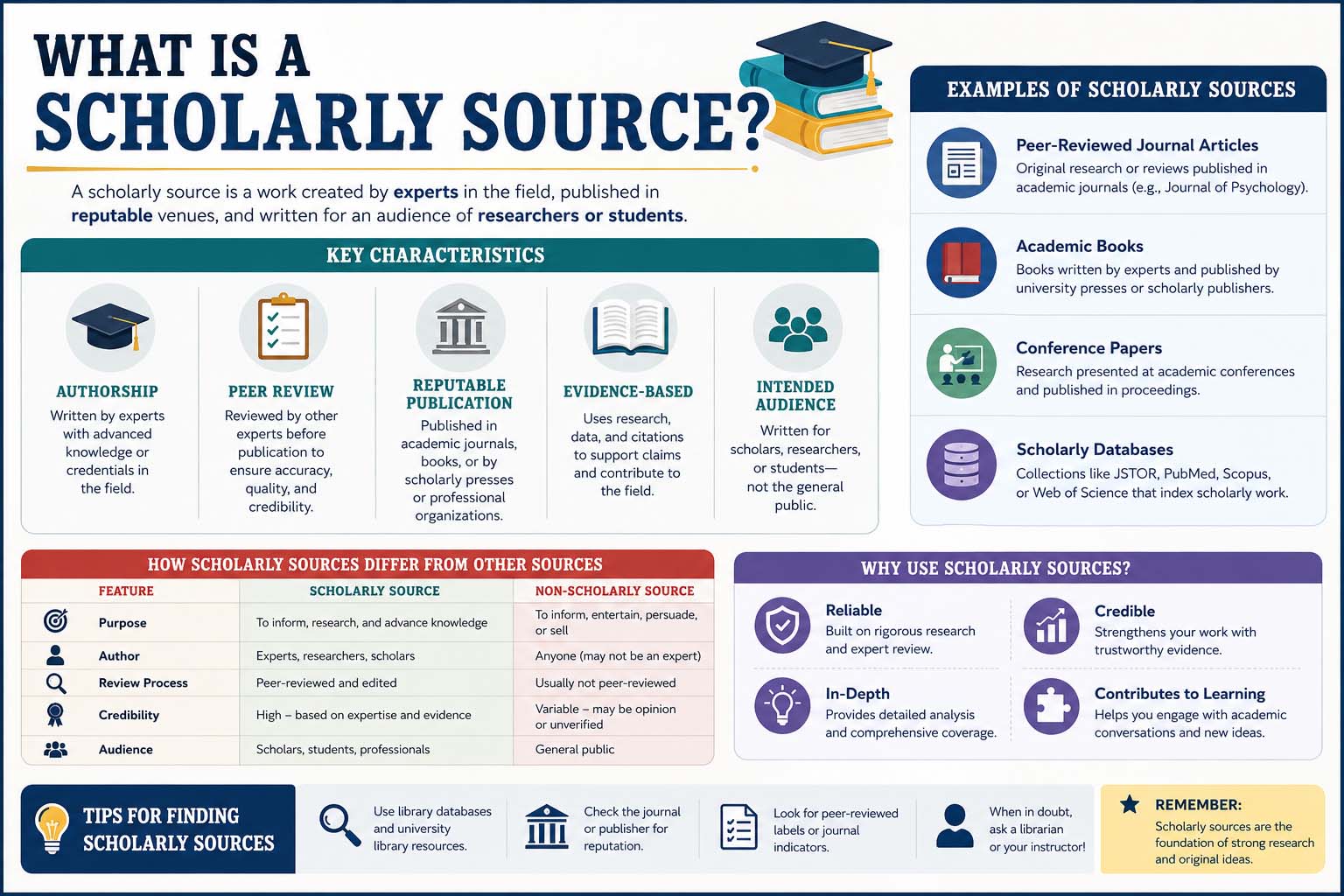
Many students ask what is considered a scholarly source when they begin academic writing. A scholarly source is generally created by experts who have strong knowledge in a specific subject area. These sources are often published in academic journals or by educational institutions. Before publication, the content usually goes through a peer-review process where other experts evaluate the quality and accuracy of the work.
Scholarly sources contain detailed information and are supported by research, statistics, and references. Authors usually include citations to show where their information comes from. This makes the content more reliable because readers can verify the facts. Academic journals, dissertations, university press books, and scientific studies are all considered scholarly sources.
Another important feature of scholarly writing is the formal language. These sources avoid casual language and focus on objective information. Articles are often lengthy and include sections such as an introduction, methodology, results, and conclusion. This structure helps readers understand the research process and findings clearly.
Libraries and university databases are common places to find scholarly sources. Databases such as JSTOR, PubMed, and Google Scholar provide access to academic materials from trusted publishers. Professors and teachers often recommend using these databases because the information is more credible than random websites found online.
What Is a Scholarly Source Example
Students frequently search for what is a scholarly source example to better understand the concept. One clear example of a scholarly source is a peer-reviewed journal article about climate change published in an academic science journal. This article would include research data, references, graphs, and information written by scientists who specialize in environmental studies.
Another example is a medical research paper published in a healthcare journal. Such papers are written by doctors or researchers and contain scientific evidence based on studies and experiments. These articles help medical professionals and students stay informed about new discoveries and treatments.
Books published by university presses are also scholarly sources. For instance, a history book written by a professor and published by a respected academic institution would be considered scholarly. These books are often carefully researched and reviewed before publication.
Dissertations and theses created by graduate students can also serve as scholarly sources. These works contain original research and are supervised by academic professionals. Although they may not always be peer-reviewed in the same way as journals, they still provide valuable academic information.
Understanding what is a scholarly source example can help students choose better references for assignments. Reliable sources strengthen arguments and show that the writer has conducted proper research.
What Is a Scholarly Source?
Many people still wonder what is a scholarly source? In simple terms, a scholarly source is a publication designed to inform readers about academic research or professional studies. These sources are intended for experts, students, and researchers rather than the general public.
Scholarly sources are different from ordinary online articles or magazines because they are based on evidence and research. The information is usually reviewed by experts before being published. This process ensures that the content meets high academic standards.
Academic journals are among the most common scholarly sources. These journals publish articles written by researchers in subjects such as science, business, education, technology, and medicine. Articles often include charts, tables, and references to support the findings.
The author’s credentials are another important part of a scholarly source. Most scholarly articles are written by professors, researchers, or professionals with advanced degrees. Their experience and expertise make the information more trustworthy.
What Is a Non Scholarly Source
To fully understand academic research, it is also necessary to know what is a non scholarly source. Non scholarly sources are materials created for the general public rather than academic audiences. These sources are usually easier to read and may focus more on entertainment, opinions, or quick information instead of detailed research.
Examples of non scholarly sources include newspapers, blogs, magazines, and many websites. While these sources can still provide useful information, they are not always reviewed by experts. This means the information may sometimes be biased or inaccurate.
For example, a celebrity magazine article discussing health trends would not be considered scholarly because it lacks scientific evidence and academic references. Similarly, personal blogs often share opinions rather than verified facts.
Non scholarly sources usually use simple language and colorful images to attract readers. They are designed to be entertaining and accessible rather than deeply analytical. Unlike scholarly articles, they often do not include citations or detailed research methods.
Why Scholarly Sources Matter
Scholarly sources play a major role in education and research because they provide dependable information. In a world where misinformation spreads quickly online, academic sources help readers find accurate facts supported by evidence.
Using scholarly sources also improves critical thinking skills. Readers learn how to analyze research, evaluate evidence, and understand complex topics. This process helps students become better researchers and writers.
Conclusion
Understanding what is a scholarly source is essential for academic success and reliable research. Scholarly sources are written by experts, reviewed by professionals, and supported by evidence. They include journal articles, academic books, and research papers that provide trustworthy information.