
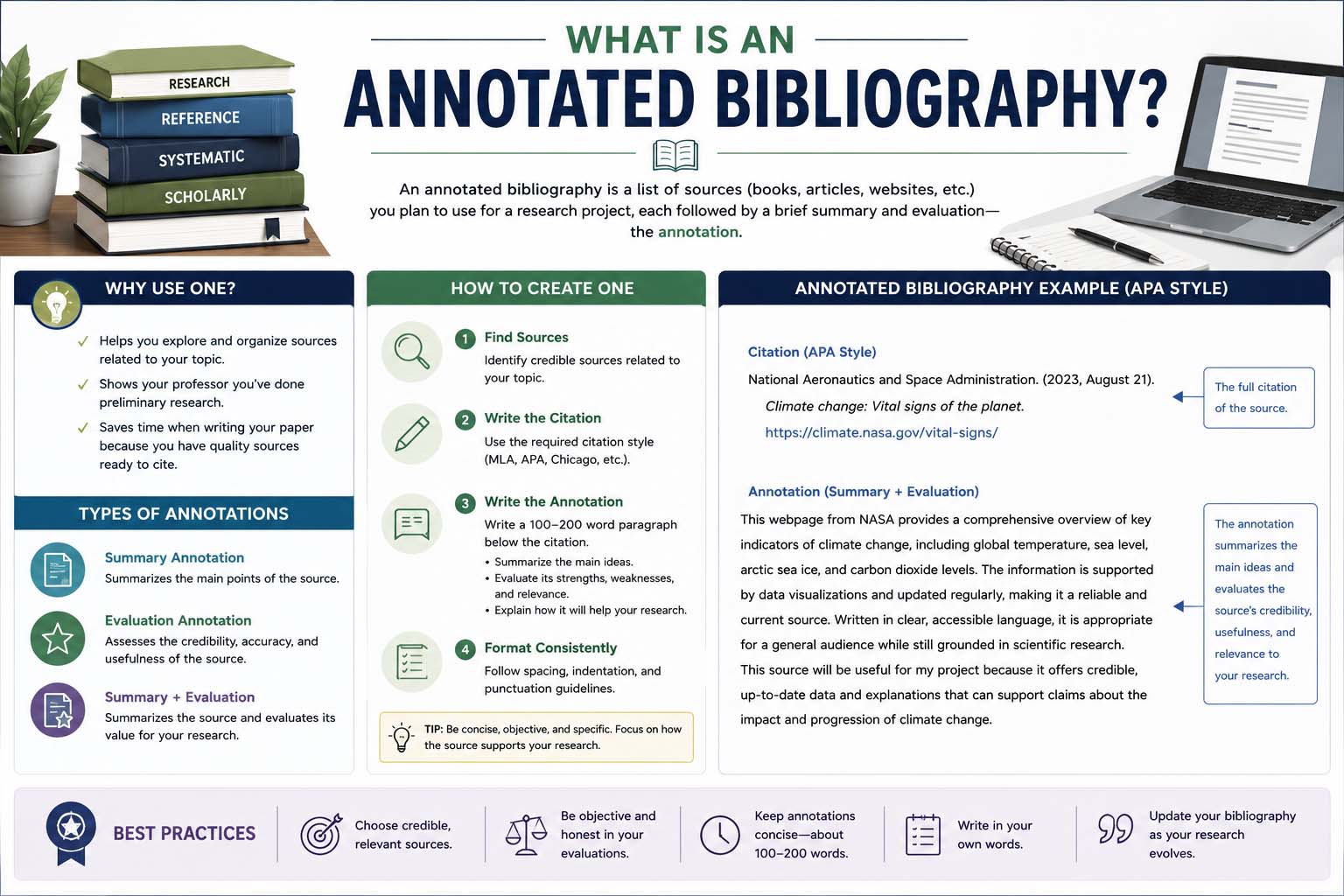
Research assignments often require more than simply collecting sources. Students are expected to evaluate information, understand how sources contribute to a topic, and demonstrate critical thinking. One common academic tool used for this purpose is an annotated bibliography.
Many students ask, what is an annotated bibliography? Understanding this concept can improve research skills, strengthen academic writing, and help organize information more effectively.
Whether you’re preparing a research paper, thesis, dissertation, or classroom assignment, knowing how to create an annotated bibliography is an important academic skill.
This guide explains what an bibliography is, its purpose, formatting styles, examples, and step-by-step instructions for creating one successfully.
What Is an Annotated Bibliography?
An bibliography is a list of sources that includes a citation followed by a brief descriptive and evaluative paragraph called an annotation.
The citation identifies the source.
The annotation explains:
- The source’s main ideas
- Its usefulness
- Its credibility
- Its relevance to the research topic
Unlike a standard , an annotated bibliography provides additional information about each source.
This helps readers understand why the source was selected and how it contributes to a research project.
What Is the Purpose of an Annotated Bibliography?
A common question among students is what is the purpose of an annotated bibliography.
Annotated bibliographies serve several important academic functions.
Organize Research
Evaluate Source Quality
Annotations encourage critical analysis of source reliability and usefulness.
Improve Research Skills
Students learn to assess information rather than simply collect it.
Support Future Writing
Annotations provide useful notes when writing research papers later.
Demonstrate Understanding
Teachers often use annotated bibliographies to assess research progress and comprehension.
Because of these benefits, annotated bibliographies are widely used in high school, college, and graduate-level coursework.
Components of an Annotated Bibliography
Most bibliography entries contain two parts.
Citation
The citation follows a specific style format such as:
- APA
- MLA
- Chicago
Annotation
The annotation is typically between 100 and 200 words.
It may include:
- Summary
- Evaluation
- Reflection
- Relevance
Together, these components provide a complete overview of each source.
What Is an Annotated Bibliography Example?
Many students learn best by seeing examples.
What Is an Annotated Bibliography Example?
Below is a simplified example:
Smith, J. (2024). The Impact of Technology on Education. Academic Press.
This book examines how digital tools influence classroom learning. The author discusses online education, student engagement, and technology integration. The source provides valuable background information for research on educational technology. The author’s expertise and extensive references increase the source’s credibility.
This example includes both the citation and a brief explanation of the source’s value.
Types of Annotations
Annotations can serve different purposes depending on assignment requirements.
Descriptive Annotation
Descriptive annotations summarize source content.
They focus on:
- Main arguments
- Topics covered
- Scope of information
Evaluative Annotation
Evaluative annotations assess source quality.
They may discuss:
- Accuracy
- Reliability
- Author expertise
- Research value
Combination Annotation
Many assignments require both summary and evaluation.
This is the most common approach in higher education.
What Is an Annotated Bibliography APA?
Students often need to follow specific citation styles.
What Is an Annotated Bibliography APA?
An APA annotated follows the guidelines established by the American Psychological Association (APA).
Key APA features include:
- Author name
- Publication year
- Title
- Publisher
- Hanging indent format
The annotation appears directly below the citation.
APA style is commonly used in:
- Education
- Psychology
- Social sciences
- Business studies
Always check assignment instructions for exact formatting requirements.
Step-by-Step Guide to Writing an Annotated Bibliography
Creating an bibliography becomes easier when approached systematically.
Step 1: Choose Reliable Sources
Select academic and trustworthy materials relevant to your topic.
Examples include:
- Books
- Journal articles
- Scholarly websites
- Research reports
Step 2: Create the Citation
Step 3: Read the Source Carefully
Identify:
- Main arguments
- Supporting evidence
- Key findings
Step 4: Write a Summary
Briefly explain the source’s purpose and content.
Step 5: Evaluate the Source
Assess:
- Credibility
- Accuracy
- Usefulness
Step 6: Explain Relevance
Describe how the source contributes to your research topic.
Following these steps helps create stronger annotations.
Common Mistakes Students Make
Students often encounter challenges when writing annotated bibliographies.
Summarizing Too Much
Annotations should not become full article reviews.
Ignoring Evaluation
Many students summarize without analyzing source quality.
Poor Citation Formatting
Incorrect citation styles can reduce assignment grades.
Using Weak Sources
Reliable academic sources improve overall research quality.
Being Too Brief
Annotations should provide enough detail to explain source value.
Avoiding these mistakes strengthens academic work.
Benefits of Learning Annotated Bibliography Skills
Developing skills offers long-term academic advantages.
Better Research Organization
Students manage sources more effectively.
Stronger Critical Thinking
Evaluating sources improves analytical skills.
Easier Essay Writing
Annotations provide ready-made research notes.
Improved Academic Performance
Well-organized research often leads to stronger assignments.
These benefits extend beyond individual projects and support future educational success.
Annotated Bibliographies in Higher Education
Annotated bibliographies are widely used in:
High School Research Projects
Students learn basic research techniques.
Undergraduate Coursework
College assignments frequently require annotated bibliographies.
Graduate Programs
Graduate students often prepare extensive annotated bibliographies for theses and dissertations.
Professional Research
Researchers use annotated bibliographies to organize literature reviews and project planning.
The skill remains valuable throughout academic and professional careers.
Tips for Writing Better Annotations
Stay Concise
Focus on essential information.
Use Academic Language
Maintain a professional tone.
Be Objective
Avoid emotional opinions unless specifically requested.
Focus on Relevance
Explain why the source matters to your topic.
Proofread Carefully
Clear writing improves readability and credibility.
These habits help create high-quality annotations.
FAQ
What is an annotated bibliography?
An bibliography is a list of sources that includes citations and explanatory annotations.
What is the purpose of an annotated bibliography?
Its purpose is to summarize, evaluate, and explain the relevance of research sources.
What is an annotated bibliography example?
An annotated bibliography example includes a properly formatted citation followed by a brief summary and evaluation of the source.
What is an annotated bibliography APA?
An APA annotated bibliography follows American Psychological Association citation guidelines while including annotations below each citation.
How long should an annotation be?
Many annotations range from 100 to 200 words, although assignment requirements may vary.
Conclusion
Understanding what is an annotated bibliography is an important step in developing strong research and academic writing skills. More than just a list of sources, an annotated bibliography helps students organize information, evaluate credibility, and demonstrate critical thinking.