Decision-making is a part of everyday life. People make decisions at home, in school, at work, and in business environments. Some decisions are simple and require very little thought, while others become difficult and complicated. Many individuals wonder when does decision-making become more complex because understanding the causes of complexity can improve problem-solving and critical thinking skills.
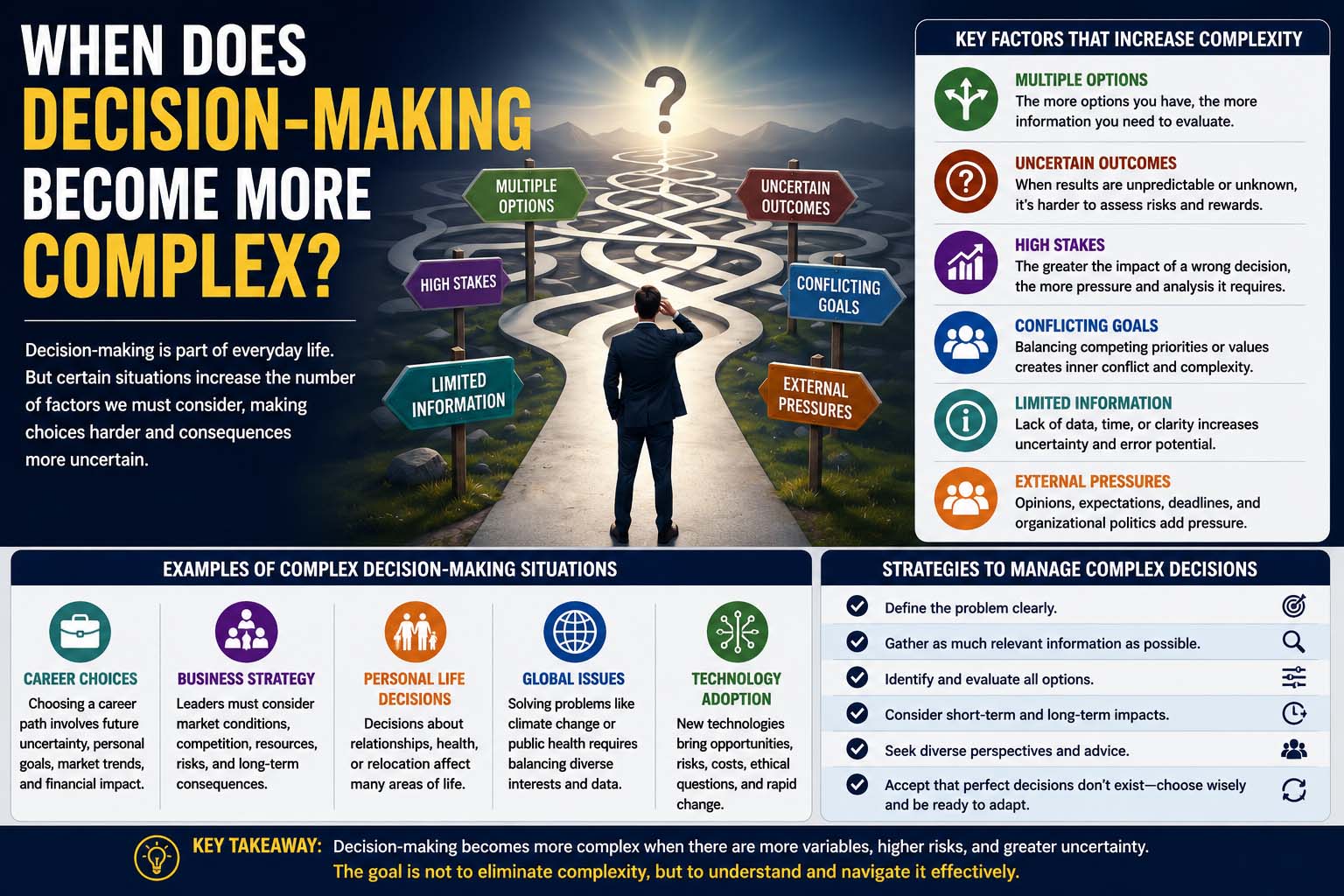
Decision-making becomes more complex when there are multiple choices, uncertain outcomes, emotional pressure, limited information, or significant risks involved. As responsibilities increase and situations become more unpredictable, making the right decision often requires deeper analysis and careful planning. Businesses, governments, and individuals all face complex decisions that can affect future success and stability.
Understanding the Decision-Making Process
Decision-making is the process of choosing between two or more options. Every decision involves evaluating information, considering possible outcomes, and selecting the best course of action.
Simple decisions usually involve low risk and limited consequences. For example, choosing what to eat for lunch or what movie to watch often requires little effort.
The complexity of decision-making increases when more factors must be considered at the same time.
Multiple Choices Increase Complexity
One major reason when does decision-making become more complex is the number of available choices. The more options a person has, the harder it becomes to compare and evaluate them effectively.
For example, a customer selecting between two smartphones may decide quickly. However, if there are dozens of models with different features, prices, and reviews, the process becomes more confusing.
Businesses often face this challenge when deciding between multiple strategies, suppliers, or investment opportunities. Too many options can create uncertainty and slow the decision-making process.
Lack of Information Makes Decisions Harder
Decision-making becomes more difficult when information is incomplete or unclear. People often struggle to make confident choices when they do not fully understand the situation.
For example, a business owner launching a new product may not know how customers will respond.
Limited information increases the risk of making poor decisions. This is why research, data collection, and analysis are important for reducing uncertainty.
Risk and Uncertainty Create Complexity
Risk is another major factor that explains when does decision-making become more complex. Decisions involving financial loss, safety concerns, or long-term consequences usually require careful evaluation.
Investors often experience complex decision-making because stock markets are unpredictable. A wrong investment choice could lead to major financial losses.
Similarly, medical professionals may face difficult decisions involving patient treatment options where outcomes are uncertain. The possibility of negative consequences makes these decisions more stressful and complicated.
Emotional Pressure Affects Judgment
Emotions play an important role in human decision-making. Stress, fear, excitement, or anxiety can make it harder to think clearly and objectively.
For example, people making decisions during emergencies may act quickly without fully analyzing the situation. Emotional attachment can also influence important personal decisions involving relationships, family, or careers.
Group Decision-Making Challenges
Decision-making often becomes more complicated when multiple people are involved.
In companies, managers and employees may disagree about budgets, strategies, or project plans. Political organizations and governments also face challenges because different groups support different solutions.
Group decision-making can take longer because discussions, debates, and negotiations are required. Conflicts and communication problems may increase complexity further.
Technological and Global Changes
Modern technology and globalization have made many decisions more complex than in the past. Businesses now operate in highly competitive global markets where conditions change rapidly.
Companies must consider international regulations, digital security, customer trends, and technological innovation when making decisions. A decision that works well in one country may not succeed in another market.
Ethical and Moral Considerations
Ethics and morality are important reasons why decision-making becomes more complex. Some decisions involve questions about fairness, honesty, social responsibility, or environmental impact.
For example, businesses may face ethical decisions about employee treatment, environmental policies, or customer privacy. Governments often make decisions involving public safety, healthcare, and human rights.
Balancing profits, laws, and ethical responsibilities can be difficult because different people may have different values and beliefs.
Time Pressure and Deadlines
Time limitations often increase decision-making complexity. When people must make decisions quickly, they may not have enough time to gather information or evaluate alternatives properly.
Emergency situations such as natural disasters, medical emergencies, or financial crises require fast action. In these situations, decision-makers may feel intense pressure to choose quickly while still avoiding mistakes.
The Role of Experience in Decision-Making
Experience can help reduce complexity because experienced individuals often recognize patterns and understand risks more effectively. Professionals who have handled similar situations before may feel more confident when making decisions.
For example, experienced doctors, pilots, and business managers usually make faster and more accurate decisions because of their knowledge and training.
However, even experienced individuals may face complex situations when conditions are completely new or unpredictable.
How to Manage Complex Decisions
There are several ways to improve complex decision-making. Gathering reliable information is one of the most important steps. Research and analysis help reduce uncertainty and improve confidence.
Breaking large decisions into smaller parts can also make the process easier to manage. Comparing advantages and disadvantages carefully helps individuals evaluate choices more clearly.
Seeking advice from experts or trusted individuals can provide valuable insights and different perspectives. Time management and emotional control are also important for making balanced decisions.
Conclusion
Understanding when does decision-making become more complex helps people improve their critical thinking and problem-solving abilities. Decision-making becomes more difficult when there are multiple choices, limited information, emotional pressure, ethical concerns, or high levels of risk involved.
Modern businesses, governments, and individuals face increasingly complex decisions due to globalization, technology, and changing social expectations. While complex decisions can be stressful, careful planning, research, and experience can improve outcomes.