
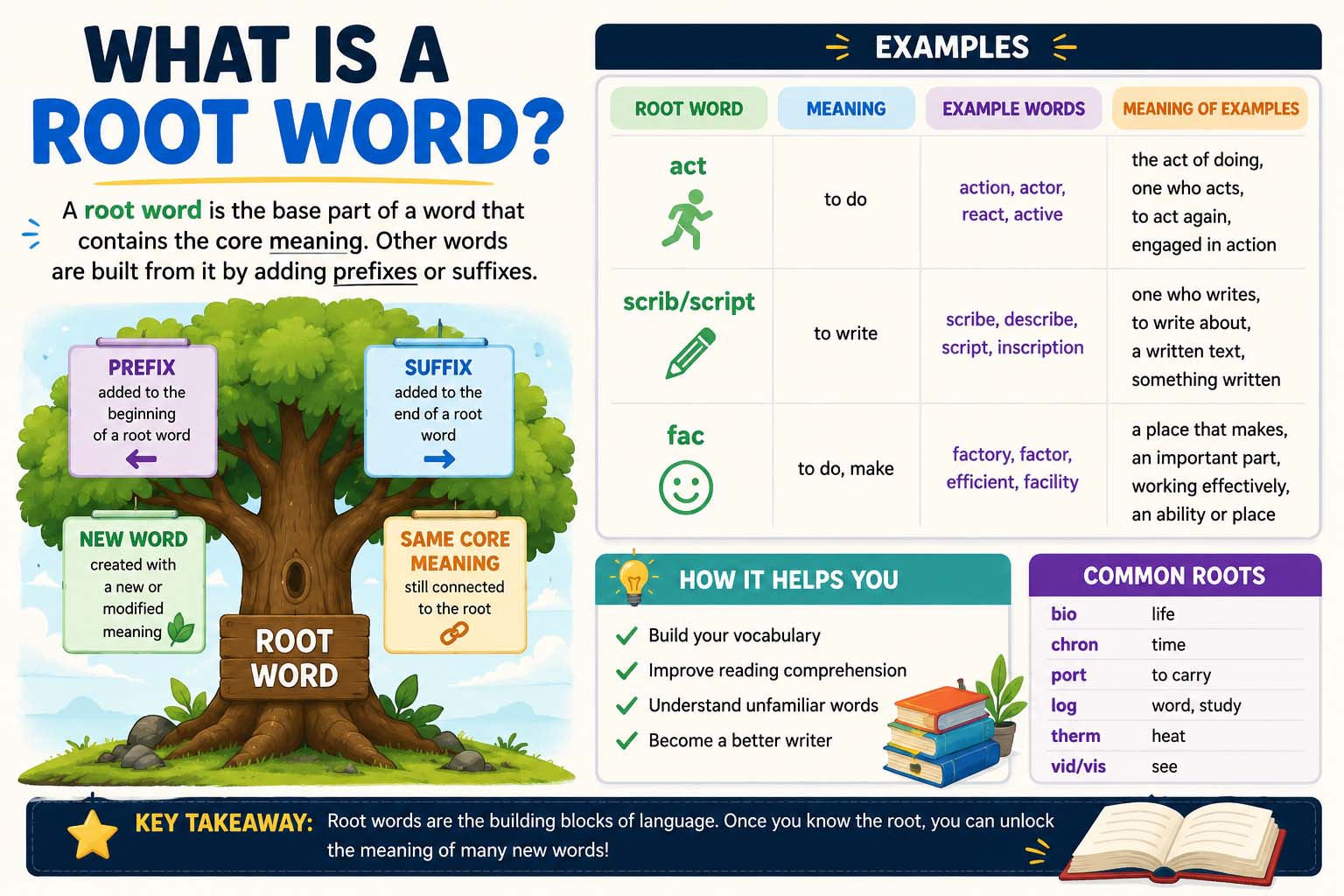
If you’ve ever wondered how words are formed or why certain words share similar meanings, understanding root words is a great place to start. Many students ask, what is a root word, especially when studying vocabulary, reading, spelling, and language arts.
A word is the basic part of a that carries its main meaning. It serves as the foundation from which other words are built. By adding prefixes and suffixes to a root , many new words can be created.
What Is a Root Word? Simple Definition
To answer the question what is a root word?, think of it as the core building block of a word.
For example:
- Help → Helpful
- Help → Helpless
- Help → Helping
The “help” is the because it provides the basic meaning for all related words.
Root words can often stand alone as complete words, although some roots come from Latin or Greek and may not function as independent words in modern English.
Why Are Root Words Important?
Understanding root words offers several academic benefits.
Students who learn common roots can:
- Expand vocabulary faster
- Improve reading comprehension
- Understand unfamiliar words
- Strengthen spelling skills
- Improve writing abilities
- Perform better on tests
Rather than memorizing thousands of individual words, students can learn a smaller number of root words and use them to understand many related terms.
What Is the Root of a Word?
Many learners ask, what is the root of a word?
The root is the part that remains after removing prefixes and suffixes.
Consider the word:
“Unhappiness”
Breakdown:
- Prefix: un-
- Root: happy
- Suffix: -ness
The root “happy” provides the central meaning.
Similarly:
“Replay”
- Prefix: re-
- Root: play
The root word “play” tells us the action being discussed.
What Is a Word Root?
Another common question is what is a word root.
A word root refers to the most basic form of a word from which other words are developed.
Word roots often come from:
- English
- Latin
- Greek
For example:
Latin Root: “Port”
Meaning: carry
Words created from this root include:
- Transport
- Portable
- Import
- Export
Because “port” means carry, all of these words relate to carrying something.
Greek Root: “Bio”
Meaning: life
Examples:
- Biology
- Biography
- Biodegradable
Knowing the root helps students understand multiple words at once.
Common Root Word Examples
Here are some frequently used root words.
| Root Word | Meaning | Example Words |
|---|---|---|
| Act | Do | Action, Active, Actor |
| Form | Shape | Inform, Reform, Formation |
| Write | Record | Rewrite, Writer, Writing |
| Play | Activity | Replay, Player, Playful |
| Move | Change Position | Remove, Movement, Moved |
These examples demonstrate how one root can generate many related words.
What Is a Root of a Word?
Students may also ask, what is a root of a word when analyzing vocabulary.
The root is the meaningful base that helps determine a word’s definition.
Example:
“Disagreement”
Breakdown:
- Prefix: dis-
- Root: agree
- Suffix: -ment
The root “agree” provides the core meaning.
By understanding the root, students can often guess the meaning of unfamiliar words.
Root Words vs Prefixes and Suffixes
Understanding the difference between these word parts is important.
Root Word
The central meaning.
Example:
- Read
Prefix
Added to the beginning.
Example:
- Reread
Prefix:
- Re = again
Suffix
Added to the end.
Example:
- Reading
Suffix:
- Ing = ongoing action
Together, prefixes, roots, and suffixes help create thousands of words in English.
Step-by-Step: How to Identify a Root Word
Students can follow a simple process.
Step 1: Look for Prefixes
Common prefixes include:
- Un-
- Re-
- Pre-
- Dis-
Example:
“Preview”
Prefix:
- Pre-
Remaining word:
- View
Step 2: Look for Suffixes
Common suffixes include:
- -ing
- -ed
- -ly
- -ful
Example:
“Carefully”
Suffix:
- Ly
Remaining word:
- Careful
Then remove:
- Ful
Root:
- Care
Step 3: Identify the Core Meaning
Ask:
That section is usually the root.
How Root Words Improve Reading Skills
Root words are especially helpful when reading challenging texts.
Suppose a student encounters:
“Predictable”
Even if they have never seen the word before, they may recognize:
- Pre = before
- Dict = say
This helps them infer the meaning.
Students who understand root words often become more confident readers because they can decode unfamiliar vocabulary independently.
How Root Words Improve Writing Skills
Strong writers use varied vocabulary.
Learning roots helps students:
- Choose precise words
- Expand word choice
- Understand word relationships
- Avoid repetition
For example, learning the root “spect” (to look) helps students understand:
- Inspect
- Respect
- Spectator
- Perspective
This broadens vocabulary naturally.
Study Tips for Learning Root Words
Learn Common Latin and Greek Roots
Many academic words originate from Latin and Greek.
Start with:
- Bio (life)
- Tele (far)
- Geo (earth)
- Chron (time)
Create Flashcards
Write:
Front:
- Root word
Back:
- Meaning and examples
Practice Word Breakdown
Take new vocabulary words and identify:
- Prefix
- Root
- Suffix
Read Regularly
Books, articles, and educational content provide repeated exposure to root words.
Common Mistakes Students Make
Memorizing Without Understanding
Understanding the root meaning is more effective than simple memorization.
Ignoring Prefixes and Suffixes
These word parts often change the overall meaning significantly.
Assuming Every Root Stands Alone
Some roots, especially Greek and Latin roots, do not function as independent English words.
FAQ
What is a root word?
A root word is the basic part of a that carries its main meaning and serves as the foundation for other related words.
What is the root of a word?
The is the core portion of a after prefixes and suffixes are removed.
What is a word root?
A is the fundamental element from which other words are created, often originating from English, Latin, or Greek.
Why are root words important?
They help students expand vocabulary, improve reading comprehension, and understand unfamiliar words more easily.
What are some examples of root words?
Examples include:
- Act
- Form
- Play
- Write
- Move
How can I learn root words faster?
Practice identifying roots in everyday vocabulary, use flashcards, and study common Latin and Greek roots.
Conclusion
Understanding what is a root word is one of the most valuable skills for improving vocabulary and language comprehension. Root words provide the foundation of countless English words and help students recognize patterns across reading and writing tasks.