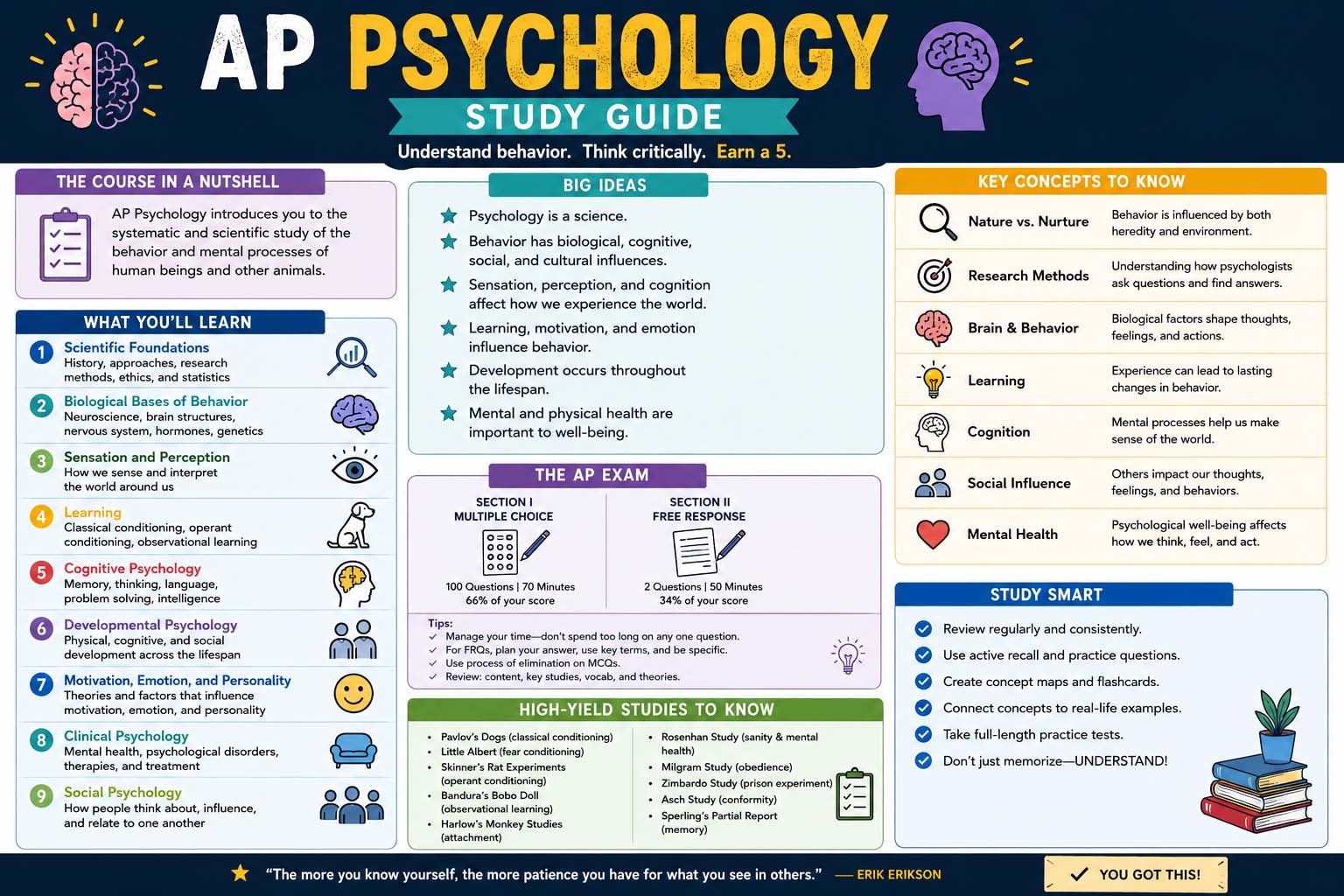
AP Psychology is one of the most popular Advanced Placement courses because it introduces students to the scientific study of human behavior and mental processes. The course covers fascinating topics such as learning, memory, personality, development, emotions, and psychological disorders.
However, the AP Psychology exam requires more than memorization. Students must understand concepts, apply theories, analyze scenarios, and interpret research findings.
What Is AP Psychology?
AP Psychology is a college-level course offered in high school that explores the science of behavior and mental processes.
Students learn about:
- Biological influences on behavior
- Cognitive processes
- Human development
- Psychological disorders
- Research methods
- Social interactions
The course helps students develop critical thinking and scientific reasoning skills while earning potential college credit.
Understanding the AP Psychology Exam
Before creating a study plan, it’s important to understand the exam structure.
The AP Psychology exam typically includes:
Multiple-Choice Questions
Students answer questions that test:
- Definitions
- Concepts
- Applications
- Research interpretation
Free-Response Questions (FRQs)
Students apply psychological principles to real-world situations.
Strong performance requires both content knowledge and analytical thinking.
AP Psychology Study Guide 2026: Key Topics to Review
An effective AP Psychology study guide 2026 should focus on the major units tested on the exam.
Students should review both vocabulary and concept application.
Major Content Areas
- Psychology foundations
- Research methods
- Biological psychology
- Sensation and perception
- Learning
- Cognition
- Motivation and emotion
- Developmental psychology
- Personality
- Psychological disorders
- Social psychology
A balanced review of all topics is essential for exam success.
AP Psychology Unit 0 Study Guide
Topics Covered
- History of psychology
- Major psychological perspectives
- Key psychologists
- Scientific thinking
- Introduction to research
Important Figures
Students should understand contributions from:
- Wilhelm Wundt
- Sigmund Freud
- Ivan Pavlov
- B.F. Skinner
- Jean Piaget
Why Unit 0 Matters
Although introductory, these concepts create the foundation for understanding later units.
Knowing psychological perspectives helps students analyze behavior from multiple viewpoints.
AP Psychology Unit 1 Study Guide
Unit 1 typically focuses on research methods and scientific investigation.
Key Concepts
- Experimental design
- Correlation vs causation
- Independent variables
- Dependent variables
- Sampling techniques
- Ethical guidelines
Research Methods Students Should Know
Experiments
Used to establish cause-and-effect relationships.
Surveys
Collect information from large groups.
Naturalistic Observation
Observes behavior in real-world settings.
Case Studies
Provides in-depth analysis of individuals or groups.
Research methods frequently appear in both multiple-choice and free-response questions.
Biological Bases of Behavior
This unit examines how biology influences thoughts and actions.
Major Topics
- Nervous system
- Endocrine system
- Brain structures
- Neurotransmitters
- Genetics
Important Brain Areas
Students should understand the functions of:
- Frontal lobe
- Parietal lobe
- Temporal lobe
- Occipital lobe
- Cerebellum
- Amygdala
- Hippocampus
Diagrams and labeling exercises can help reinforce these concepts.
Learning and Conditioning
Learning theories represent a major portion of AP Psychology.
Classical Conditioning
Developed by Ivan Pavlov.
Example:
Operant Conditioning
Developed by B.F. Skinner.
Focuses on:
- Reinforcement
- Punishment
- Behavior modification
Observational Learning
Proposed by Albert Bandura.
People learn by watching others.
Understanding real-world examples improves retention.
Cognition, Memory, and Thinking
Cognitive psychology explores mental processes.
Topics Include
- Memory systems
- Encoding
- Storage
- Retrieval
- Problem solving
- Language development
Memory Types
Sensory Memory
Brief storage of sensory information.
Short-Term Memory
Temporary information storage.
Long-Term Memory
Long-lasting knowledge and experiences.
Memory-related questions frequently appear on exams.
Developmental Psychology
Major Theorists
Jean Piaget
Focused on cognitive development.
Erik Erikson
Developed psychosocial stages.
Lawrence Kohlberg
Studied moral development.
Students should understand each theory’s stages and applications.
Personality and Psychological Disorders
These units explore individual differences and mental health.
Personality Theories
- Psychoanalytic
- Trait
- Humanistic
- Social-cognitive
Psychological Disorders
Common disorders include:
- Anxiety disorders
- Depression
- Bipolar disorder
- Schizophrenia
Students should know symptoms, causes, and treatment approaches.
Social Psychology
Social psychology studies how people influence one another.
Topics Include
- Conformity
- Obedience
- Group behavior
- Attitudes
- Prejudice
- Social influence
Classic studies by Solomon Asch and Stanley Milgram are especially important.
Step-by-Step AP Psychology Study Plan
Creating a structured plan helps students prepare effectively.
Step 1: Review the Course Framework
Identify all major units and learning objectives.
Step 2: Create a Weekly Schedule
Assign specific units to each study session.
Step 3: Use Active Recall
Test yourself rather than simply rereading notes.
Step 4: Practice Vocabulary
Psychology contains many specialized terms.
Flashcards can be helpful.
Step 5: Complete Practice Questions
Frequent practice improves confidence and retention.
Step 6: Review Weak Areas
Spend additional time on challenging topics.
Effective Study Tips for AP Psychology
Use Flashcards
Great for vocabulary review.
Create Concept Maps
Visual learning improves understanding.
Teach Concepts to Others
Explaining material reinforces knowledge.
Practice FRQs
Free-response questions require application skills.
Review Regularly
Short study sessions are often more effective than cramming.
Consistency leads to stronger long-term retention.
Example AP Psychology Question
Question
A student receives praise after completing homework and begins studying more frequently.
What learning principle is demonstrated?
Answer
Positive reinforcement.
Explanation
The praise increases the likelihood that the behavior will occur again.
Understanding application-based questions is critical for exam success.
Common Mistakes Students Make
Memorizing Without Understanding
The exam emphasizes application, not just definitions.
Ignoring Research Methods
Research concepts appear frequently.
Skipping FRQ Practice
Writing skills matter on exam day.
Studying Only Favorite Topics
Avoiding these mistakes improves overall performance.
Frequently Asked Questions
What is the best AP Psychology study guide?
The best guide combines unit reviews, vocabulary practice, active recall, and official practice questions.
How difficult is AP Psychology?
Many students find AP Psychology manageable, but success requires consistent studying and concept application.
What should I study first?
Start with foundational topics such as psychological perspectives and research methods.
Is AP Psychology mostly memorization?
No. Students must also analyze situations and apply psychological concepts.
How can I prepare for the AP Psychology exam study guide review?
Focus on major units, practice questions, vocabulary, and free-response exercises.
Conclusion
A strong AP Psychology study guide helps students organize their preparation and focus on the concepts most likely to appear on the exam. By reviewing foundational topics, mastering research methods, understanding major psychological theories, and practicing application-based questions, students can approach the AP Psychology exam with confidence.