
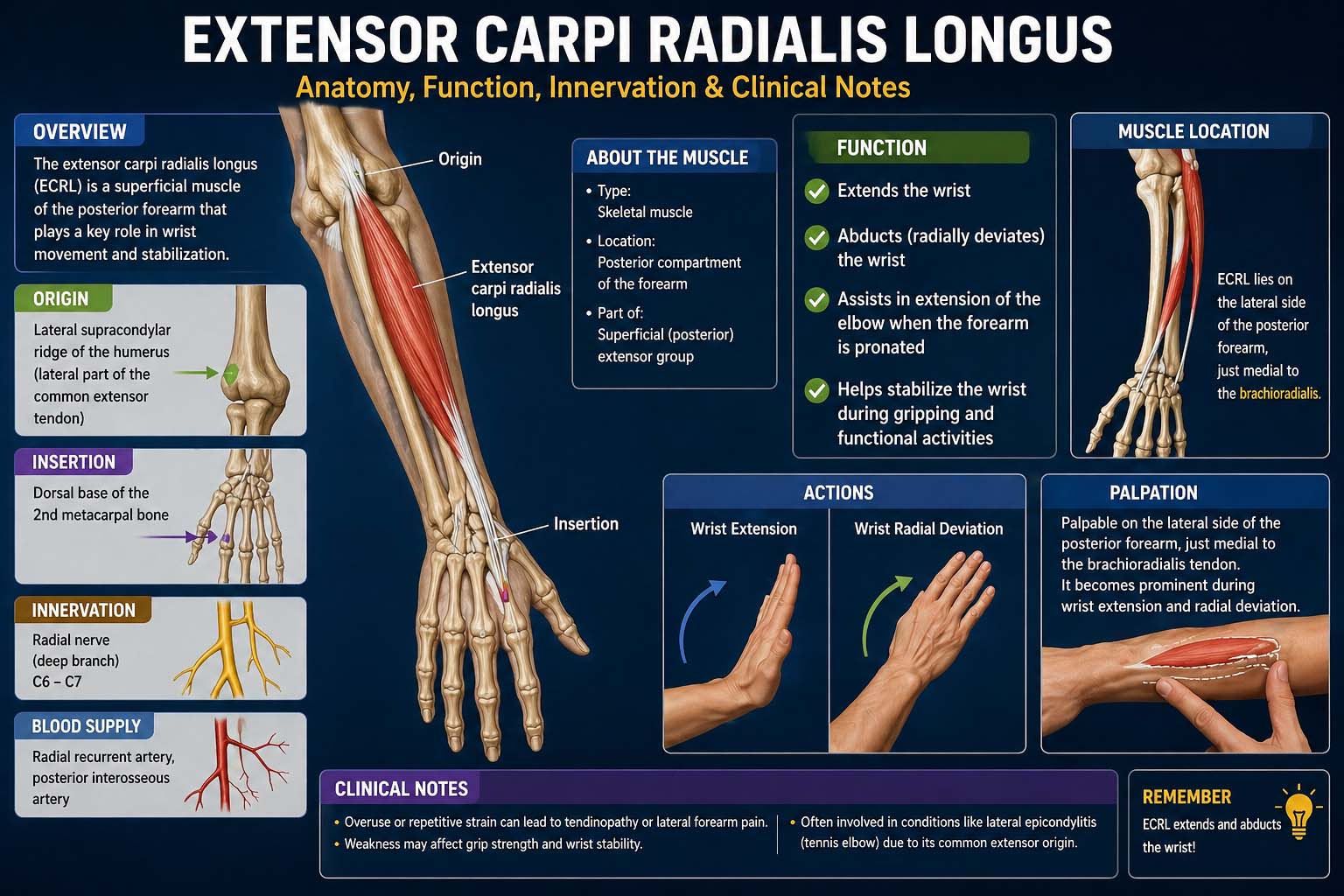
The extensor carpi radialis longus is an important muscle located in the forearm that plays a major role in wrist movement and hand stability. It is especially active during gripping, lifting, typing, and many sports activities. Understanding this muscle can help students, fitness enthusiasts, and people recovering from arm injuries learn how the forearm works. Because the forearm contains many muscles working together, the longus is often studied alongside nearby muscles that assist with wrist extension and movement.
This muscle belongs to the superficial layer of the posterior forearm muscles. It starts near the upper arm and extends down toward the hand through a tendon. Its design allows it to create controlled wrist extension while supporting hand function during everyday tasks.
Extensor Carpi Radialis Longus and Brevis
The phrase extensor carpi radialis longus and brevis refers to two closely related muscles found on the lateral side of the forearm. These muscles often work together to extend and abduct the wrist. Although they share similar functions, they differ in size, attachment points, and exact movement contribution.
The extensor carpi radialis longus is the longer and more superficial muscle, while the extensor carpi radialis brevis lies deeper and slightly shorter. During activities such as holding a tennis racket, shaking hands, lifting objects, or stabilizing the wrist during finger flexion, both muscles are activated. This teamwork helps create smooth wrist motion and prevents strain on smaller structures.
In clinical settings, irritation near these muscles may contribute to lateral elbow pain, commonly associated with overuse injuries. Because of their shared location and function, they are often examined together.
Extensor Carpi Radialis Longus Origin and Insertion
Understanding the origin and insertion is essential for anatomy students and rehabilitation professionals. The origin of this muscle is the lateral supracondylar ridge of the humerus, just above the lateral epicondyle. This position gives the muscle leverage to influence wrist motion efficiently.
The insertion is located at the base of the second metacarpal bone on the dorsal side of the hand. The tendon travels beneath the extensor retinaculum before attaching to the hand. This long path allows the muscle to transfer force from the forearm to the wrist and hand.
Because of its origin high on the humerus and insertion on the hand, the muscle crosses both the elbow and wrist regions. While it mainly acts on the wrist, it may also assist slightly in elbow flexion due to its position.
Extensor Carpi Radialis Longus Action
The main extensor carpi radialis longus action is wrist extension and radial deviation. Wrist extension means moving the hand backward, while radial deviation means moving the hand toward the thumb side. These combined actions are useful in many functional tasks.
When someone lifts a cup, types on a keyboard, throws a ball, or performs push movements, the muscle helps stabilize the wrist. Stability is critical because finger flexor muscles generate stronger grip force when the wrist remains slightly extended. Without the support of the , gripping strength can decrease.
This muscle is also active during sports such as tennis, golf, badminton, and weight training. Repetitive use can sometimes lead to tightness or tendon irritation. Proper warm-up, stretching, and balanced strengthening may help maintain healthy forearm mechanics.
Nerve supply to the muscle comes from the radial nerve, which controls many extensor muscles of the arm and forearm. If radial nerve function is impaired, wrist extension can become weak.
Extensor Carpi Radialis Brevis and Longus
The relationship between extensor carpi radialis brevis and longus is significant because these muscles are often discussed together in anatomy and sports medicine. Both muscles extend the wrist, but the brevis is usually more involved in pure extension, while the longus contributes strongly to radial deviation and stabilization.
These slightly different insertion points allow each muscle to influence wrist mechanics in unique ways. Together, they create controlled and balanced movement.
In repetitive hand tasks such as computer work, painting, manual labor, or racquet sports, both muscles may become fatigued. This is why ergonomic positioning and proper rest are important for preventing discomfort.
Importance in Daily Life
The is constantly working during normal daily movements. Opening doors, carrying shopping bags, writing with a pen, and using tools all require wrist stabilization. Even simple gestures like waving or using a smartphone involve coordinated forearm muscle activity.
Because modern lifestyles often involve repetitive keyboard and mouse use, forearm extensor health has become increasingly important. Strengthening and mobility exercises may reduce stiffness and improve endurance for desk workers and athletes alike.
Common Injuries and Rehabilitation
Overuse of the extensor carpi radialis longus may lead to pain near the outer elbow or forearm. This can happen after sudden increases in lifting, sports practice, or repetitive hand tasks. Symptoms may include soreness, weakness, or discomfort during gripping.
Treatment usually includes rest, activity modification, stretching, massage, and progressive strengthening. In some cases, physical therapy helps restore normal movement patterns. Recovery often improves when wrist posture and workload are corrected.
How to Keep It Healthy
Maintaining forearm health involves regular movement, proper posture, and balanced exercise. Wrist extension stretches, grip strengthening, and avoiding excessive repetitive strain can support the . Athletes should warm up before training, while office workers should take short breaks during long sessions of typing.
Hydration, overall fitness, and gradual training progression also play a role in muscle health. When pain persists, medical guidance is recommended.
Conclusion
The extensor carpi radialis longus is a key forearm muscle responsible for wrist extension, radial deviation, and hand stability. It works closely with neighboring muscles to support gripping, lifting, sports, and everyday tasks. By understanding the extensor carpi radialis longus and brevis relationship, the extensor carpi radialis longus origin and insertion, and the extensor carpi radialis longus action