
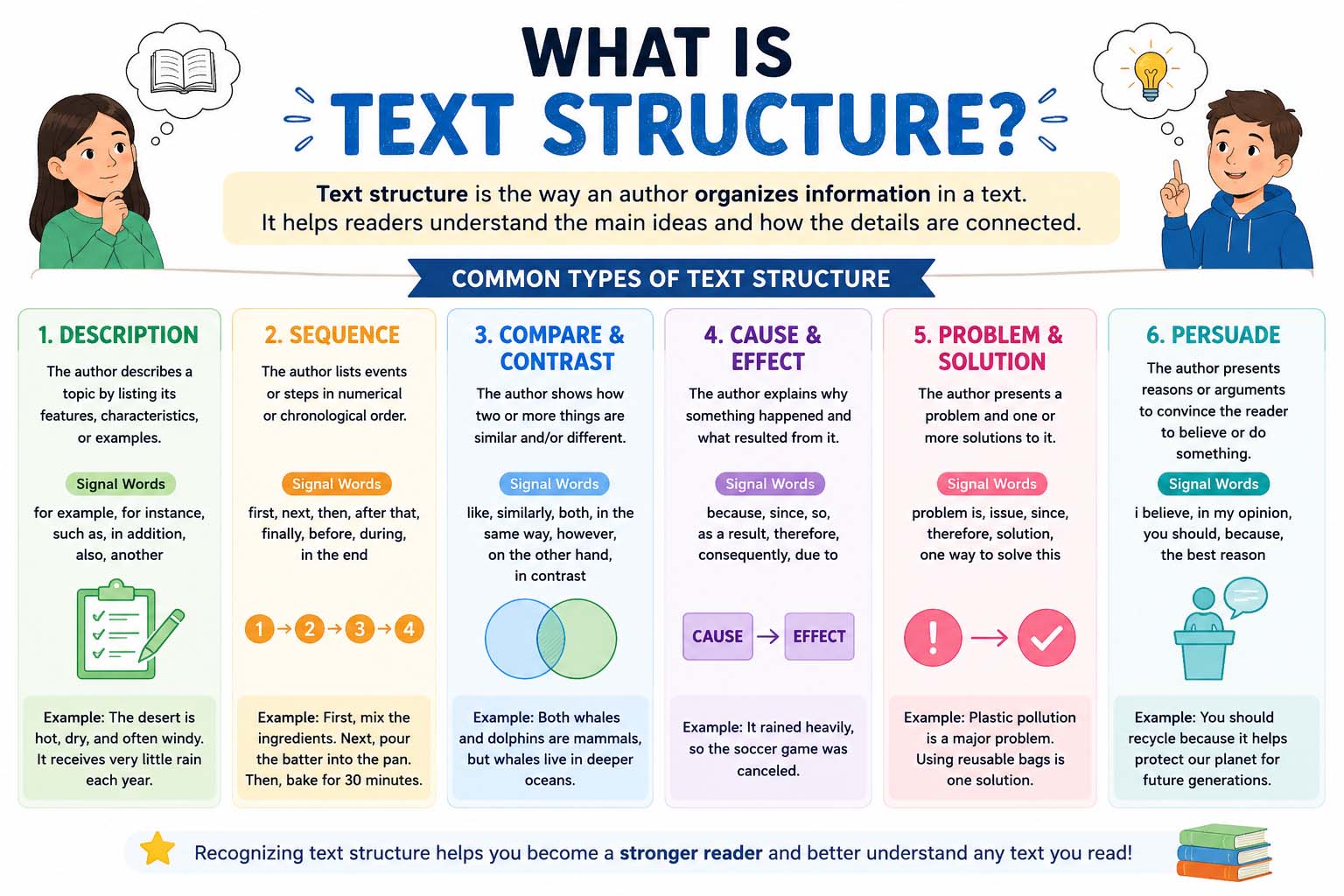
Authors use different text structures to present ideas clearly and help readers understand the purpose of the text.
Understanding is an important reading and writing skill for students because it improves comprehension, critical thinking, and academic performance. Whether someone is reading a science article, history textbook, or short story, recognizing the structure makes it easier to identify key ideas and supporting details.
What Is a Text Structure?
A text structure is the organizational pattern an author uses to arrange information in a passage.
Authors choose specific structures depending on their purpose. For example:
- To describe something
- To explain a problem
- To compare ideas
- To show events in order
- To explain causes and effects
Recognizing these patterns helps readers predict information and better understand the text.
Text structures are commonly taught in elementary school, middle school, and high school reading programs.
Why Text Structure Is Important
Understanding what is the of a passage helps students improve reading comprehension.
When students identify how information is organized, they can:
- Find important details faster
- Understand the author’s purpose
- Summarize information more easily
- Improve note-taking skills
- Strengthen writing organization
Text structure also helps students prepare for standardized tests and academic essays.
Good readers naturally recognize structure patterns while reading.
Common Types of Text Structures
There are several major text structures students should learn.
Description Structure
One of the most common patterns is description .
What Is Description Text Structure?
Many students ask what is description because it is widely used in textbooks and informational writing.
In a descriptive structure, the author explains details about a topic, person, place, or object.
The passage often includes:
- Characteristics
- Features
- Examples
- Sensory details
Example of Description Structure
“A volcano is a mountain that can erupt with lava, ash, and gases. Volcanoes are found in many parts of the world and vary in size and shape.”
This passage describes a volcano using details and characteristics.
Signal words often include:
- For example
- Such as
- Characteristics
- Includes
Sequence or Chronological Structure
This structure presents information in time order or step-by-step format.
Example
“First, mix the ingredients. Next, place the batter in the oven. Finally, allow the cake to cool.”
This structure is common in:
- Instructions
- Historical events
- Recipes
- Science experiments
Signal words include:
- First
- Next
- Then
- Finally
- Before
- After
Cause and Effect Structure
Cause and effect explains why something happens and what results from it.
Example
“Heavy rainfall caused flooding in several neighborhoods.”
The rainfall is the cause, while the flooding is the effect.
Signal words include:
- Because
- As a result
- Therefore
- Since
- Due to
This structure is common in science and history writing.
Compare and Contrast Structure
Compare and contrast shows similarities and differences between two or more topics.
Example
“Dogs are generally more social, while cats are often more independent.”
Signal words include:
- Similar
- Different
- However
- Unlike
- Both
This structure helps students analyze relationships between ideas.
Problem and Solution Structure
This structure presents a problem and explains possible solutions.
Example
“Plastic pollution harms oceans. Recycling and reducing plastic use can help solve the problem.”
Signal words include:
- Problem
- Solution
- Challenge
- Resolve
- Improve
Problem and solution structures are common in persuasive and informational writing.
What Is Text Structure in Reading?
Text structure plays a major role in reading comprehension.
When students recognize patterns, they understand the author’s ideas more clearly.
For example:
- Sequence helps readers follow events
- Cause and effect explains relationships
- Description helps visualize information
Teachers often ask students to identify text structures while reading passages because it strengthens analytical thinking.
How to Identify Text Structure
Students can follow a simple process to identify text structure more easily.
Step 1: Look for Signal Words
Certain keywords often reveal the structure type.
For example:
- “Because” suggests cause and effect
- “First” suggests sequence
- “Unlike” suggests compare and contrast
Step 2: Identify the Author’s Purpose
Ask:
- Is the author describing something?
- Explaining steps?
- Comparing ideas?
- Solving a problem?
Understanding the purpose helps determine the structure.
Step 3: Examine Organization Patterns
Notice how ideas are arranged.
Are events in time order? Are similarities and differences discussed? Is there a problem followed by solutions?
Examples of Text Structures in Real Life
Text structures appear in everyday reading materials.
Description
Travel blogs describing destinations.
Sequence
Recipe instructions or game tutorials.
Cause and Effect
News articles explaining events.
Compare and Contrast
Product reviews comparing phones or laptops.
Problem and Solution
Environmental articles discussing climate change.Recognizing structures helps students understand both academic and real-world texts.
Student-Friendly Tips for Learning Text Structure
Practice With Short Passages
Reading small examples makes it easier to recognize patterns.
Highlight Signal Words
Marking important keywords helps students identify structures quickly.
Create Graphic Organizers
Charts and diagrams can help organize ideas visually.
Read Different Types of Texts
Students improve faster when reading stories, articles, textbooks, and essays regularly.
Practice Writing With Structures
Writing paragraphs using specific structures helps students understand them better.
Common Mistakes Students Make
Confusing Similar Structures
Compare and contrast can sometimes look similar to description.
Carefully examine the author’s purpose.
Ignoring Signal Words
Signal words provide important clues.
Missing them can make identification harder.
Focusing Only on One Sentence
Students should examine the entire passage, not just a single sentence.
FAQ About Text Structure
What is text structure in simple words?
Text structure is the way an author organizes information in writing.
Why is text structure important?
It helps readers understand ideas, identify important details, and improve comprehension.
What are the main types of text structure?
Common types include description, sequence, cause and effect, compare and contrast, and problem and solution.
What is description text structure?
Description structure explains details, features, or characteristics about a topic.
How can students identify text structure?
Students can look for signal words, analyze organization patterns, and determine the author’s purpose.
Is text structure important for writing?
Yes. Good text structure helps writers organize ideas clearly and improve readability.
Conclusion
Understanding what is text structure is an essential academic skill for students of all ages. Text structures help organize ideas, improve reading comprehension, and strengthen writing abilities.