
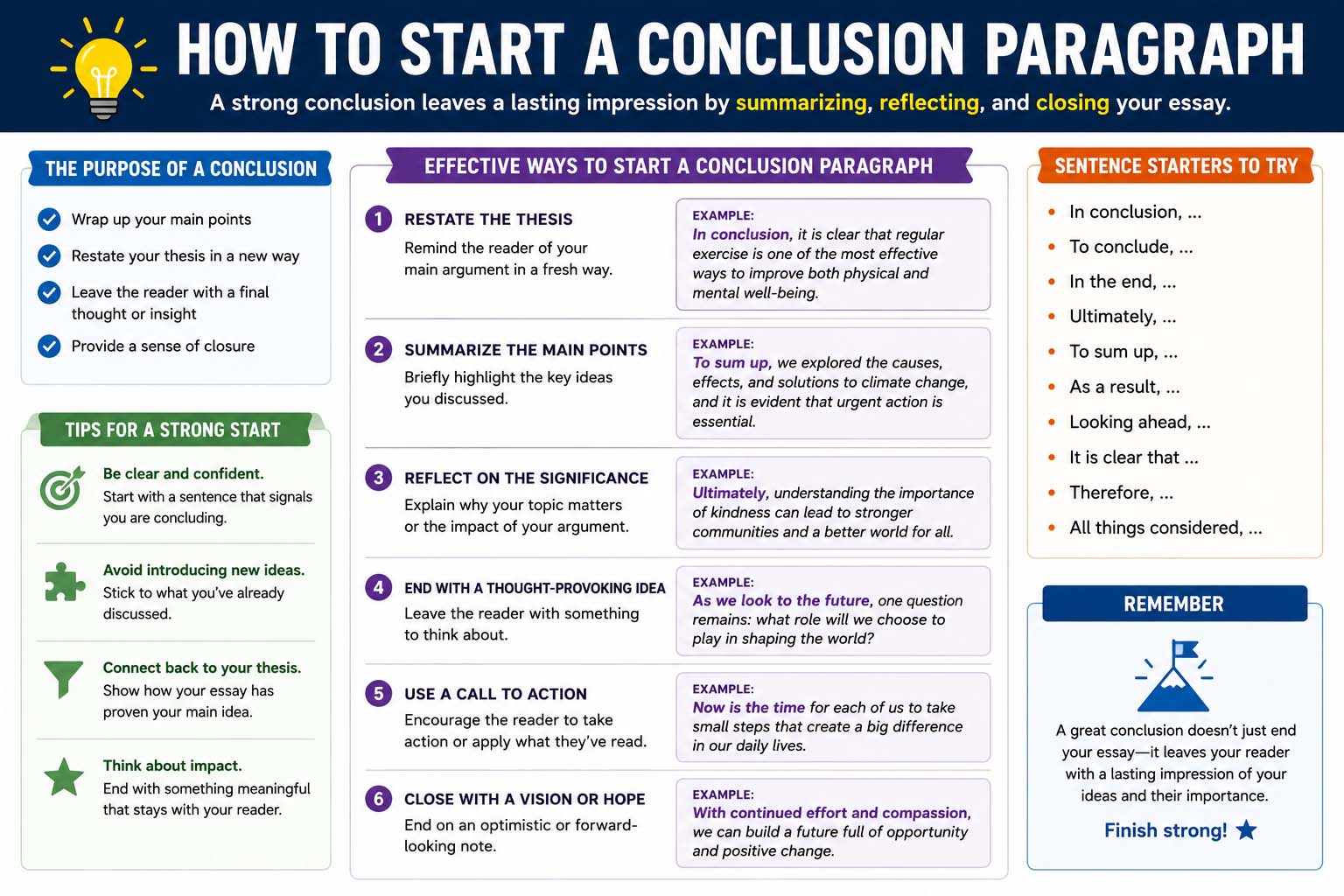
Writing a strong conclusion is one of the most important parts of any essay. Many students know how to begin an introduction but struggle when trying to end their paper effectively. Learning how to start a conclusion paragraph can help make essays feel more complete, professional, and organized.
A conclusion paragraph gives readers a final understanding of your topic. It summarizes your main ideas, reinforces your argument, and leaves a lasting impression.
Whether you are writing a school essay, research paper, argumentative assignment, or personal reflection, understanding how to create a strong conclusion is an essential academic skill.
This guide explains how to start a conclusion paragraph step by step, including useful examples, beginner-friendly writing strategies, and practical tips for students in 2026.
What Is a Conclusion Paragraph?
A conclusion paragraph is the final section of an essay or written assignment.
Its main purpose is to:
Restate the main idea.
Summarize important points.
Provide closure for the reader.
End the essay clearly and confidently.
A good conclusion should feel natural instead of rushed.
Why Conclusion Paragraphs Matter
Many students underestimate the importance of the ending section.
However, teachers and readers often remember the conclusion because it represents the final message of the paper.
A strong conclusion can:
Improve essay flow.
Strengthen arguments.
Increase clarity.
Make writing more professional.
Create a memorable ending.
Weak conclusions may confuse readers or make essays feel unfinished.
How to Start a Conclusion Paragraph Step by Step
Students often ask how to start a conclusion paragraph in a simple and effective way.
The process becomes easier when broken into clear steps.
Step 1: Revisit the Main Idea
Start by returning to the essay’s central argument or topic.
Do not copy the thesis word-for-word.
Instead, rewrite it naturally using fresh wording.
Step 2: Summarize Key Points
Briefly mention the main supporting ideas from the essay.
Keep this section short and focused.
Step 3: End With a Final Thought
Finish with a meaningful statement, insight, or reflection related to the topic.
How to Start Off a Conclusion Paragraph
Students searching for how to start off a conclusion paragraph often want transition phrases that sound smooth and professional.
Some effective opening phrases include:
“Overall”
“To summarize”
“As discussed”
“Ultimately”
“In the end”
“These examples show”
However, avoid overusing repetitive phrases in every assignment.
How to Start a Conclusion Paragraph Without Saying In Conclusion
Many teachers encourage students to avoid repetitive wording like “In conclusion.”
Fortunately, there are many natural alternatives.
Here are some examples:
“Overall, the evidence suggests…”
“Ultimately, this topic shows…”
“Considering these points…”
“These arguments demonstrate…”
Using varied transitions makes writing sound more advanced and professional.
Example of a Strong Conclusion Opening
Here is a simple student-friendly example:
This opening works because it:
Restates the main idea.
Uses natural wording.
Transitions smoothly into the conclusion.
How to Start a Conclusion Paragraph in an Essay
Understanding how to start a conclusion paragraph in an essay depends on the essay type.
Argumentative Essays
Restate the main argument confidently.
Example:
“The evidence clearly supports the importance of renewable energy investment.”
Informative Essays
Summarize the topic clearly.
Example:
“Understanding climate change helps communities prepare for future environmental challenges.”
Narrative Essays
Example:
“That experience taught me the value of patience and responsibility.”
Different essay types require slightly different conclusion styles.
How to Start a Conclusion Paragraph for an Essay Naturally
Many students struggle with making conclusions sound smooth instead of forced.
The best method is to connect the ending naturally to the introduction.
For example:
If the introduction asked a question, the conclusion can answer it.
If the introduction described a problem, the conclusion can explain the solution.
This creates a sense of balance throughout the essay.
Common Mistakes Students Make
Many conclusion paragraphs become weak because students make avoidable mistakes.
Repeating the Thesis Exactly
Restating the same sentence word-for-word sounds repetitive.
Adding New Information
Conclusions should summarize existing ideas instead of introducing completely new arguments.
Ending Too Abruptly
A short or rushed conclusion may feel incomplete.
Using Overly Formal Language
Complicated vocabulary can make writing harder to understand.
Simple and clear writing usually works best.
Best Tips for Writing Better Conclusions
Improving conclusion paragraphs takes practice.
Helpful strategies include:
Read your essay before writing the conclusion.
Focus on clarity instead of complexity.
Keep the tone consistent.
Use smooth transitions.
Avoid unnecessary repetition.
Strong writing usually sounds natural and organized.
Student-Friendly Conclusion Structure
A beginner-friendly conclusion structure often follows this format:
Restate the main idea.
Summarize key points.
Add a final thought.
This simple structure works well for most essays and assignments.
Examples of Conclusion Starters
Students often search for ready-to-use examples.
Here are several helpful options:
“Overall, this topic highlights…”
“Ultimately, the essay demonstrates…”
“As discussed throughout the essay…”
“These examples reveal…”
“In the broader context…”
Using different phrases helps improve vocabulary variety.
Why Good Conclusions Improve Grades
Teachers often evaluate essays based on organization and clarity.
A strong conclusion shows:
Critical thinking.
Writing structure.
Topic understanding.
Communication skills.
Even average essays can feel stronger with an effective ending paragraph.
How to Practice Writing Conclusions
Practice is one of the best ways to improve academic writing.
Students can practice by:
Rewriting old conclusions.
Comparing strong essay examples.
Reading professional articles.
Writing summaries of short passages.
Over time, conclusions become easier and more natural to write.
FAQ About How to Start a Conclusion Paragraph
What is the best way to start a conclusion paragraph?
Begin by restating the essay’s main idea using fresh wording.
Can I say “In conclusion” in an essay?
Yes, but many teachers prefer more natural transition phrases.
How long should a conclusion paragraph be?
Most conclusions are one short paragraph, depending on essay length.
Should new information appear in the conclusion?
No. Conclusions should summarize existing ideas instead of adding new arguments.
How do I make my conclusion stronger?
Use clear wording, summarize important points, and finish with a memorable final thought.
Conclusion
Learning how to start a conclusion paragraph is an important writing skill for students at every academic level. A strong conclusion helps organize ideas, strengthen arguments, and create a more polished essay overall.
By restating the main idea naturally, summarizing key points clearly, and ending with a thoughtful final statement, students can write conclusions that feel professional and complete.